Blitz Bureau
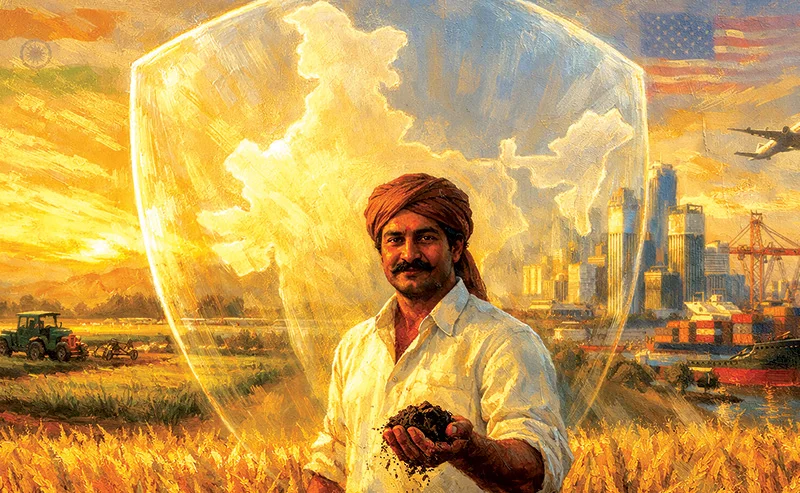
NEW DELHI: Union Commerce Minister Piyush Goyal last week hailed the framework announced on the IndiaUS trade agreement while insisting that the Government made sure that it “keeps farmers fully protected while widening India’s export room in high‑value sectors.”
“Agricultural products from Indian farmers will be exported to the United States at zero duty. At the same time, no tariff concessions have been granted for agricultural products from US farmers entering the Indian market,” he said.
The trade agreement provides a zero-tariff entry to a wide array of American goods including almonds, walnuts, pistachios, apples, oranges, blueberries, cranberries and soybean oil among others. The agreed upon framework also demolishes all non-tariff related barriers for US agricultural products, giving them unprecedented market access and boost.
As per the agreement announced on February 7, the US is prepared to slash tariffs on Indian goods from 50 per cent to 18 per cent on select Indian goods in exchange for India emanating non-tariff barriers in addition to dropping tariffs imposed by India on select US goods to 0 per cent. Interestingly the joint statement published by the Ministry of commerce also failed to mention Trump’s bold claim of India stopping all purchase of Russian oil. Here is a breakdown of the deal’s layout and the agricultural products in the spotlight, and the political tug-ofwar following the official joint statement.
1. Tree nuts (almonds, walnuts, & pistachios): Already a billion-dollar trade, the agreement further slashes the retaliatory tariffs that had previously hampered California growers.
2. Dried distillers’ grains: A high-protein by-product of corn ethanol production, these grains are slated for the Indian animal feed industry to support poultry and dairy.
3. Red sorghum: Primarily intended for animal feed, this provides US farmers a massive new outlet for grain exports.
4. Berries (blueberries & cranberries): Building on 2023 negotiations, these will now enter with minimal duties in fresh, frozen, and dried forms.
5. Soybean oil (quota-based): Unlike other oils, US soybean oil will enter through a managed quota system to prevent a total crash of domestic prices.
6. Wine and spirits: High-end American bourbon and Napa Valley wines will see a reduction in the “premium” tax bracket, targeting India’s growing urban middle class.
Opposition targets agricultural concession Opposition leaders have launched a sharp attack at the recently proposed agreement. AAP leader Sanjay Singh labelled the agreement as a “death warrant” for Indian farmers. O p p o s i t i o n members have alleged the Modi Government of not putting up a fight being ‘submissive’ to Trump’s demands.
“Where is India which used to look Nixon, George Bush and Obama in the eye and forge practical relations? Why does it feel today that the interests of the common people of India are undermined before the interests of Narendra Modi and his two friends, Ambani and Adani? This is not an Agreement with the US, but a compromise with our self-respect,” Congress leader Pawan Khera said on IndiaUS Interim trade agreement. Congress’ Priyank Kharge joined the attack as well. Taking to social media to register his protest against the recently announced India-US trade agreement Kharge said that the deal allows 0 per cent import tariffs which will “destroy Indian farmers by flooding the market with the US agricultural produce”.
Notably, the joint statement includes a specific clause that says that the two countries can modify their commitments if the other country changes the agreed upon tariffs. An executive order pushed out by Donald Trump stated if the US official finds that India has resumed imports of Russian oil, they “shall recommend whether and to what extent” Trump should take additional action against India that could involve “reimposition” of the punitive 25 per cent tariffs on India.
Government defends move
The Agreement reflects India’s commitment to safeguarding farmers’ interests and sustaining rural livelihoods by completely protecting sensitive agricultural and dairy products, including maize, wheat, rice, soya, poultry, milk, cheese, ethanol(fuel), tobacco, certain vegetables, meat, etc,” Union Minister Piyush Goyal wrote on X defending the agreement. Goyal has maintained that the agreement protects ‘staple Indian agriculture products, MSMEs and farmers’. “Agricultural products from Indian farmers will be exported to the United States at zero duty. At the same time, no tariff concessions have been granted for agricultural products from US farmers entering the Indian market. The agreement also makes it clear that genetically modified (GM) food will not be allowed into India,” Goyal said at a press conference earlier today.