Shalini S Sharma
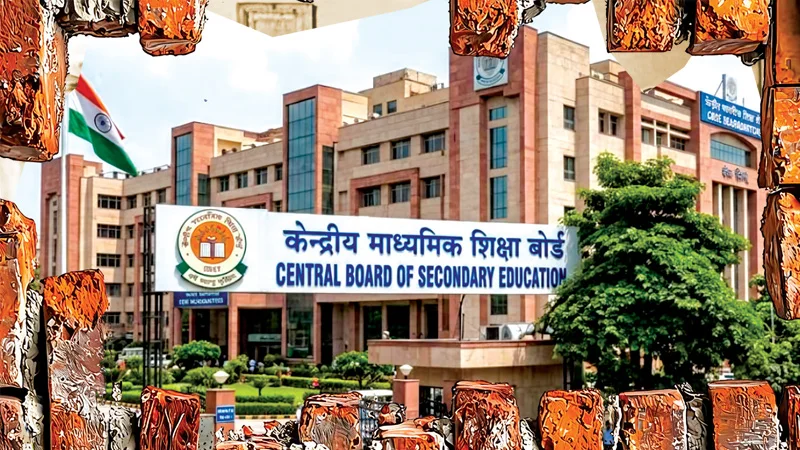
At roughly 25,000 schools affiliated to it, the Central Board of Secondary Education (CBSE) caters to a very tiny fraction of the 15 lakh schools in India. The 25 million students, who come under its purview, also comprise a miniscule portion of the 250-million odd school-going children in the country. But the relative smallness of its numbers does not take away from the big problems that the Board is facing.
For the past over a decade, the CBSE had been toying with the idea of using technology for assessments. It had done some failed pilots, but the implementation was put off due to the absence of good scanning technology which did not involve tearing up of answer sheets to lay the pages flat for reading through the machine.
Staggering number
This year, for the first time, with advanced book-scanning technology becoming available, the Board embarked on its biggest, full-scale scanning and digital evaluation exercise of class XII board papers. From February 17 till April 10, a total of 18.5 lakh students of Class XII wrote the CBSE exams for 120 different subjects. With each student taking five-six subjects and with an average of 5.5 subjects per student, this translated into answer-sheets totalling a staggering 10 million, or 1 crore.
On each day of the exam cycle, hundreds of thousands of answer-sheets were sealed and transported from 8000+ exam centres to regional collection hubs. As soon as the scripts would arrive, they would enter the digital pipeline. In a 50-day exam period, the scanning teams would have had to maintain a daily scan count of roughly 200,000 to 250,000 booklets to ensure that they did not fall behind the exam schedule.
Then, evaluation through on-screen marking (OSM), was happening concurrently. Because the Board aimed for a relatively tight result declaration window, the evaluation process began while the exams were still going on for later subjects. This meant the digital infrastructure should have been able to handle millions of concurrent uploads, annotations, and marks-entry updates simultaneously.
The weak link
Each of 10 million distinct, hand-written, multi-page documents contained not just the answers but identification codes, barcodes for anonymisation and multiple sections that had to be mapped to the right examiner. This is where the problem began, because the agency selected to oversee and handle this onerous task was a black-listed entity, called Coempt Edu Teck, from Hyderabad.
It bid Rs 384.6 crore for the project against Rs 951.3 crore quoted by TCS. This means that Coempt’s quoted rate per answer-sheet was average Rs 25 against an average of Rs 62 of TCS. To be fair to the CBSE, it was only following the Government’s SOP when it selected Coempt on the basis of its lowest bid, or L1 quotation. It’s another matter, though, that reports are now emerging which suggest that the tender document itself was tailor-made for Coempt.
That’s how even in the technical section, which carries a weight of 70 per cent, against only 30 per cent for the financial bid, Coempt was able to score 91 out of 100 against 89 scored by TCS.
Even if due process was followed, enough background check on the antecedents of the company to handle such a project in the past with full success, should have been done. With the numbers in reckoning in Class XII exams, even a 1 per cent error rate in digitisation process meant over 100,000 answer-sheets with corrupt, misplaced or incorrect evaluation.
Shoddy scanning
The real extent of the problem became apparent only when students started accessing their answer-sheets for re-evaluation. What they encountered here – blurred images, missing pages or incomplete scans – led one to believe that either poor quality scanners were used or teachers themselves scanned the papers using their mobile phones.
The vendor’s infrastructure was probably optimised for data (like objective sheets or standardised forms) rather than high-resolution document preservation (the nuanced, handwritten, multi-page descriptive answers used in Class XII) and the pressure to meet these daily quotas almost inevitably led to a decline in quality.
A firm like TCS typically manages large-scale digital operations (like the Railway recruitment exams or national-level banking tests) using specialised, hardened infrastructure designed for massive, concurrent global access.
Given Coempt’s track record and its history at the Telangana State Board (2019), critics argue that the vendor lacked the specific experience in high-stakes, large-volume, descriptive-script digitisation. By selecting the bid on cost rather than proven capacity, the CBSE effectively traded ‘security and operational robustness’ for ‘budget efficiency’.
Tech as the norm
Heads have rolled at the CBSE as after this fiasco but the lesson is not to abandon technology, but to test it and calibrate it more rigorously. It is not as if manual evaluation is fool-proof and does not lead to complaints. On the contrary, it was precisely because of the problems arising out of the old system that the CBSE had decided to shift to the digital system.
Doing away with high-cost, high-risk physical transportation of millions of answer-sheets to centralised hubs and reducing human factor in marking by providing teachers with digital tools are good enough reasons for technology to become the norm in assessments.
By selecting the bid on cost rather than proven capacity, the CBSE effectively traded ‘security and operational robustness’ for ‘budget efficiency’