Blitz Bureau
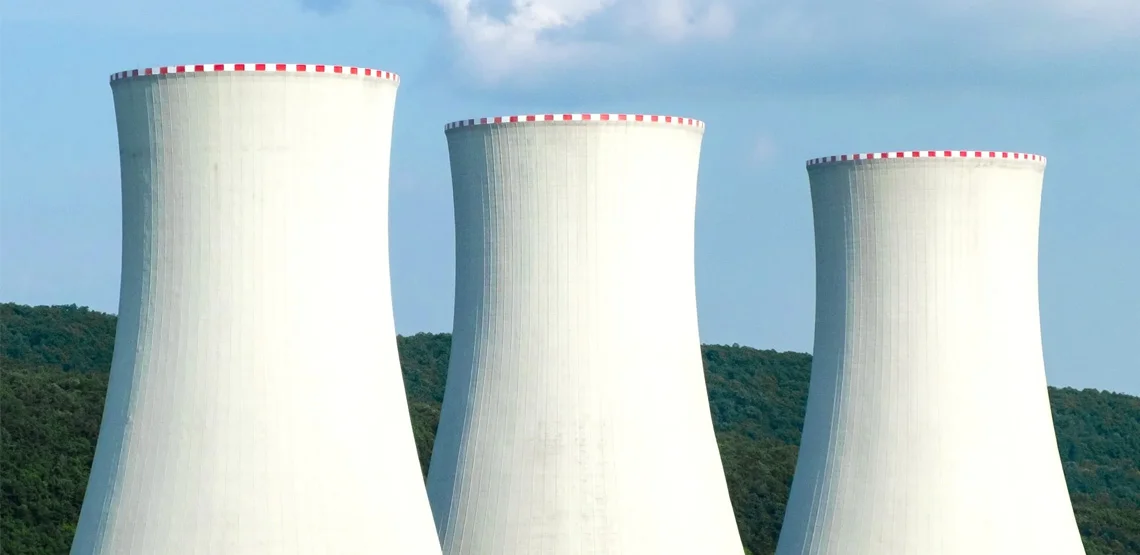
NEW DELHI: India means to have a hundred gigawatts of nuclear power by 2047. It has 8.78 today. The interesting number in the atomic energy programme is not the target but the rate the target implies, and that number is four.
The Press Information Bureau’s research unit published an explainer titled Nuclear Energy Technology in India on 28 August 2026 at 10.29 am, explainer number 159731, drawing on the Department of Atomic Energy, the Bhabha Atomic Research Centre, the Nuclear Power Corporation of India Limited, the Indira Gandhi Centre for Atomic Research and the Nuclear Fuel Complex. It is a teaching document rather than a news release, and it carries the fleet figures in one place, which is why it is worth the arithmetic.
The arithmetic of the 2047 target
India operates 24 nuclear power reactors with an installed capacity of 8.78 GW. Nine units of a combined 7.5 GW are under construction. Ten indigenous Pressurised Heavy Water Reactors have been approved in fleet mode, and pre-project activity has been cleared for two 500 MW Fast Breeder Reactors. The stated goal is 100 GW by 2047.
Blitz India did the division. Because the target is a round hundred, the present fleet is exactly 8.78 per cent of it. Commission every one of the nine units now being built and the figure reaches 16.28 GW, or 16.28 per cent. That leaves 83.72 GW to be added in the twenty-one years to 2047 — 3.99 GW a year, every year. Set against the fleet that exists today, the country would have to add, annually, capacity equal to 45.4 per cent of everything it has built so far. The hundred is the headline. The four is the work.
Bigger units, and a second stage
A second division tells you what the fleet is becoming. Twenty-four reactors carrying 8.78 GW average 366 MW a unit. The nine units under construction carry 7.5 GW between them — an average of 833 MW. The reactors India is building are, on average, more than twice the size of the reactors India runs. That is a change in the industrial problem as much as in the energy one: forgings, pressure vessels, steam generators and heavy transport all scale with it.
The programme those units belong to was set out by Dr Homi J. Bhabha in 1954 and has three stages. In the first, Pressurised Heavy Water Reactors burn natural uranium and the spent fuel is reprocessed for plutonium. In the second, Fast Breeder Reactors use that plutonium to make electricity while breeding more fissile material, and produce uranium-233 from thorium. In the third, thorium reactors run on that uranium-233. India’s own uranium is low-grade and has to be supplemented by imports; its thorium is abundant, lying in the coastal sands of Kerala, Tamil Nadu, Andhra Pradesh, Odisha, West Bengal and Jharkhand. The three stages exist to get from the one to the other.
The second stage began in April 2026, when the Prototype Fast Breeder Reactor at Kalpakkam attained first criticality. The Indira Gandhi Centre for Atomic Research led its design, development, testing, safety assessment, commissioning and indigenisation, and — the figure that matters for anyone thinking about the next twenty-one years — achieved nearly 90 per cent domestic manufacture of the reactor’s equipment and systems, working with Indian industry.
What is running, what is being built, what is promised
| Parameter / Metric | Details |
|---|---|
| Reactors in operation | 24 |
| Installed nuclear capacity | 8.78 GW |
| Units under construction | 9, totalling 7.5 GW |
| Average size, operating fleet | 366 MW a unit |
| Average size, units being built | 833 MW a unit |
| Approved in fleet mode | 10 indigenous PHWRs |
| Pre-project cleared | Two 500 MW Fast Breeder Reactors |
| Second stage began | PFBR Kalpakkam, first criticality, April 2026 |
| Indigenous content, PFBR | Nearly 90 per cent |
| Small modular reactor outlay | ₹20,000 crore, Union Budget 2025-26 |
| SMRs to be operational by 2033 | At least five |
| Target | 100 GW by 2047 |
| Implied build rate | 3.99 GW a year for 21 years |
Twenty thousand crore for small reactors
The Union Budget for 2025-26 announced a Nuclear Energy Mission and set aside ₹20,000 crore for the research, design, development and deployment of indigenous Small Modular Reactors. Three designs are named: the Bharat Small Modular Reactor, BSMR-200, rated at 220 MWe and designed jointly by BARC and NPCIL; a 55 MWe SMR-55; and a High-Temperature Gas-Cooled Reactor intended for hydrogen production. The government’s stated aim is to have at least five indigenous SMRs operating by 2033. The SHANTI Act, 2025 is the enabling instrument, and the explainer names greater private-sector participation as one of its purposes.
The case for the small reactor is not that it is cheaper per unit of power. It is that it is manufactured rather than constructed. A 220 MWe module built in a factory and assembled on site converts a civil-engineering problem into a production-line problem, which is a problem Indian industry has repeatedly shown it can solve. It also fits where a 700 MW unit does not — beside a retiring coal station, next to an industrial cluster needing process heat, or at the end of a grid too weak to take a large block of power.
What the document does not settle
Two things the explainer does not carry, and this desk will not supply from anywhere else. It does not give a year-by-year commissioning schedule for the nine units under construction, and it does not state the patent or licensing position on the BSMR-200 design. Both are knowable; neither is published in this document, and neither is asserted here.
The corrective suggestion is small and it follows from the arithmetic. The number that decides 2047 is not 100. It is 3.99. If the Department of Atomic Energy and the Nuclear Power Corporation of India were to publish a single rolling commissioning calendar — unit, site, rated capacity, expected year of criticality, expected year of commercial operation, revised each year — the country could watch the rate rather than the target, and the industry that has to forge, weld and transport those units could plan against it. Ninety per cent indigenous manufacture on the PFBR proves the capacity exists. What a supplier cannot plan against is a target with no calendar under it.