Port and Rail Move Together on the East Coast
NEW DELHI: MThe Ministry of Ports, Shipping and Waterways commissioned an 18.5-metre deep-draft capability at Paradip Port in Odisha on 21 August, part of seven projects worth ₹427.80 crore, and signed three concession agreements worth ₹1,580.36 crore to mechanise berths adding 23 million tonnes a year of handling capacity. Two days earlier the Union Cabinet had sanctioned ₹9,450 crore for four railway multitracking projects covering 410 km, three of which sit on the line that carries cargo to and from that same port.
Paradip handles coking coal, iron ore and petroleum for the steel and refining belt of eastern India. Its constraint has never been the sea. It has been the depth of water at the berth, which decides the size of ship that can come alongside, and the number of tracks on the line inland, which decides how fast the cargo leaves. Both were addressed inside seventy-two hours, by two different ministries, in two releases that do not mention each other.
Deeper water at the berth is worth nothing if the wagons cannot clear the stockyard, and the two sanctions that fix both ends of that problem were issued three days apart without either release naming the other.
AT A GLANCE
● ₹427.80 crore — seven projects inaugurated at Paradip Port, including a ₹352 crore deepening to 18.5 metres (Ministry of Ports, Shipping and Waterways, 21 August 2026)
● ₹1,580.36 crore — three build-operate-transfer concession agreements signed for berth mechanisation at the same port, adding 5, 8 and 10 million tonnes a year (same release)
● 80% now, 100% by 2030 — berth mechanisation achieved and targeted at Paradip (same release)
● ₹9,450 crore — Cabinet sanction for four railway multitracking projects totalling 410 km, for completion by 2030-31 (Ministry of Railways, 19 August 2026)
● 72 km — Cuttack–Paradeep third and fourth line, one of the four sanctioned sections (same release)
● 173 km and 75 km — Kharagpur–Bhadrak fourth line and Bhadrak–Haridaspur fourth line, the other two east-coast sections (same release)
● 76 million tonnes a year — additional freight capacity the Ministry of Railways projects from the four projects at full commissioning (same release)
WHAT 18.5 METRES BUYS
Draft is the depth of water a loaded vessel needs beneath it, and it rises with how much cargo the vessel carries. Where the water at the berth is shallower than a fully laden ship’s draft, that ship must either sail part-loaded from origin or stop offshore and transfer cargo into smaller vessels, a process called lightering that adds days and cost to every tonne. The ₹352 crore deepening removes that step for the vessels the new depth can take.
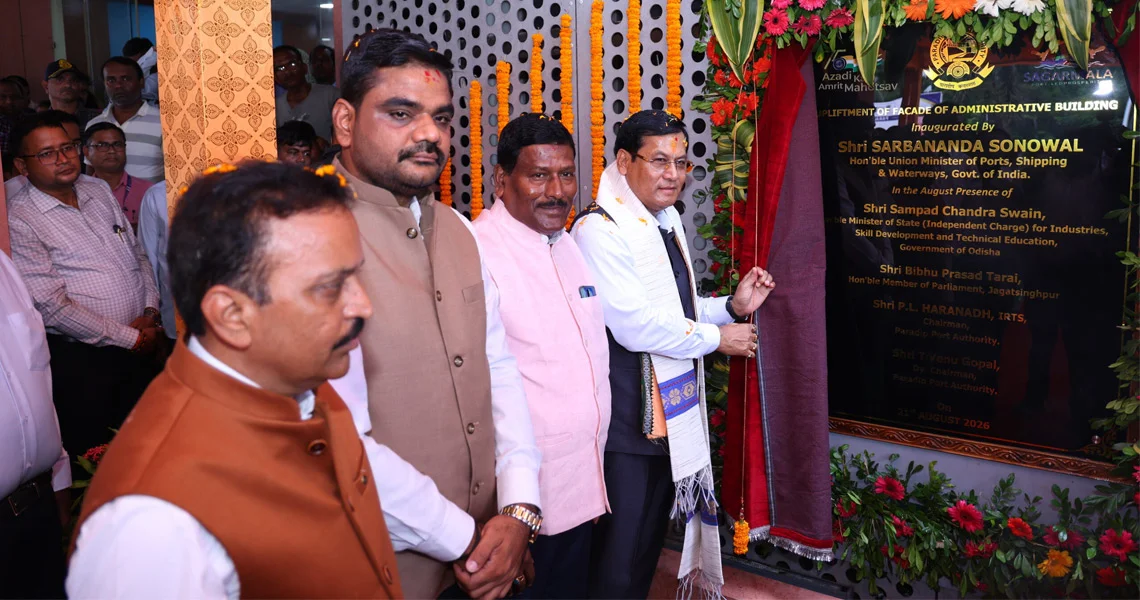
The other projects named in the ₹427.80 crore package are the support system rather than the headline: a second Atharbanki bridge of 500 metres and three lanes at ₹24.89 crore, a ₹15.50 crore vessel traffic management system, ₹20 crore of piped natural gas to 546 residential quarters, a ₹12.18 crore upgrade of the administrative building and a ₹2.10 crore sports hostel. Those five and the deepening come to ₹426.67 crore against a stated package of ₹427.80 crore for seven projects, so one project of about ₹1.13 crore is not itemised in the release. The traffic management system is the one that compounds with the draft, because a deeper channel is only useful if vessel movement through it is scheduled tightly.
THE DISTINCTION THE ARITHMETIC DEPENDS ON
₹427.80 crore is work commissioned. ₹1,580.36 crore is work agreed and not begun. The three mechanisation concessions — a 5 million tonne South Quay at ₹498.69 crore, an 8 million tonne multipurpose berth at ₹630.67 crore and a 10 million tonne captive CQ-III berth at ₹451 crore — are build-operate-transfer contracts, which means a private operator finances and builds the equipment and recovers the cost from handling charges over the concession period. The capacity is future capacity. The two figures should not be added into a single number, and the 23 million tonnes should not be counted until the cranes are turning.
The same discipline applies to the railway sanction. ₹9,450 crore is an approval with a 2030-31 horizon. Nothing has been laid. The 76 million tonnes a year of freight capacity, the 6,448 villages and about 60 lakh people the Ministry of Railways names, and its estimates of 13 crore litres of oil imports avoided and 65 crore kg of carbon dioxide, are all projections at full commissioning.
WHY THE TWO SANCTIONS BELONG IN ONE STORY
Read the four railway sections against a map of the port. Cuttack–Paradeep is the 72 km spur that reaches the port gate. Bhadrak–Haridaspur, 75 km, carries the Odisha iron ore. Kharagpur–Bhadrak, 173 km, is the trunk running north towards the Jharkhand and West Bengal steel plants. Three of the four sanctioned sections, 320 km of the 410 km, lie on the corridor that Paradip feeds. The fourth, Gummidipundi–Gudur at 90 km, is a different problem: it relieves the Chennai–Vijayawada trunk further south.
Neither release makes this connection. The port release counts tonnes and rupees at the quay; the railway release counts kilometres and villages along the line. Set side by side, they describe a single evacuation build-out in which the sea end and the land end are being widened at once — which is the only sequence in which either investment returns what it promises.
WHERE THE SEQUENCING RISK SITS
The two timelines are not the same. The draft is available now. The berth mechanisation runs on concession schedules the release does not publish. The railway capacity arrives by 2030-31. For four years, therefore, a port able to take deeper ships and to handle cargo faster will be discharging onto a line that has not yet been widened. Whether that becomes a bottleneck depends on how much of the 23 million tonnes of new berth capacity comes on stream before the fourth line does — a sequencing question that sits between two ministries and is answered in neither document.
The accountability for it maps cleanly enough by office. Draft and berth commissioning belong to the Paradip Port Authority under the Ministry of Ports, Shipping and Waterways. Multitracking execution belongs to the East Coast Railway and South Eastern Railway zones under the Ministry of Railways. The interface — the timing of one against the other — belongs to neither on its own, which is precisely the sort of gap that PM Gati Shakti was created to close.
BLITZ RECOMMENDS
Publish a joint commissioning calendar for the corridor. If the Paradip Port Authority and the East Coast Railway placed their two schedules on one page — berth-by-berth mechanisation dates against section-by-section track commissioning dates — the sequencing gap would be visible to both, and to the shippers who have to plan around it, four years before it can turn into congestion. The instrument for it already exists in the PM Gati Shakti National Master Plan; what is missing is a published, dated overlay for this one corridor. A second step costs nothing: the Ministry of Railways could report the four sanctioned sections against physical progress each quarter, in kilometres of track laid rather than in rupees released, so that a reader can see the line being built rather than the money being spent.
Mobile scheme pays Indian brands more
NEW DELHI: The Ministry of Electronics and Information Technology has notified a Mobile Phone Manufacturing Scheme with an outlay of ₹62,500 crore running five financial years from FY27 to FY31, and for the first time it pays an Indian-owned brand a materially higher rate than a global contract manufacturer. The release is dated 21 August 2026.
The scheme has two target segments. The first covers large-scale manufacturing and pays a differentiated incentive of 2.25% to 5%; entry requires ₹10,000 crore of turnover in FY26, existing brands must then hold ₹5,000 crore of annual sales and new brands must reach ₹10,000 crore. The second segment is reserved for Indian brands and pays a 5% base incentive plus a further 3% for Indian design and research and development; entry requires only ₹1,000 crore of turnover in FY26, but also more than 51% Indian shareholding, Indian management, and domestic intellectual property, trademark and R&D. Both segments can earn up to 1.5% more for domestic sourcing, conditional on at least 25% localisation, and second-segment applicants get a one-year gestation period.
Stacked at their maxima, the two ladders come out at 9.5% for an Indian brand meeting every condition and 6.5% for a large-scale manufacturer doing the same — a three-percentage-point preference that the release does not state as a figure but that follows from the rates it publishes.
The ministry puts cumulative production over the scheme’s tenure at about ₹39 lakh crore and direct employment at about 60,000. Both are projections against future output, not delivered figures, and ₹62,500 crore is a ceiling payable against production that has yet to happen rather than money disbursed. The release carries no application window dates.
US sets double duties on Indian paprika extract
NEW DELHI: The United States Department of Commerce published final affirmative determinations in both halves of a paired trade-remedy case against India on 21 August, setting anti-dumping and countervailing duties on oleoresin paprika, the concentrated colouring extract pressed from capsicum peppers. The two duties stack as cash deposits at the American border.
On the subsidy track, case C-533-939, Commerce set a net countervailable subsidy rate of 25.42% for Synthite Industries, 18.67% for Mane Kancor Ingredients and 21.90% for all other Indian producers and exporters. On the dumping track, case A-533-938, the weighted-average margins are 5.78% for Synthite, 4.24% for Mane Kancor and 5.08% for all others. Both respondents are Kerala oleoresin houses, and the period of investigation in each case ran from 1 April 2024 to 31 March 2025.
Commerce values United States imports of oleoresin paprika from India at $56,441,682 in 2024, in the fact sheet it issued with the preliminary subsidy determination on 30 January 2026. India is not one supplier among several in this trade; it is substantially the whole of it.
Two qualifiers carry weight. The petition that began the case, filed by the single American producer Rezolex of Las Cruces, New Mexico, alleged dumping margins of 235.82% to 284.83%; Commerce’s own final figures came in at 4.24% to 5.78%. In this case the alleged figure was a claim and the published rates are the determination, and it is the determination that the border will collect on. And this is not yet a duty order. The United States International Trade Commission must determine within 45 days of the 21 August determination whether the domestic industry is materially injured. A negative vote terminates the proceeding and refunds every cash deposit.
Commerce also found that critical circumstances exist for Synthite alone on the subsidy side, which allows duties to reach back to shipments made before the preliminary determination. The finding is negative for Mane Kancor, for all other exporters, and across the whole dumping case.
The exposure runs inland from Kochi. Oleoresin extraction draws on the Byadgi and Teja capsicum grown in Andhra Pradesh, Telangana and Karnataka, and the American market it serves is processed cheese, snack seasoning and cosmetics.
Sugar retail price up 15.6% in a month
NEW DELHI: Retail sugar moved from ₹48.18 a kg on 20 July to ₹55.70 a kg on 20 August, a rise of 15.6% inside a month, and the Department of Food and Public Distribution set out on 21 August the production shortfall behind it and the four measures taken against it.
The current season is now expected to close near 306 lakh tonnes against an initial estimate of about 343 lakh tonnes, in a country whose normal output runs 320 to 340 lakh tonnes and whose domestic consumption runs 280 to 290 lakh tonnes. The international price rose from $474 a tonne on 30 June to $552 a tonne on 20 August, more than 16%, against a projected global deficit of about 33 lakh tonnes in 2026-27.
The four measures are a stock limit of 400 tonnes on dealers running from 1 August to 30 November, a cap on bulk consumers at fifteen days of consumption from 1 September, permission to import 10 lakh tonnes of raw sugar duty-free, and an advisory to states and mills to begin crushing from 15 October. The department expects the early start to lift October production above 10 lakh tonnes against a usual 3 to 4 lakh tonnes.
Three figures in that set are not what they appear. The 306 lakh tonnes is an expectation for a season not yet closed. The 10 lakh tonnes of duty-free raw sugar is a permission, not a landed quantity. And the October production figure is contingent on mills actually crushing from 15 October rather than on their customary date.
The department also records that diversion of sugar to ethanol has been reduced from about 12% in 2022-23 to about 9% in 2025-26, that 97% of sugarcane dues stood paid as on 20 August, and that ₹14,600 crore of subsidy was given to the sector between 2014 and 2021 with none announced since 2021-22.
Monsoon runs 13% below normal to date
NEW DELHI: The India Meteorological Department’s extended-range outlook issued on 20 August puts all-India rainfall from 1 June to 19 August at 13% below the Long Period Average, which places the 2026 southwest monsoon in the department’s below-normal category.
The shortfall is not spread evenly. For the week from 13 to 19 August the South Peninsula recorded 19.5 mm against a normal of 42.7 mm, 54% short. Over the same week East and Northeast India were 12% short, Central India 10% and Northwest India 7%. Uttar Pradesh stands 16% short for the season to 21 August, at 443.1 mm against a normal of 525.7 mm, with the eastern subdivision of the state 23% short against 4% in the west.
The department’s outlook for the week from 20 to 26 August keeps rainfall below normal for the country as a whole, with Central India normal to above normal, East and Northeast India normal and Peninsular India below normal. Against a well-marked low pressure area over northeast Madhya Pradesh, the department warned of isolated heavy to very heavy rainfall over East Madhya Pradesh on 21 and 22 August.
Two distinctions matter for reading these figures. The 13% is cumulative for the season to date, not a final seasonal number; the season runs to 30 September and the department’s own outlook expects Central India to recover in the week ahead. And the 54% figure for the South Peninsula is a single week’s departure, not that region’s seasonal position.
A season closing short with the peninsula worst affected reaches beyond the kharif crop. Reservoir storage feeds both irrigation in the rabi season and hydroelectric generation, and a dry September raises evening peak power demand at the point in the year when hydro storage is thinnest.
42 one-stop centres sanctioned but not running
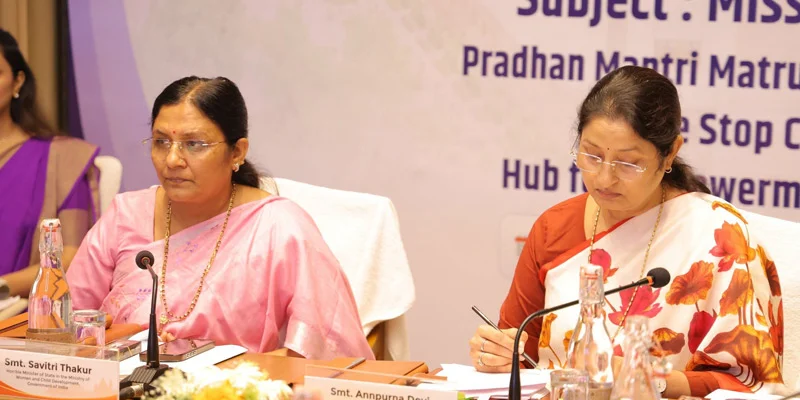
NEW DELHl: Of 1,033 One Stop Centres approved under Mission Shakti, 991 are functional, the Ministry of Women and Child Development told its consultative committee on 21 August. The 42 sanctioned but not operating are the gap in a network that has assisted more than 15.20 lakh women.
A One Stop Centre is the single point at which a woman facing violence is meant to reach police assistance, medical aid, legal counsel and temporary shelter without going to four separate offices. A centre that exists on a sanction list and not on the ground leaves that consolidation unavailable in whichever district it was sanctioned for.
Under the Pradhan Mantri Matru Vandana Yojana the ministry reports more than ₹21,343 crore disbursed to more than 4.60 crore beneficiaries. The entitlement is ₹5,000 for the first child, paid as ₹3,000 at pregnancy registration and ₹2,000 at childbirth, and ₹6,000 where the second child is a girl. Set against the beneficiary count, the disbursed amount averages about ₹4,640 a beneficiary — below the lower of the two entitlements, which is consistent with a share of beneficiaries having received the first instalment and not yet the second, and is the figure the ministry is best placed to explain.
Every one of these numbers is cumulative scheme-to-date rather than annual, and the release does not give the date from which the cumulation runs.
On the administrative side, biometric authentication has enrolled 64.65 lakh beneficiaries since 21 May 2025 and the Due List initiative has onboarded 36.42 lakh since 1 July 2025. The women’s helpline 1515 has been used more than 22.52 lakh times, and more than 87% of the over one lakh grievances received have been resolved. Under SANKALP, 36 state-level and 765 district-level Hubs for Empowerment of Women are functional.
Closing the 42-centre gap is the smallest and most tractable item on that list. Each is already sanctioned; what stands between sanction and operation is ordinarily premises, staff appointment or the district-level order that puts both together.
Eased land-border rule draws ₹4,895.65 crore
NEW DELHI: Twenty-nine foreign investments with a proposed value of ₹4,895.65 crore have come in under the revised framework for investment carrying land-bordering-country ownership, counted to 20 August, the Ministry of Commerce and Industry said on 21 August. It is the first published measure of what the relaxation has drawn.
The framework is Press Note 2 of 2026, together with amendments to the Foreign Exchange Management (Non-debt Instruments) Rules, 2019 notified on 1 May 2026. It permits investment carrying non-controlling land-bordering-country ownership of up to 10% to use the automatic route without prior government approval. It replaces the requirement under Press Note 3 of 2020 that every case of such beneficial ownership go for government approval, a rule that had frozen a large class of global venture and private equity vehicles out of India because small limited-partner stakes sat inside their structures.
The investments span information technology, artificial intelligence, information and communication, manufacturing, pharmaceuticals, data centres and transport services. The source jurisdictions named are Mauritius, the United States, the Republic of Korea, Japan, Singapore, Luxembourg and the Cayman Islands.
Two readings of that list matter. The figure is proposed investment reported under the framework, not money received or deployed, and the count is cumulative over three and a half months rather than monthly. And none of the seven named jurisdictions is a land-bordering country: what the relaxation has unlocked is capital domiciled elsewhere that carried an interest of 10% or less from a land-bordering country somewhere in its ownership chain.
Reserves at $716.9 billion, gold does the work
NEW DELHI: India’s foreign exchange reserves stood at $716,907 million in the week ended 14 August, up $9,905 million on the week, the Reserve Bank of India reported in its weekly statistical supplement on 21 August. Foreign currency assets added $7,225 million to $581,851 million and gold added $2,679 million to $111,417 million; special drawing rights fell $5 million to $18,740 million and the reserve position in the International Monetary Fund rose $5 million to $4,899 million.
The twelve-month figures tell a different story from the weekly ones. Total reserves are up $21,801 million over the year. Within that, gold is up $25,750 million and foreign currency assets are down $4,052 million. The whole of the annual increase, and more, is the rising value of the gold already held rather than fresh dollar accretion.
That distinction bears on what the reserve is for. Gold is a store of value; foreign currency assets are what a central bank sells when it wants to steady the exchange rate. A reserve growing through gold revaluation is larger on the page and no more liquid at the counter.
The Reserve Bank marks the series provisional, and notes that foreign currency assets exclude its own holdings of special drawing rights and its contribution to the funding of Nexus Global Payments. The figures are as on 14 August and published on 21 August, a week behind the market they describe.
The same supplement puts scheduled commercial banks’ aggregate deposits at ₹2,69,41,367 crore as on 31 July, up 10.2% over the year, and bank credit at ₹2,20,78,095 crore, up 10.0%.