NEW DELHI: India spent this week being told, by its own arithmetic, that it has changed the engine. On Monday 31 August the National Statistics Office put real growth for the April–June quarter of 2026-27 at 7.8 per cent — real Gross Domestic Product of ₹81.36 lakh crore against ₹75.46 lakh crore a year earlier. The headline travelled everywhere. The sentence underneath it did not. Gross Fixed Capital Formation, which is the plain name for what the country builds and buys to produce with, grew 11.9 per cent against 5.8 per cent in the same quarter last year. Private consumption grew 7.1 per cent. Work the two against the quarter’s total increase in real output and the result is this: of the ₹5,89,923 crore by which the economy grew, investment supplied ₹2,98,325 crore and household consumption ₹2,98,094 crore. For the first quarter in memory, the building half of the economy carried marginally more of the growth than the buying half. That is not a headline the release contains. It is what the release means.
The money followed the arithmetic. On Friday 4 September the Reserve Bank reported foreign exchange reserves of $740.8 billion for the week ended 28 August — a record, up $11.48 billion on the week, and the ninth consecutive weekly rise. On Monday 1 September the government notified Semicon 2.0, the next phase of the India Semiconductor Mission, with a fiscal outlay of ₹1,27,500 crore across six pillars running from chip design through machines and materials, fabrication and advanced packaging to research and to the people who will do the work. On the same day the gross Goods and Services Tax take for August was published at ₹1,99,853 crore, up 14.8 per cent on a year earlier and within a hundred and fifty crore of the two-lakh-crore line. A statistical series does not usually agree with a tax series and a reserve series all in one week. This week the three said the same thing.
Then, at 2:55 on Friday morning, the country did something it had failed at once before. GSLV-F17 lifted off from the second launch pad at Sriharikota and placed EOS-05 into a sub-geosynchronous transfer orbit about nineteen minutes later. EOS-05 is India’s first imaging satellite meant to work from geostationary orbit — that is, to sit at a fixed point above the subcontinent and watch it continuously rather than pass over it twice a day. It is the successor to the GISAT-1/EOS-03 mission that was lost in flight. For a farmer waiting on a cyclone track or a district officer watching a river rise, the difference between a photograph twice a day and a camera that never looks away is the whole difference.
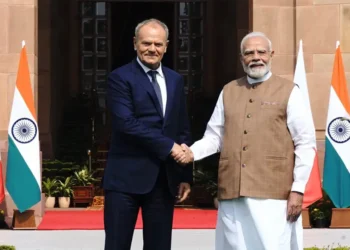
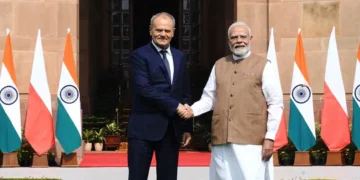
The week’s diplomacy came to Delhi rather than leaving it. Belgian Prime Minister Bart De Wever arrived on 2 September with his defence minister and fifteen companies — the first visit by a Belgian head of government in two decades — held a long meeting with the Prime Minister, and went on to Mumbai on 4 September for the diamond, port and logistics trade, the industry that has quietly made Antwerp and Surat two halves of one business. India also kept an air bridge open to Nepal through the week, the Ministry of External Affairs dispatching successive C-130J flights of relief for the flood-hit districts and taking the total past 68 tonnes. And on Saturday 5 September the President conferred the National Teachers Awards on forty-eight school teachers at Vigyan Bhawan — twenty-six men, twenty-two women, from twenty-seven States, seven Union Territories and six central organisations. Markets, as they often do in a good week for the economy, looked the other way: the Sensex closed Friday at 76,515.43 and the Nifty 50 at 23,897.70, both about one per cent lower on the week.