India powers up the silicon economy
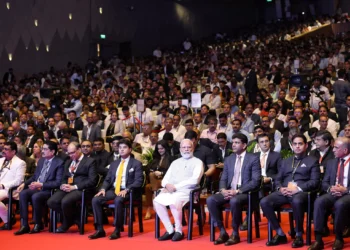
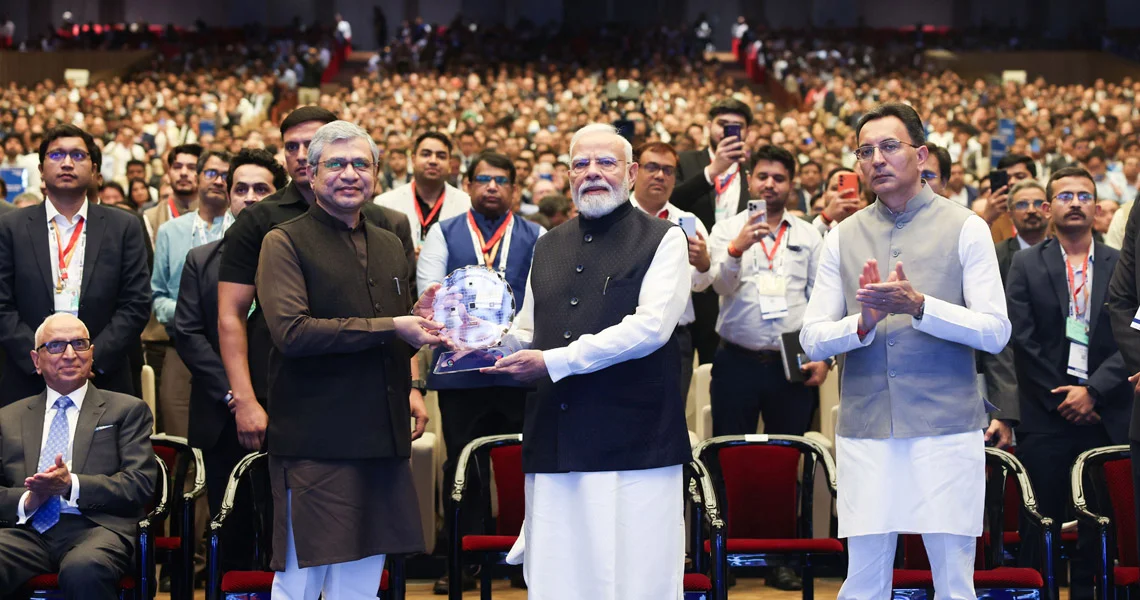
New Delhi, 19 September Students have been sending the Prime Minister Narendra Modi chips they designed themselves. He mentioned it almost in passing while inaugurating SEMICON India 2026 at Yashobhoomi in Dwarka, and it is the detail that explains what has changed. Four years ago the argument in this hall was whether India could build a fabrication plant at all. This year the argument was about gases, chemicals, packaging materials and where the electricity will come from.
The fifth edition of the conference ran from 17 to 19 September under the theme “Silicon to Systems: Building the Ecosystem”. According to the Prime Minister’s Office release of 17 September 2026, commercial production has now begun at two more plants, in Mohali and Surat, and chips made in India are reaching customers at home and abroad.
From plants to the pieces around them
PM Modi announced a second phase of the India Semiconductor Mission worth 13.5 billion dollars, alongside regulatory changes meant to make it easier for international firms, start-ups and design houses to work together. Twelve projects stand approved under the first phase. The second phase is built around six areas rather than one: design, machines and materials, more fabs, the assembly and testing industry, research, and talent.
That shift matters more than it sounds. A fabrication plant that has to import every gas, every chemical and every substrate is an assembly address, not an industry. Tata Electronics used the conference to sign with Nexperia, INOX Air Products and Sumitomo Chemical for exactly those inputs at Dholera and Jagiroad. Kaynes Semicon signed on advanced packaging and system-on-module work. Suchi Semicon and eInfochips exchanged their first batch of commercial devices.
Industry reports from the floor put the investment commitments made during the three days at about one lakh crore rupees, or eleven to twelve billion dollars, with roughly one lakh jobs attached and sixteen agreements signed on the opening day alone. Set that against the mission’s own second-phase figure and the arithmetic is striking: the commitments announced in three days come to roughly 85% of what the Government has budgeted for the entire phase.
Where the power comes from
The part of the address that industry will have listened to hardest was about electricity. A fab cannot tolerate a dip, let alone an outage, and an AI data centre next door will draw more power than the town around it. The Prime Minister set out solar capacity now above 160 GW, nuclear generation opened to private participants, and small modular reactors under development.
This is the unglamorous half of a semiconductor policy. Taiwan and South Korea did not become chip nations on subsidy alone; they did it on grids that do not fail. India is making the same bet in public, which at least allows it to be judged.
Blitz Data Card
New Delhi : At a glance
Second phase of the India Semiconductor Mission: 13.5 billion dollars
Projects approved under the first phase: 12
Plants that began commercial production this year: 2 — Mohali and Surat
Engineering students trained for chip design: 70,000 against a target of 1,00,000
Solar capacity: above 160 GW
What India gains
A chip supply chain with its inputs, its packaging and its designers inside the country, and 1 lakh jobs attached to the commitments announced.
EPFO cover gets a ₹25,000 boost
New Delhi, 19 September An employee starting work at 20,000 rupees a month has, until now, been outside the provident fund unless the employer chose otherwise. That ends. The Union Cabinet has raised the wage ceiling for compulsory coverage under the Employees’ Provident Fund Organisation from 15,000 rupees a month to 25,000, and the Government expects more than 51 lakh additional employees to come inside the statutory net.
According to the Prime Minister’s Office release of 16 September 2026, the ceiling had last been revised in September 2014. Twelve years of wage growth have passed since, and in several States and occupations the minimum wage itself has climbed close to the old threshold — which is another way of saying the ceiling had stopped keeping anybody in and had started keeping people out.
The annual cost to the Government is put at 11,339 crore rupees against the 10,250 crore it already spends, an increase of 1,089 crore, or 10.6%. The five-year estimate is 56,696 crore. That figure is worth a second look: it is exactly five times the annual number, which means the estimate assumes the covered population does not grow at all over five years. If formalisation continues, the cost will be higher than the paper says — and so will the number of people protected.
Coverage brings three things with it, not one: provident fund savings, pension under the Employees’ Pension Scheme, and insurance under the Employees’ Deposit Linked Insurance Scheme. The organisation currently reports about 7.98 crore contributing members across roughly 7.68 lakh establishments, and pays pension to around 82 lakh people. The 51 lakh who now come in amount to a 6.4% widening of the contributing base.
Blitz Data Card
New Delhi : At a glance
Wage ceiling for compulsory EPFO cover: raised from 15,000 to 25,000 rupees a month
Employees expected to come inside: more than 51 lakh
Annual government outgo: 11,339 crore rupees, against 10,250 crore at present
Five-year estimate: 56,696 crore rupees
Contributing members at present: about 7.98 crore, across about 7.68 lakh establishments
Pensioners under the Employees’ Pension Scheme: about 82 lakh
Ceiling last revised: September 2014
What India gains
Pension, provident fund and insurance protection for 51 lakh more working people, and a social security framework that finally matches what Indians are actually paid.
India’s software story hits $221 billion
Mumbai, 19 September India sold 221.4 billion dollars of software services to the world in 2025-26, 8.2% more than the year before. The figure comes from the Reserve Bank of India’s annual survey on computer software and information technology enabled services exports, released on 18 September 2026.
Add the business delivered through offices Indian companies own abroad and the total reaches 239.3 billion dollars, a rise of 9.5%. The two legs sum: 221.4 plus 17.9 equals 239.3, and the 17.9 billion dollars is the same local business of foreign affiliates that the survey reports separately.
The survey reached 7,569 exporting companies and 2,363 replied, a response rate of 31.2% that nonetheless covers about 89% of estimated exports, because most of the large firms are in it.
That second number is the one that does not fit the headline. Local business done by the overseas arms of Indian companies grew from 13.9 billion dollars to 17.9 billion — a rise of 28.8%, more than three times the growth in exports billed from India. Indian information technology is increasingly selling inside the customer’s country rather than shipping the work home, which changes where the value is taxed, where the jobs sit, and how much of this revenue reaches an Indian city at all.
The United States took 54.1% of India’s software exports and Europe 31.8%, the United Kingdom alone accounting for 15.4% — which is to say nearly half of Europe’s share. Between them the two markets take 85.9% of the total. Delivery remains overwhelmingly off-site, at 91.7%, and business process outsourcing is still the largest part of the technology-enabled services side.
Blitz Data Card
Mumbai : At a glance
Software services exports, 2025-26: 221.4 billion dollars, up 8.2%
Including overseas commercial presence: 239.3 billion dollars, up 9.5%
Local business of foreign affiliates: 17.9 billion dollars, against 13.9 billion a year earlier
Share taken by the United States: 54.1%; Europe: 31.8%; the United Kingdom alone: 15.4%
Delivered off-site: 91.7%
Companies surveyed: 7,569; companies that replied: 2,363, covering about 89% of estimated exports
What India gains
A services export line worth 239.3 billion dollars, and an early warning that a growing share of it is now earned outside India’s borders.
India’s craftsmen get a modern toolkit
Kolkata, 19 September Thirty lakh carpenters, potters, blacksmiths, cobblers, weavers and boat-makers have registered under PM Vishwakarma in three years. About 24.50 lakh of them have finished basic skill training, 18.15 lakh have received a modern toolkit delivered through India Post, and 6.18 lakh have taken a loan of up to one lakh rupees at 5% a year — 5,297 crore rupees in all.
According to the Ministry of Micro, Small and Medium Enterprises release of 18 September 2026, marking the third anniversary at the Dhono Dhanyo Auditorium in Kolkata, 81.7% of those registered have been trained, 60.5% have their tools, and 20.6% have credit. The scheme reaches an artisan easily and trains them well; it loses four in five before the money arrives.
Union Minister for MSME Jitan Ram Manjhi gave the figures. The average loan works out to about 85,712 rupees against a one lakh rupee ceiling, so those who do borrow are borrowing close to the limit — which suggests the constraint is access, not appetite.
West Bengal joined the scheme only in May 2026 and has already received more than seven lakh applications, Chief Minister Suvendu Adhikari told the gathering. The scheme was launched on 17 September 2023.
India pushes paperless trade at SCO
Dushanbe, 19 September Trade ministers of the Shanghai Cooperation Organization met in Dushanbe on 17 September 2026 for their twenty-fifth meeting, and India used the floor to argue for the least glamorous item on any trade agenda: paperwork.
According to the Ministry of Commerce and Industry release of 18 September 2026, India, represented by Yashvir Singh, pressed for simplified customs procedures, paperless trade and the electronic exchange of documents, alongside multimodal connectivity and shorter transit times.
The framing was the three pillars the Prime Minister set out at the SCO Summit in Bishkek — security, connectivity and opportunity.
India also asked for supply chains to be diversified across agriculture, critical minerals, pharmaceuticals, manufacturing and electronics, and for cross-border payments and trade finance to be made reachable by smaller firms. It restated its commitment to a rules-based multilateral trading system with the World Trade Organization at its centre.
The ministers adopted a joint statement and agreed an action plan for 2026-2030, which now goes to the SCO heads of government for approval. They also approved regulations for a working group on the creative economy. The next ministerial meeting will be held in Uzbekistan in 2027.
For an Indian exporter the practical point is transit. Goods moving to Central Asia cross several borders, and every additional inspection is a cost that shows up in the price. An action plan is not a customs window — but it is the document the customs window eventually comes from.

India, Canada put CEPA on the fast track
New Delhi, 19 September Commerce and Industry Minister Piyush Goyal and Canada’s Minister of International Trade Maninder Sidhu have agreed to speed up negotiations on the India-Canada Comprehensive Economic Partnership Agreement and to conclude it at the earliest, Akashvani reported on 19 September 2026.
Both sides expect the agreement to open trade in goods and services, investment and wider economic cooperation. Goyal said an early conclusion would help realise a shared ambition of raising bilateral trade substantially.
What India would obtain is worth stating plainly rather than leaving to the phrase “mutual benefit”. Canada buys engineering goods, pharmaceuticals, textiles and information technology services, and it maintains one of the larger Indian diaspora populations in the world — which makes services mobility and the recognition of professional qualifications as consequential to Indian negotiators as any tariff line.
No text has been released and no date has been set. Until one is, this is an agreement to hurry, not an agreement.
India’s silicon talent factory
New Delhi, 19 September Every semiconductor policy argument eventually arrives at the same place: who will do the work. India’s answer is a training target of one lakh engineering students for chip design, and according to the Prime Minister’s Office release of 17 September 2026, seventy thousand have been trained.
That is 70% of the target, and it is the most concrete number the mission has published about itself. The remaining thirty thousand carry no date.
The pipeline is being widened at the same time. Six ChipIN regional centres have been announced to put chip-design tools within reach of institutions outside the existing clusters, and the India Semiconductor Mission and Intel India have launched an introductory semiconductor course. Intel India has separately agreed with the New Age Makers’ Institute of Technology on workforce development covering artificial intelligence and semiconductor technologies.
Two cautions belong here. A trained student is not an employed engineer, and the mission has not said how many of the seventy thousand are now working in the industry — a figure that would tell the country far more than the training count does. And design training, on its own, produces designers for other people’s products; the intellectual property stays where the product is owned. The Prime Minister’s own request at Yashobhoomi, that industry run its research and development inside India, is the acknowledgement of exactly that.
What India gains, if the pipeline holds, is the one input a fab cannot import: people who can design the chip it makes.
India’s broadband gap laid bare
New Delhi, 19 September
India has laid the fibre in a major way. According to Performance Audit Report No. 19 of 2026 on BharatNet, tabled in Parliament on 12 August 2026, 2.19 lakh gram panchayats — 96.70% of the revised target of 2.26 lakh — were service-ready as of November 2025. On infrastructure, the project has very nearly done what it set out to do.
The auditor’s finding is about what happened next. Of the gram panchayats that were service-ready, 33.20% were operational. Multiply the two and the figure that reaches the village is 32.1% of the targeted panchayats — roughly one in three.
Where the network stops working
The Comptroller and Auditor General’s report attributes about 48% of non-operational cases to fibre faults or cuts, and records a mean time to restore of 17 days. Bandwidth utilisation stood at 17.91%. Expenditure to November 2025 was 39,888 crore rupees against an approved 42,068 crore, of which 30,920 crore belonged to Phase-II — so 94.8% of the money has been spent to reach a third of the intended use.
The audit covered 2017-18 to 2022-23 with the position updated to November 2025, and examined Bharat Broadband Network Limited, Bharat Sanchar Nigam Limited, the Universal Service Obligation Fund and the Department of Telecommunications across eight States and one Union Territory.
Two States that did it
The most useful paragraph in any audit is the one that shows the target is reachable. Here it is Gujarat and Punjab, where operational gram panchayats were above 90% — against a national figure of 33.20%. Whatever those two circles are doing about fault localisation and restoration is a practice the rest of the country can copy, and the report says so in the language of recommendation rather than blame.
The auditor also notes that the private-led implementation model showed stronger financial discipline and better service delivery than the public-sector-led model, and that 2,001.43 crore rupees diverted by Bharat Sanchar Nigam Limited has since been recouped, with utilisation certificates now required under the Amended BharatNet Programme.
The report reads the merger of Bharat Broadband Network Limited into Bharat Sanchar Nigam Limited, and the move to a single implementing agency under the Amended BharatNet Programme approved by the Cabinet in August 2023, as the Government’s own acknowledgement of the execution difficulties it records. That programme widens the scope from 2.5 lakh gram panchayats to 6.4 lakh villages — 2.56 times the earlier ambition.
Blitz Data Card
New Delhi : At a glance
Gram panchayats service-ready, November 2025: 2.19 lakh of a revised 2.26 lakh — 96.70%
Service-ready gram panchayats actually operational: 33.20%
Bandwidth utilised: 17.91%
Share of non-operational cases caused by fibre faults or cuts: about 48%
Mean time to restore a fibre fault: 17 days
Expenditure to November 2025: 39,888 crore rupees against an approved 42,068 crore
States above 90% operational: Gujarat and Punjab
What India gains
A measured account of where rural broadband stops working, and two States whose figures show the target is reachable.