Blitz Bureau
NEW DELHI: Nearly two decades of negotiation closed in January. What stands between the text and an Indian exporter’s invoice is a legislative calendar in Brussels and Strasbourg.
India and the European Union concluded negotiations on their free trade agreement in New Delhi on 27 January 2026, closing a file first opened in 2007. On the European Commission’s own account it is the largest trade agreement either side has ever concluded: the two economies already trade goods and services worth more than €180 billion a year, the agreement eliminates or reduces tariffs on 96.6 per cent of EU exports to India, and the Commission estimates around €4 billion a year in duty savings on European products. For Indian exporters the corresponding gain is easier access for textiles, garments and pharmaceuticals into a market of some 450 million relatively high-income consumers.
None of that is in force yet, and the reason is procedural rather than political. India ratifies trade agreements by executive decision — Union Cabinet approval, without a parliamentary vote. The European Union does not: the trade chapters require approval by the Council of the European Union and the consent of the European Parliament, which must vote on tariffs, services and digital trade as a package. Ratification has been expected around the middle of 2026. Separately, the Investment Protection Agreement — the instrument that governs how a European investor in India, or an Indian investor in Europe, can pursue a dispute — was not settled alongside the trade text and remains to be agreed.
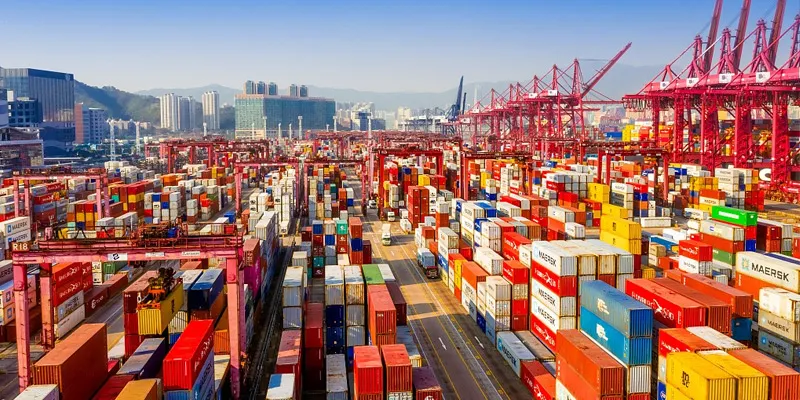
Waiting on a vote: container operations at Jawaharlal Nehru Port. Preferential access for Indian textiles and pharmaceuticals into the European Union begins on the date of entry into force, not the date of conclusion.
A concluded agreement changes nothing at a customs counter. An exporter’s duty falls on the date of entry into force — and that date is set in Brussels and Strasbourg.
At a Glance
• Negotiations concluded: New Delhi, 27 January 2026
• Talks first launched: 2007
• Current two-way trade: over €180 billion a year in goods and services
• EU export lines covered: tariffs cut or removed on 96.6 per cent
• Estimated duty saving: about €4 billion a year on European products
• Indian sectors named as gainers: textiles, garments, pharmaceuticals
• Indian ratification route: executive — Union Cabinet approval
• EU ratification route: Council approval plus European Parliament consent
• Expected EU ratification: around mid-2026
• Still outstanding: the separate Investment Protection Agreement
• Source of EU figures: European Commission
For an ordinary reader the practical question is what changes and when. Three things are worth holding on to. First, nothing changes at a customs counter until the agreement enters into force, so an exporter costing an order for the winter season should still assume today’s duty. Second, the gains are concentrated in labour-intensive sectors — ready-made garments in Tiruppur and Ludhiana, textiles in Surat and Panipat, formulations plants across Gujarat, Himachal and Telangana — which means the employment effect, when it arrives, will show up in exactly the districts where employment matters most. Third, European access to the Indian market rises too, notably in automobiles and wine, and Indian producers in those lines have the ratification window to prepare.
The honest reading is that the hard part is over and the slow part has begun. A twenty-year negotiation that closes is a genuine achievement of persistence by both administrations, and the Indian side has already done what its constitution requires of it. What remains is a European legislative calendar that India does not control and cannot accelerate. The constructive use of the interval is preparation: getting rules-of-origin documentation, testing and certification and standards compliance in order in the exporting clusters, so that Indian firms can use the preference from the first day it exists rather than discovering the paperwork in month three. That work costs little and is entirely within India’s own hands.