Blitz Bureau
NEW DELHI:America took $25.47 billion of Indian goods in the first quarter of this financial year — more than any other country. The number to hold alongside it is 18: the effective tariff those goods now face, down from close to 50 at the peak of last year’s dispute.
Read those two figures together and the shape of the year becomes clear. The February settlement did not merely remove a penalty; it re-ranked India against the countries it competes with for the same American shelf space. At 18 per cent, Indian goods now enter below Vietnam and Bangladesh, both at 20, and well below China. In categories where the entire business is conducted on margins of a few percentage points — ready-made garments, home textiles, cut and polished stones, generic formulations, engineering components — a two-point tariff difference is not a rounding error. It is the reason a buyer in North Carolina re-books next season’s order in Tiruppur instead of Dhaka. For the worker at the end of that chain, the tariff line is an employment line.
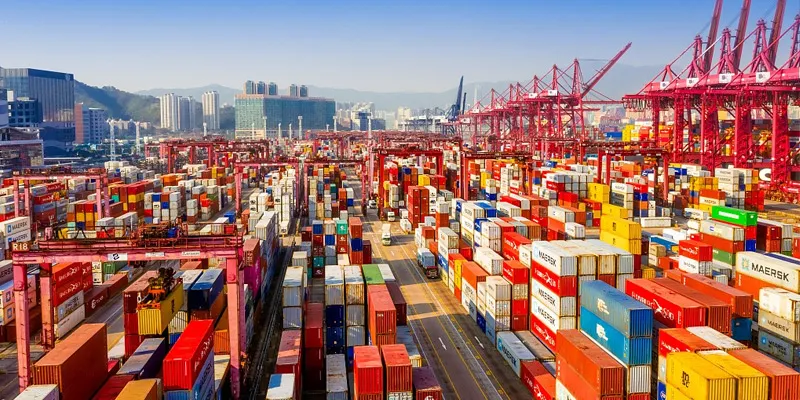
Where the tariff lands: the American market absorbed $25.47 billion of Indian merchandise in April–June, the single largest destination for the quarter.
A tariff is not felt at the border. It is felt eight thousand miles inland, in the week a buyer decides which country to re-order from.
At a Glance
• India’s exports to the US, April–June (FY27): $25.47 billion — the largest single destination
• Effective tariff on Indian goods: 18 per cent, following the February 2026 settlement
• Peak position last year: close to 50 per cent, combining a 25 per cent reciprocal duty and a 25 per cent additional duty
• Comparative position: Vietnam and Bangladesh at 20 per cent; China materially higher
• Sectors most exposed to the change: textiles and apparel, gems and jewellery, pharmaceuticals, engineering goods — all thin-margin, all labour-intensive
• Wider context: India’s June merchandise exports rose 15.5 per cent to $40.41 billion, with imports at $70.84 billion
For readers who are not in the export trade, the corridor shows up in three other places. Students: an American degree remains the single largest overseas education outlay Indian families make, and the visa and fee rules attached to it move independently of tariffs — worth tracking separately rather than assuming a warm trade relationship carries them along. Travellers and the diaspora: remittance and travel flows are far less sensitive to tariff schedules than to airline capacity and consular processing times, which is why the practical question for most families is how many direct seats exist between Indian metros and American hubs. And savers: a tariff settlement that steadies export earnings also steadies the rupee’s current-account arithmetic, which is felt at the petrol pump long before it is felt in a headline.
The constructive reading is that a settled tariff is a floor to build on, not a finish line. India’s negotiators are still working through the residual barriers — standards, certification, agricultural access, digital trade rules — and those are slower and less headline-friendly than a duty rate. The sensible domestic response is to use the window rather than admire it: put the tariff advantage into capacity, quality certification and delivery reliability in the four sectors that gained most, so that the competitive position survives the next revision of somebody else’s trade policy. Advantages granted by negotiation can be withdrawn by negotiation. Advantages built into a factory cannot.