Blitz Bureau
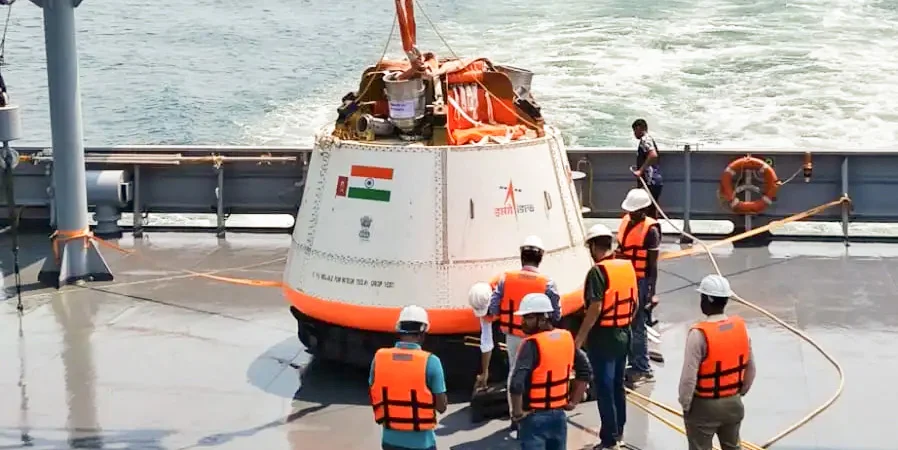
NEW DELHI: India’s human spaceflight programme took another measured step this month as ISRO put the Gaganyaan crew module’s main parachutes through a set of qualification tests, recreating a range of real-world conditions to prove the deceleration system that will bring the capsule safely home. The work clears one more gate ahead of Gaganyaan-1, the first uncrewed test flight, targeted for the second half of 2026.
The maiden flight will carry no astronaut. Instead, the human-rated LVM3 rocket will lift the crew module and the humanoid robot Vyommitra from the Satish Dhawan Space Centre at Sriharikota, gathering data on every system a future crew will depend on. It builds on an April air-drop test, when an Indian Air Force Chinook released the crew module from about three kilometres over the Bay of Bengal to validate its descent and recovery.
Step by step: Parachute qualification and an earlier air-drop test move Gaganyaan toward an uncrewed flight in H2 2026.
Human spaceflight is earned in small, deliberate tests — each parachute drop and system check is a quiet down-payment on the day an Indian crew flies.
At a Glance
- Test: Main-parachute qualification for Gaganyaan-1
- First flight: Uncrewed, targeted H2 2026; carries robot Vyommitra
- Rocket / site: Human-rated LVM3 from Sriharikota
- Roadmap: Two uncrewed missions in 2026; crewed flight in 2027
The honest note is that human-rating a launch system is unforgiving work: every abort mode, parachute and life-support loop must be proven and re-proven, and schedules rightly bend to safety rather than the calendar. ISRO has kept a deliberately staged path — test articles, drop tests and uncrewed flights before any crew leaves the pad.
The constructive read is that India is building its spaceflight capability the durable way, milestone by milestone, with a widening base of private suppliers alongside. Each cleared test brings a home-grown crewed mission — and the industry and skills around it — closer to reality.