Blitz Bureau
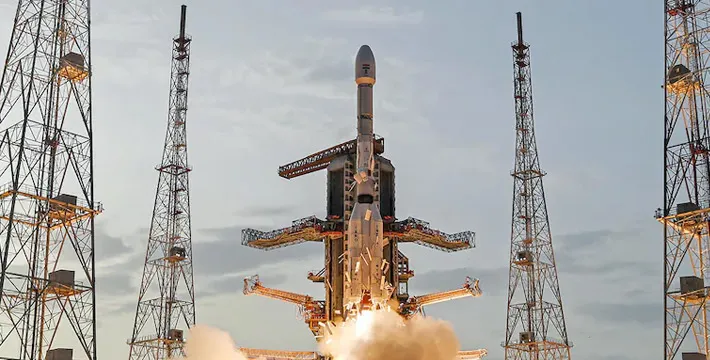
NEW DELHI: ISRO Chairman V. Narayanan has laid out a flight manifest that would make this one of the busiest years in the agency’s history: seven launches across the current financial year, with the next mission expected within roughly two months. The manifest is deliberately mixed — earth-observation satellites that watch monsoons, coastlines and farmland; communication spacecraft; technology demonstrators; and the precursor flights tied to Gaganyaan, India’s human spaceflight programme. It is the kind of calendar that tests an agency’s industrial capacity rather than its engineering ambition.
That distinction matters more than it sounds. A space agency’s constraint is rarely whether it can build a particular rocket; it is whether it can build, integrate, test and fly several of them concurrently while a separate team qualifies a crewed vehicle. Seven launches in a financial year means launch-pad turnaround, component supply chains and test facilities all running near capacity at once — and it arrives at a moment when India’s private space sector is beginning to take some of that load, a fortnight after a Hyderabad start-up put the country into the small club of nations with a privately built rocket in orbit.
Cadence is the hard part: seven launches in a financial year is less a test of engineering than of industrial throughput — pads, supply chains and test facilities running near capacity together.
Any agency can fly a rocket. Flying seven in a year, while qualifying a vehicle meant to carry people, is a different discipline entirely.
At a Glance
• Target: seven ISRO missions in the current financial year
• Next flight: expected within about two months of the July announcement
• Mix: earth observation, communications, technology demonstrators, Gaganyaan precursors
• Gaganyaan: three major crew-module qualification tests completed in July 2026
• Timeline signalled: uncrewed test flights in 2027, crewed missions from 2028
On the human spaceflight side, ISRO reported completing three major qualification tests for the Gaganyaan crew module in July, and officials have since indicated that test flights are expected in 2027 with crewed missions following in 2028. Schedule movement on a crewed programme is normal rather than remarkable — every country that has flown humans has revised its dates, usually more than once — and the qualification sequence is precisely where that revision should happen. A crew module that fails a test on the ground is a programme working correctly.
The most valuable output of a crowded manifest is not any single satellite but the earth-observation capability the year adds. Spacecraft that monitor monsoon systems, coastal change and cropping patterns feed directly into the forecasting, insurance and disaster-response systems on which tens of millions of Indian livelihoods depend — a point with particular force in a year the IMD has forecast below-normal July rainfall. The constructive way to judge this manifest, therefore, is not by launch count but by how quickly the data from those satellites reaches the agricultural extension officer, the district collector and the fisherman with a phone. India’s space programme has always been unusual in being justified by its downstream uses. Seven launches is the input; what those launches make possible on the ground is the result worth counting.