Blitz Bureau
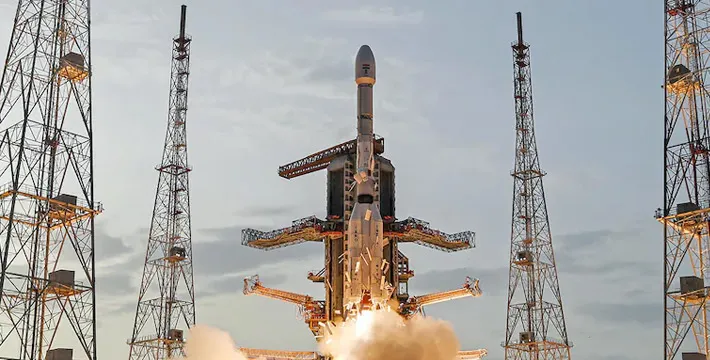
NEW DELHI: Space agencies are judged on spectacular missions and sustained by unspectacular ones. ISRO is targeting seven missions across the current financial year — the busiest launch calendar in its history — and the significance is less in any single flight than in the rhythm. Cadence is what separates a national research programme from a working launch industry, because customers, satellite builders and downstream firms can only plan around a schedule they believe will hold.
The manifest is deliberately mixed: earth-observation satellites that watch monsoons, coastlines and farmland; communication spacecraft; technology demonstrators; and the precursor flights tied to Gaganyaan, India’s human spaceflight programme. The year opened with PSLV-C62 carrying the Anvesha satellite from Sriharikota. On the crewed side, ISRO reported completing three major qualification tests for the Gaganyaan crew module in July, covering systems including water recovery and module separation — the transitions on which a crew’s survival depends and which must be demonstrated repeatedly before any human flies.
Rhythm over spectacle: Seven missions are targeted this financial year, spanning earth observation, communications and technology demonstration, alongside the qualification campaign for Gaganyaan.
The measure of a mature space programme is not how high it can reach once. It is how often it can reach at all, on a date it announced in advance.
At a Glance
• Target: seven missions across the current financial year — ISRO’s highest planned cadence
• Mix: earth observation, communications, technology demonstration, Gaganyaan precursors
• Gaganyaan: three major crew-module qualification tests completed in July, incl. water recovery and module separation
• Technologies on show: travelling-wave tube amplifiers, quantum key distribution, high-thrust electric propulsion
The technologies ISRO is bringing forward this year are as consequential as the flight count. Travelling-wave tube amplifiers built in India reduce dependence on a small number of foreign suppliers for a component every communication satellite needs. Quantum key distribution points at satellite links that cannot be quietly intercepted. High-thrust electric propulsion lets a spacecraft carry less fuel and more payload, and stay useful for longer — which changes the commercial arithmetic of every geostationary mission India might bid for. These are supplier-industry capabilities, and they matter most to the private space firms now growing around the agency.
The realistic caution is that cadence is hard, and slippage is normal rather than shameful: a mission delayed because a test bay found a problem is a mission that did its job. The constructive path is to keep the schedule ambitious but publicly honest, to keep expanding the private industrial base that builds subsystems so ISRO’s own engineers are freed for the difficult end of the problem, and to keep launch infrastructure investment ahead of demand rather than behind it. India has already proved it can do the extraordinary thing occasionally. Doing the ordinary thing reliably, seven times a year, is the harder and more valuable ambition.