For six years the Indian space programme has been reorganising itself in public, and for six years a question has trailed the reorganisation without ever being answered by the organisation at the centre of it. On 6 September 2026 it was answered. In a statement titled “ISRO’s Next Chapter: Leading India’s National Space Ecosystem”, issued on 6 September 2026 and posted on isro.gov.in, the Indian Space Research Organisation said that reports suggesting it was being privatised or diminished were “completely baseless and incorrect”, and that it “will neither be privatised nor will its importance be diminished”.
What is worth reading twice is not the denial but the division of labour the statement then sets out, because it is the first time the agency has described the split in its own words rather than a ministry’s. Mature and routinely manufactured systems — the production of proven launch vehicles, of routine satellites, of established subsystems — “can increasingly be undertaken by industry or PSUs through appropriate competitive processes”, the statement says. What ISRO keeps is the part that cannot be bought: frontier research and development, human spaceflight, next-generation launch systems, deep-space and planetary missions, and strategic national capabilities.
The agency also disposes of a confusion that has muddled a great deal of commentary. “Transferring a mature technology does not mean ISRO is withdrawing from that domain,” the statement says. A technology transfer is a manufacturing decision, not an exit.
Why now, and why it matters
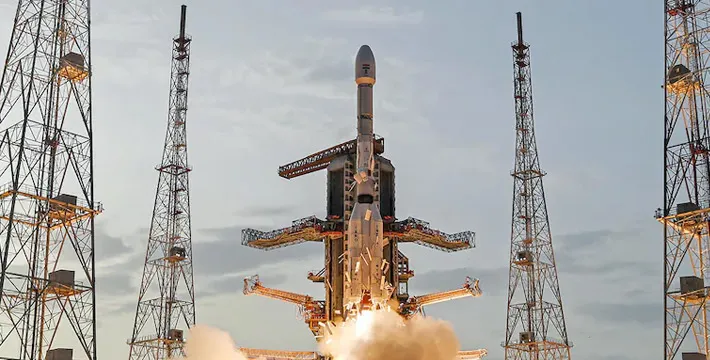
The timing is not accidental, and the statement itself supplies the reason. It places the whole transition inside Space Vision 2047 — the Bharatiya Antariksh Station by 2035, an Indian crewed mission to the Moon by 2040, next-generation and reusable launch systems, sustained lunar and planetary exploration. Those are not programmes a single agency can run while also stamping out routine communication satellites. Something had to be handed over for the rest to be reachable at all.
The scaffolding for the handover already exists. The reforms began in 2020 and were institutionalised through the Indian Space Policy 2023, alongside a progressive liberalisation of foreign direct investment in the sector, and the statement identifies all three as the frame. Since then the numbers have moved. Replying to a starred question in the Rajya Sabha on 29 January 2026, the Minister of State for Space, Dr Jitendra Singh, told the House that India’s space economy stands at an estimated $8.4 billion with 399 start-ups operating across launch vehicles, satellites, propulsion systems and space-grade electronics, and that it is expected to grow four to five times over the next eight to ten years to between $40 billion and $45 billion.
The money to carry that has been put in place. Addressing the 10th IN-SPACe Industry Connect on 11 June 2026, the same minister said a ₹1,000 crore Venture Capital Fund and a ₹500 crore Technology Adoption Fund had been introduced to support innovation and commercialisation in the sector, alongside seed funding, incubation support and an AICTE-approved space technology curriculum. The Indian National Space Promotion and Authorisation Centre, IN-SPACe, is the single window through which a private firm reaches ISRO.
What India gains
An engineer at the Vikram Sarabhai Space Centre who has spent a decade on a launch vehicle that now flies reliably is a person whose most valuable years are being spent on a solved problem. Every mature system that moves to industry is a team returned to an unsolved one. That is the whole of the argument, and it is a good one. The gain for India is not a bigger private sector for its own sake; it is a space agency that can afford to attempt a crewed lunar mission because it is no longer the only organisation in the country able to build a satellite.
There is a second gain, quieter and further off. A country whose space industry can manufacture at scale is a country that can sell launches, satellites and ground systems to others. India has been a low-cost launch provider for two decades on ISRO’s capacity alone. On industry’s capacity it becomes something else — a supplier, not a service.
THE RECORD
India’s space economy: $8.4 billion, estimate stated in the Rajya Sabha, 29 January 2026
Space start-ups operating: 399 (same reply)
Projection: four to five times in eight to ten years, to $40–45 billion
Venture Capital Fund: ₹1,000 crore · Technology Adoption Fund: ₹500 crore (11 June 2026)
Foreign satellites launched by ISRO in all: 434 · of these, after 2014: 399
Revenue earned from those launches: about €323 million and $233 million
Bharatiya Antariksh Station: target 2035 · Indian crewed lunar mission: target 2040
THE COMPARISON — foreign satellites launched by ISRO
Up to 2014 ██▌ 35
After 2014 ████████████████████████████ 399
BLITZ CALCULATION — derived here, absent from both releases
434 − 399 = 35 foreign satellites launched up to 2014. So 91.9 per cent of every foreign satellite ISRO has ever launched went up after 2014. Difference between the two periods: +1,040 per cent.
$8.4 bn to $40–45 bn is 4.76 to 5.36 times, a rise of 376 to 436 per cent — and the two funds announced against it total ₹1,500 crore.
Years between the Bharatiya Antariksh Station (2035) and the crewed lunar mission (2040): five — the interval in which the station has to prove itself before it carries the Moon programme.
WHAT INDIA GAINS
A space agency freed to attempt what only a space agency can attempt, and an industry large enough to sell India’s launch and satellite capacity to the world rather than merely supply it at home.