Blitz Bureau
NEW DELHI: The 2026 Commonwealth Games closed in Glasgow on Sunday, and the arithmetic of India’s campaign is more interesting than its rank. Fourth place with 39 medals is the headline. The distribution behind the 39 is the story — and it is the distribution, not the total, that the Union Cabinet has just spent ₹36,441 crore attempting to change. India’s 39 medals broke down as 13 gold, 17 silver and nine bronze. Boxing produced 10 of them, seven of those gold — the largest boxing gold haul by any nation at a single Commonwealth Games. The para campaign, run inside the same Games, returned seven medals: three gold, two silver, two bronze. That single week matched India’s combined para tally from every previous edition of the Commonwealth Games put together.
Concentration of that order is a compliment and a warning at the same time. A country that wins seven golds in one sport has clearly built something in that sport — a coaching pipeline, a competition calendar, a selection system that works. A country in which one sport supplies more than half the gold medals has also revealed how narrow the base beneath the podium is. The gap between fourth place and the three nations above it is not made up by winning more boxing bouts; it is made up by having three or four other disciplines capable of doing what boxing did. That is a fifteen-year construction project, not a selection decision, and it is precisely the problem the revamped Khelo India scheme has been sized to address.
The base, not the podium: a medal table records what a sporting system built a decade ago. The money approved this week is aimed at the athletes who will compete in Amdavad in 2030 and, if the bid succeeds, in 2036.
Seven boxing golds tell you India can build a world-class sporting pipeline. Seven boxing golds out of thirteen tell you how few pipelines there are.
At a Glance
• India at Glasgow 2026: fourth on the medal table — 13 gold, 17 silver, nine bronze; 39 in total
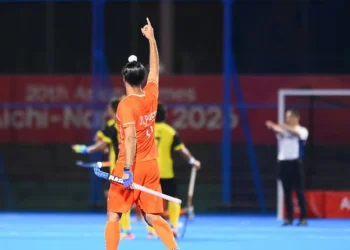
• Boxing: 10 medals including seven golds — the most golds won by any nation in the sport at a single Commonwealth Games
• Para campaign: seven medals (three gold, two silver, two bronze) — equal to India’s combined total from all previous editions
• Games dates: July 23 to August 2, 2026, in Glasgow
• Cabinet decision: revamped Khelo India scheme plus enhanced Assistance to National Sports Federations — ₹36,441 crore for 2026-27 to 2030-31
• Of which Khelo India: ₹29,054 crore, directed at building a talent pool at the grassroots
• Next home Games: Amdavad hosts the 2030 Centenary Commonwealth Games — 15 to 17 sports confirmed, India’s first since Delhi 2010
What the Cabinet has actually approved repays a closer reading than the headline number. Of the ₹36,441 crore, ₹29,054 crore goes to Khelo India itself — the grassroots identification and training programme — with the balance strengthening assistance to national sports federations, the bodies that run selection, coaching and international exposure sport by sport. The split is the policy. Money at the base widens the funnel; money at the federation level determines whether a talented fifteen-year-old in a district centre ever gets to a competition that tests her. India’s boxing result is the clearest available evidence that the second half matters as much as the first: boxing has had continuity of coaching, a dense domestic competition calendar and a federation that sends athletes abroad. That is why it delivered ten medals while several better-funded, higher-profile disciplines delivered none.
The deadline is unusually concrete. Amdavad hosts the Centenary Commonwealth Games in 2030 — only the second Games held in India, after Delhi 2010 — with 15 to 17 sports confirmed, among them athletics and para athletics, swimming and para swimming, table tennis, bowls, weightlifting and para powerlifting, artistic gymnastics, netball and boxing. An athlete who will win a medal in Amdavad is today between fourteen and twenty years old and is already in a school, an academy or a district centre somewhere. The constructive test of this week’s ₹36,441 crore is not whether it is spent, but whether, four years from now, the medal table shows India’s total rising because three new sports have started producing — not because boxing produced even more. On present evidence that is achievable, and the money has arrived early enough to matter.