NEW DELHI: Defence Minister Rajnath Singh will make an official visit to Sri Lanka from 8 to 10 September 2026, according to the Ministry of Defence’s release of 6 September 2026, leading a delegation of senior officials from the Ministry of Defence and the Ministry of External Affairs. He will hold consultations with the Sri Lankan leadership and meet the Indian community in Colombo.
Why: The visit begins on 8 September. There is no event photograph of 6 or 7 September 2026 to run, and CIR/02 bars an older frame, or an office exterior standing in for an event.
The ministry places the visit inside two frames: the Neighbourhood First policy, and MAHASAGAR — Mutual and Holistic Advancement for Security and Growth Across Regions. It recalls that India was among the first responders after Cyclone Ditwah struck Sri Lanka in 2025, and that India assisted the island through its economic crisis. What India gains from a defence minister landing in Colombo is straightforward and maritime: the sea lanes that carry India’s trade run past Sri Lanka, and a defence relationship is the least expensive way to keep them uncontested.
Sarang takes the Dhruv to Egypt
NEW DELHI: The Indian Air Force’s Sarang Helicopter Display Team has reached Egypt for the second edition of the El Alamein International Airshow, to be held from 8 to 10 September 2026 at El Alamein International Airport, the Ministry of Defence said in its release of 6 September 2026.
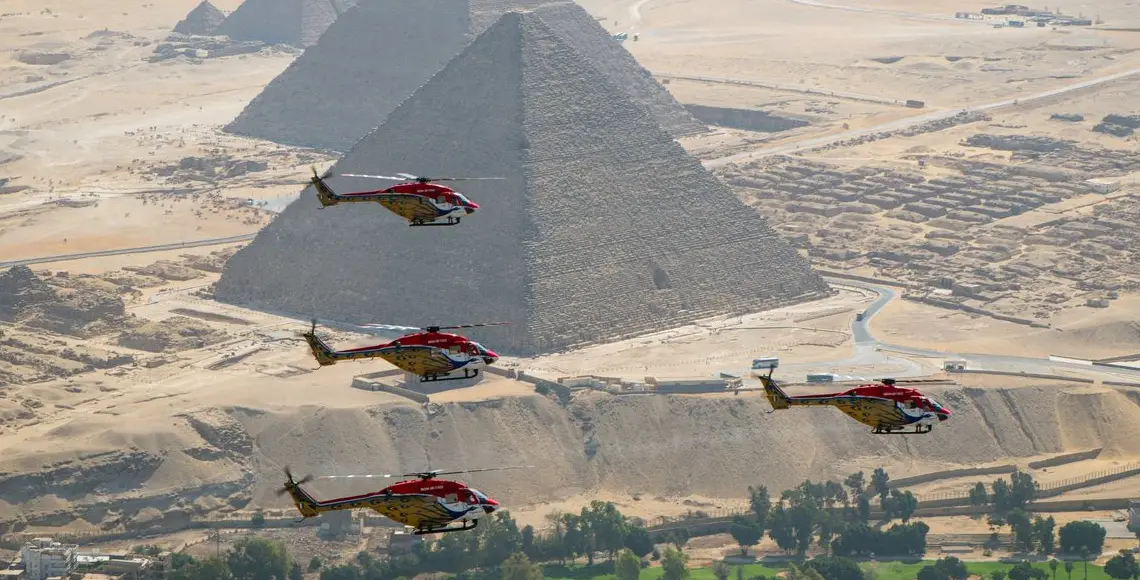
Sarang is the world’s only five-helicopter display team, and it flies the Advanced Light Helicopter Dhruv — designed and built in India. That is the point of the trip. The team will fly its “Dolphin Leap” and a new manoeuvre called the Spot Stall Turn. The audience at El Alamein is not primarily a crowd; it is the world’s air forces and the aerospace and defence industry, and what they are watching is an Indian airframe holding a five-ship formation at close proximity. India gains a demonstration no brochure can substitute — and it gains it in Egypt, at a moment when defence and diplomatic ties between the two countries are deepening.
Luxembourg’s deputy premier arrives in Delhi
NEW DELHI: Xavier Bettel, Deputy Prime Minister and Minister for Foreign Affairs and Foreign Trade of the Grand Duchy of Luxembourg, is in India from 7 to 9 September 2026. He is scheduled to meet External Affairs Minister Dr S. Jaishankar at Hyderabad House on 7 September, and on 8 September travels to Chennai to visit the IIT Madras campus, tour the IITM Research Park, and inaugurate a new SES campus.
Why: At the hour of filing the delegation-level talks had not taken place. There is no photograph of the 7 September meeting, and CIR/02 bars an older frame of either minister standing in for it.
Where to look before this is settled again: The PIB Photo Gallery for 7 September 2026; mea.gov.in photo gallery; the Embassy of Luxembourg in New Delhi.
The itinerary is the story. A foreign minister who spends his second day at an engineering campus and a research park rather than in a chancellery is signalling where his country thinks the relationship is going. Luxembourg is a financial centre of the first rank — the Ministry of External Affairs’ India-Luxembourg bilateral brief, in the edition dated September 2022, records over 250 Indian issuers on the Luxembourg Stock Exchange and the first dual listing of State Bank of India’s $650 million green bonds there in November 2021.
The second half of the itinerary points elsewhere. SES is a satellite operator; IIT Madras Research Park is where Indian deep-tech companies are incubated. Space and finance are the two things Luxembourg has that India wants at scale, and India has the engineers and the launch capacity Luxembourg does not. What India gains from three days is not a communiqué — it is access to European capital markets on terms an Indian issuer can use, and a partner in orbit.
Border villages: 1,248 projects sanctioned
The Ministry of Home Affairs had sanctioned 1,248 projects worth ₹3,020.32 crore under the Vibrant Villages Programme as of July 2026, with a further 1,655 projects sanctioned by central ministries, according to the PIB backgrounder on the programme issued on 6 September 2026.
Why: A programme backgrounder has no event of its own date to photograph. The illustrations carried on the PIB page are undated composites, which CIR/02 does not allow.
The arithmetic in that backgrounder repays a careful reading, because it says something the prose does not. Phase one carries ₹4,800 crore for 662 villages along the northern border, covering a population of about 1.42 lakh.
Phase two, approved by the Union Cabinet on 2 April 2025 and launched at Nathanpur in Assam’s Cachar district on 20 February 2026, carries ₹6,839 crore for 1,954 villages across the rest of the land frontier. Blitz checked both sets of legs against the published totals: 4,800 and 6,839 sum exactly to the stated ₹11,639 crore, and 662 and 1,954 sum exactly to the stated 2,616 villages. The account holds.
Divide, and the design of the programme becomes visible. Phase one commits ₹7.25 crore a village; phase two commits ₹3.50 crore. Phase one is roughly twice as intensive per village — which is what a programme does when it is building all-weather road into the Himalaya rather than extending a network that already reaches the plain. Of phase one’s ₹4,800 crore, ₹2,500 crore, or 52.08 per cent, was earmarked for road connectivity alone.
Then divide again, and the figure that stays with you appears. Phase one’s 662 villages hold about 1.42 lakh people — an average of 215 residents a village. The outlay works out at about ₹3.38 lakh for every person living there.
There is no other public programme in India that spends at that rate per head, and the backgrounder explains why without quite saying it: on 3 May 1999 the first report of intrusion in the Kargil sector came not from a radar or a patrol but from local residents.
India shares more than 15,000 km of land border with seven countries — 4,096.7 km with Bangladesh, 3,488 km with China, 3,323 km with Pakistan. The programme’s phrase for these settlements is that they are not the country’s last villages but its first. What India gains is a frontier that is inhabited, and an inhabited frontier is the cheapest security India will ever buy.
BLITZ DATA CARD
THE RECORD
Combined outlay, VVP-I and VVP-II: ₹11,639 crore
VVP-I: ₹4,800 crore · 662 villages · population about 1.42 lakh · FY 2022-23 to 2026-27
VVP-II: ₹6,839 crore · 1,954 villages · 334 blocks · 15 States and 2 UTs · to FY 2028-29
Sanctioned by MHA as of July 2026: 1,248 projects, ₹3,020.32 crore
Sanctioned by central ministries: a further 1,655 projects
India’s international land border: over 15,000 km with seven countries
THE COMPARISON — outlay per village
VVP-I ████████████████████ ₹7.25 crore
VVP-II █████████▌ ₹3.50 crore
BLITZ CALCULATION — derived here, absent from the release
₹4,800 cr ÷ 662 villages = ₹7.25 crore a village. ₹6,839 cr ÷ 1,954 villages = ₹3.50 crore a village. Difference: −51.7 per cent per village between phase one and phase two.
₹4,800 crore ÷ 1,42,000 residents = ₹3.38 lakh per resident of a phase-one village.
₹3,020.32 cr ÷ ₹4,800 cr = 62.92 per cent of the phase-one outlay committed by MHA as of July 2026.
Leg-sum check, and it holds: 4,800 + 6,839 = 11,639 ✓ · 662 + 1,954 = 2,616 ✓
WHAT INDIA GAINS
A land frontier that people stay on. Border residents are the first to see what crosses it, and a village that has a road, a signal and a livelihood is a village that still has people in it to look.
A national workshop on saving vultures
Panchkula: Union Environment Minister Bhupender Yadav inaugurated a national workshop on the theme “From Crisis to Recovery — Conserving India’s Vultures” at Panchkula, Haryana, on 6 September 2026, marking International Vulture Awareness Day, according to the Ministry of Environment, Forest and Climate Change’s release of that date.
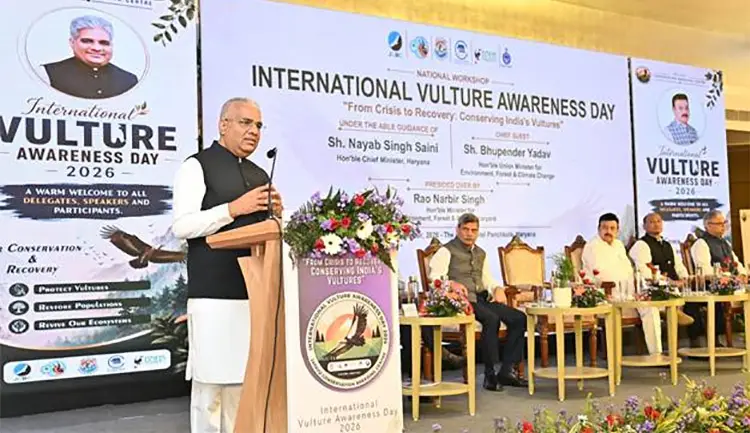
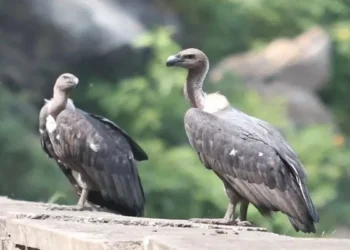
The ministry’s release names nine vulture species found in India, resident and migratory — the White-rumped, Long-billed, Slender-billed, Red-headed, Egyptian, Himalayan Griffon, Eurasian Griffon, Cinereous and Bearded. The minister described the birds as nature’s own cleaning system: by consuming carcasses quickly they recycle nutrients and interrupt the disease pathways that follow a carcass left to rot. He attributed the sharp decline in numbers since the 1990s to a break in the food chain, chiefly the veterinary painkillers that reached vultures through the cattle they fed on, and called for the continued creation of Vulture Safe Zones and for the technical capacity to support recovery in the wild.
The event was organised with the Central Zoo Authority, the Haryana Forest and Wildlife Department, the Bombay Natural History Society and the Jatayu Conservation Breeding Centre at Pinjore. India gains something narrower and more practical than sentiment here: a scavenger that clears carcasses at no cost is public sanitation the exchequer does not pay for, and its loss is a bill that lands on someone.
Bring industry in on Day One: Jitendra
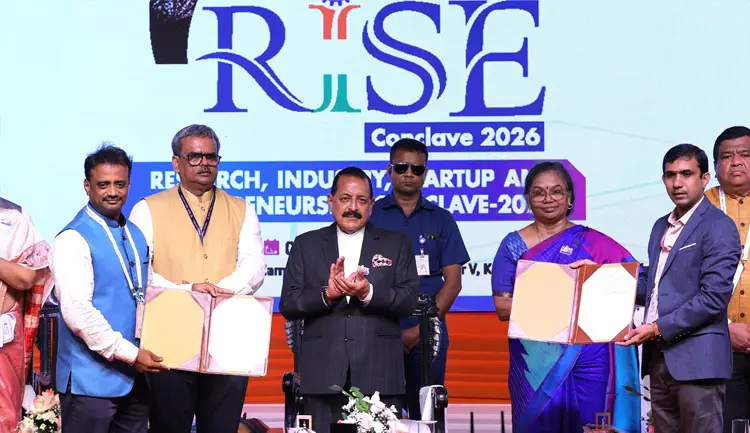
Kolkata: “The commercial arm should be in association with the lab right from day one.” With that sentence, at the 6th RISE Conclave at CSIR-IICB in Kolkata on 6 September 2026, Dr Jitendra Singh, Minister of State (Independent Charge) for Science and Technology and Earth Sciences, proposed a change in how Indian laboratories and Indian industry are supposed to meet, according to two releases of the Ministry of Science and Technology issued that day.
The point he was making is more specific than the usual call for collaboration, and it is worth setting out precisely. The Indian model has been to develop a technology in a laboratory and then look for a licensee. What the minister proposed is that the commercial partner be identified at the project-planning stage, so that market dynamics, design, environmental sustainability, supply-chain requirements and commercial viability shape the technology while it is still being built — rather than a technology reaching the market and only then discovering it must be modified to meet what a user actually needs.
What industry brought to the room in return is the more interesting half. Critical minerals dominated: rare-earth extraction, permanent magnets, recycling, lithium beneficiation, and the recovery of vanadium and titanium. Companies asked CSIR laboratories for technological hand-holding to scale these, and the discussion extended to exploration for rare earths in eastern India. The minister also proposed a common research facility for the foundry sector, with industry articulating the requirement and the government providing the platform.
The conclave itself produced eight memoranda of understanding, four technology transfers, two product launches and one facility inauguration, with 67 experts across eight panels covering healthcare, manufacturing, advanced materials, critical minerals, decarbonisation and science-driven start-ups. Four CSIR laboratories showed capability across minerals, medicine, materials and machines.
Dr Singh also made an argument about geography that deserves more attention than it will get. More than 50 to 60 per cent of India’s start-ups, he said, do not belong to the metros; young innovators from smaller cities are matching and in several cases exceeding their counterparts in the large ones. His conclusion was that scientific institutions must reach out to them rather than expect them to travel to established technology hubs — which is, in one sentence, an argument for holding the country’s science conclaves in Kolkata rather than always in Bengaluru.
What India gains: a shorter distance between a laboratory result and a factory, and a critical-minerals capability built at home rather than imported at whatever the world price turns out to be.
A suggestion, offered only to help the work move faster: the four technology transfers signed at Kolkata would be more useful to the next set of firms if CSIR published, alongside each, the stage of readiness at which the transfer happened. A company deciding whether to take a laboratory technology needs to know how far from a factory it starts.
Nagaland’s audit reaches the House
Kohima : The Comptroller and Auditor General of India’s State Finances Audit Report on the Government of Nagaland for the year 2024-25, Report No. 2 of 2026, was tabled in the State Legislature on 3 September 2026, having been sent to the State Government on 11 March 2026.
The report opens on a number that is easy to miss. Nagaland’s gross state domestic product grew 9.39 per cent in 2024-25 over the previous year, the auditor records — growth that would be noticed anywhere. The State’s own revenue performance improved, with higher tax collections, notably from the goods and services tax, and higher devolution of central taxes. Non-tax revenue also rose.
What the auditor then examines is the shape of the spending rather than its size, and here the report is careful and specific. Committed costs and subsidies — salaries, pensions, interest, the obligations a State cannot decline — accounted for 75.01 per cent of revenue expenditure, 60.99 per cent of total expenditure and 71.50 per cent of revenue receipts in 2024-25. Capital expenditure, the auditor notes, remained volatile and below budgeted levels.
Those three percentages allow a fourth to be worked out, and Blitz has worked it here. If committed costs are 60.99 per cent of total expenditure and 71.50 per cent of revenue receipts, then revenue receipts equal 85.30 per cent of total expenditure — which is to say the State spends about ₹1.17 for every ₹1 it receives as revenue. That single ratio is the report’s argument in one line, and it explains why the auditor writes that there is limited fiscal space for capital investment.
The report also records what has gone right, and the CAG says so plainly. It notes as positive steps the implementation of the Single Nodal Agency mechanism and SNA-SPARSH for tracking funds in centrally sponsored schemes — the systems that let a rupee released in Delhi be followed to the district that spends it. It flags delays in the submission of utilisation certificates, some outstanding from 2011-12, and the substantial use of Minor Head 800 — “Other Receipts / Expenditure” — which reduces the transparency of financial reporting.
The auditor’s own recommendations are the point of the exercise: augment revenue, control expenditure, and undertake structural reform to secure long-term fiscal health. Nagaland contributed 0.14 per cent of India’s gross domestic product in the year under review — a small State whose fiscal architecture is, for that reason, unusually legible. What is learnt from it is transferable, and the CAG’s remedies are addressed to a system, not to a person.
A suggestion, offered only to help the work move faster: the utilisation certificates outstanding from 2011-12 are the oldest item on the auditor’s list and the least contested. A State-level drive to close the pre-2015 backlog alone would clear the longest-standing observation in the report and would cost nothing but clerical time.
BLITZ DATA CARD
THE RECORD
Report: CAG of India, State Finances Audit Report, Government of Nagaland, Report No. 2 of 2026
Year audited: 2024-25 · Sent to Government: 11 March 2026 · Tabled: 3 September 2026
GSDP growth in 2024-25: 9.39 per cent
Nagaland’s share of India’s GDP: 0.14 per cent
Committed costs and subsidies: 75.01% of revenue expenditure · 60.99% of total expenditure · 71.50% of revenue receipts
Undischarged liabilities carried forward: ₹26.43 crore (0.14% of total expenditure)
THE COMPARISON — committed costs and subsidies, as a share of
Revenue expenditure ███████████████ 75.01%
Revenue receipts ██████████████▎ 71.50%
Total expenditure ████████████▏ 60.99%
BLITZ CALCULATION — derived here, not stated in the report
60.99 ÷ 71.50 = 0.8530. Revenue receipts are 85.30 per cent of total expenditure — the State spends about ₹1.17 for every ₹1 of revenue receipt. Difference between the two committed-cost ratios: 10.51 percentage points.
WHAT INDIA GAINS
A published, independent reading of a State’s books within six months of the year closing, and a set of remedies any State facing the same arithmetic can pick up without commissioning its own study.