



Blitz Bureau
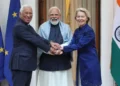
NEW DELHI: THE formal announcement of the India-European Union Free Trade Agreement by Prime Minister Narendra Modi and top EU leaders, in New Delhi on January 27, marks a watershed moment in India’s external economic engagement. After nearly two decades of negotiations and a decisive re-launch in 2022, the FTA‘s finalisation signals a strategic alignment shaped by a rapidly fragmenting global order. India’s Commerce Minister Piyush Goyal and European Commissioner for Trade and Economic Security Maroš Šefčovič on January 27 signed the joint announcement on the conclusion of the negotiations on the FTA, in the presence of PM Modi and European Commission President Ursula von der Leyen, as well as President of the European Council António Costa.
The conclusion of the India-EU Free Trade Agreement marks a significant milestone in India-EU relations, said Prime Minister Narendra Modi. He noted that this agreement will deepen economic ties, create opportunities for people and strengthen the IndiaEurope partnership for a prosperous future. “We have delivered the mother of all deals,” said European Commission President Leyen in her statement. “We are creating a market of 2 billion people. This is a tale of two giants – the world’s second- and fourth-largest economies. Two giants who choose partnership in a true win-win fashion. A strong message that cooperation is the best answer to global challenges.”
For Indian exporters, the FTA promises deeper access to a 450-millionstrong affluent market
The numbers justify the rhetoric. The EU is India’s one of the largest trading partners, with bilateral trade in goods and services growing steadily over the years. The FTA is expected to significantly expand this footprint by slashing tariffs, easing regulatory barriers and opening new avenues in services, digital trade and green technologies. For Indian exporters – particularly in pharmaceuticals, textiles, engineering goods, chemicals and IT services – the deal promises deeper access to a 450-million-strong affluent market. European companies, in turn, gain greater entry into one of the world’s fastest-growing major economies.
Crucially, the agreement goes beyond conventional tariff liberalisation. It addresses investment protection, intellectual property, sustainable development and supply-chain resilience. EU leaders have emphasised that the pact sets “high but balanced standards” on labour and environmental issues, while recognising India’s development priorities. As Leyen noted, “This agreement respects our values while acknowledging different starting points.”
For India, the FTA represents a calibrated shift in trade policy. After years of caution and its decision to stay out of the Regional Comprehensive Economic Partnership (RCEP), New Delhi has increasingly embraced selective but ambitious trade deals. The EU agreement builds on the recent FTAs with the UAE, Australia and the UK, but is far more comprehensive in scope. Officials have stressed that India has protected sensitive sectors such as agriculture and dairy, while securing gains in services and professional mobility. The strategic subtext is hard to miss. In a world shaken by geopolitical rivalry, supply-chain shocks and protectionist instincts, both sides see value in ‘de-risking’ and diversifying away from excessive dependence on China.
Challenges, of course, will remain in implementation, regulatory alignment and dispute resolution. But the political commitment at the highest level gives the agreement an uncommon momentum. More than just a trade pact, the India-EU Free Trade Agreement is a statement of intent – that two major democracies can shape rules, not just react to them. In an era of global churn, that may be its most enduring significance.