Giriraj Singh Union Minister of Textiles
NEW DELHI: When we speak of an Aatmanirbhar Bharat, we are not just speaking of self-reliance in production but of leadership in global value chains. Few sectors capture this opportunity as clearly as footwear. It is one of the most universal products in daily life used by a school student walking to class, a worker standing through long shifts, a delivery partner constantly on the move and an athlete pushing physical limits. Yet despite being the world’s second largest producer, India holds only a marginal share in global footwear exports.
The gap is not due to lack of capacity but due to the need for a shift towards materials design and performance. At the centre of this shift lies a category that often goes unnoticed – technical textiles. I began to understand this more clearly during a recent visit to Agra. Agra is known for its footwear industry. Walking through its production clusters and interacting with manufacturers, it became evident that innovation was already underway. Several units were using materials that improved comfort, durability and flexibility. Yet many of them did not describe these as technical textiles, they simply saw them as better inputs that met evolving consumer needs.
This insight deepened during a subsequent meeting in Delhi with the footwear association. Industry stakeholders spoke about changing consumer expectations: lighter shoes, better cushioning, improved breathability, and longer durability. These were no longer premium features but were becoming standard requirements. It was in this discussion that my department highlighted a critical point: the footwear industry is already using technical textiles extensively even without formally recognising it.
That realisation reframed the entire conversation. Globally the footwear industry produces nearly 23.9 billion pairs annually with a market size of around $500 billion. India contributes about 12.5 per cent of global production, yet its export share remains at only 2 per cent which highlights a clear gap between capacity and global positioning. At the same time, nearly 86 per cent of global footwear is non-leather while India’s industry has historically been centred around leather.
At home, the story is evolving rapidly. The Indian footwear market reached a size of $20.67 billion in 2025 reflecting rising incomes and changing consumption patterns. While the average Indian still buys around two pairs of footwear per year compared to 7 to 8 pairs globally. As affordability improves and consumer preferences shift towards comfort and performance, the domestic market is set to expand significantly.
This is where technical textiles become central to the next phase of growth. At the Ministry of Textiles this transition is being approached through the Smart, Sustainable & Seamless framework. Smart footwear reflects the growing integration of technology and design. Digital tools, AI-driven modelling and foot scanning are enabling customised solutions at scale. This aligns with broader consumer trends. In 2025 India recorded 28.9 million smartwatch sales generating $780 million in revenue which indicates a growing preference for products that combine functionality with everyday use.
The sneaker segment further illustrates this shift. It is projected to grow from $3.2 billion in 2024 to nearly $6 billion by 2030 with volumes increasing from 55 million to 70 million pairs. Consumers are clearly moving towards footwear that delivers both comfort and performance and this is where technical textiles play a defining role.
Sustainability is also becoming a decisive factor. Materials such as recycled PET and biodegradable fibres are gradually entering mainstream production. For India this represents not only an environmental imperative but also a strategic opportunity to position itself as a supplier of sustainable materials in global markets.
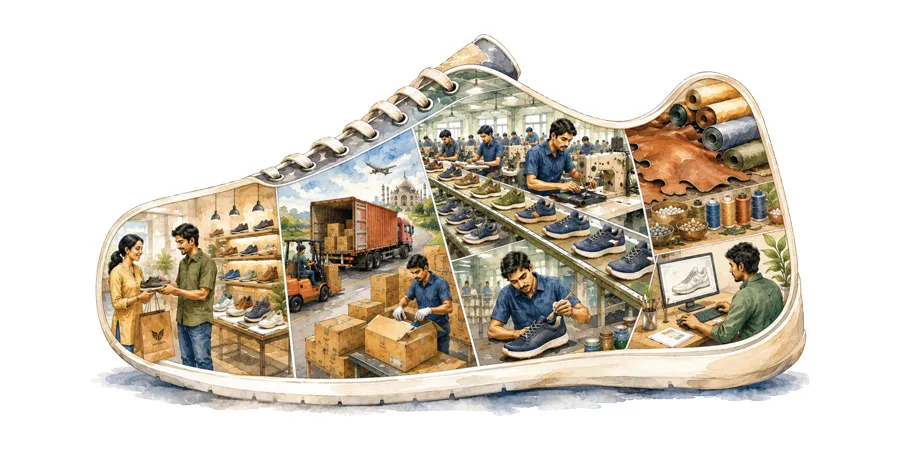
Equally transformative is the move towards seamless manufacturing. Technologies like 3D knitting and advanced fabrication are reducing waste, improving efficiency and enabling faster production cycles. This allows manufacturers to respond more effectively to evolving demand while maintaining consistency and quality.
What strengthens this transition further is the scale of India’s existing ecosystem. The footwear industry already employs over 2 million people with nearly 50 per cent women participation making it a major source of inclusive employment. With an annual production of around 2.9 billion pairs, productivity stands at approximately 4 to 5 pairs per worker per day in India.
In comparison global production reflects a much higher level of efficiency with workers producing approximately 17 to 20 pairs per day. Established clusters in Agra, Kanpur, Chennai, Ranipet, Ambur, and Kolkata are not just production hubs but the foundation on which India can scale efficiency competitiveness and global leadership in footwear.
The shift towards technical textiles is not about building a new industry but about unlocking the full potential of an existing one. The visit to Agra and the discussions in Delhi brought out a simple but powerful insight – technical textiles in footwear are not an emerging concept. They are already embedded in the industry quietly shaping products and processes.
The task ahead is to recognise, organise and scale this integration. Bringing the footwear sector more explicitly within the technical textiles ecosystem can drive innovation, expand exports and create high quality employment. It can also align India’s manufacturing capabilities with global demand trends particularly in non-leather and performance-driven segments.
India’s journey towards becoming a global manufacturing leader will depend on how effectively it leverages such intersections where traditional industries meet advanced materials and modern design. Footwear is one such intersection. Technical textiles are the thread that can help stitch this opportunity into a global success story.
The shift towards technical textiles is not about building a new industry but about unlocking the full potential of an existing one