
Blitz Bureau
California voters have rejected a first-in-the-nation tax on the net worth of billionaires following a contentious ballot fight that generated huge spending by some prominent tech leaders eager to stop their taxes from going up.
The measure’s failure is a win for Democratic leaders who opposed it, including Gov Gavin Newsom, who may run for president in 2028. Critics of the tax, known as Proposition 40, said it would have prompted ultrawealthy taxpayers to leave the state.
Most Californians vote by mail, and any ballot postmarked by Election Day that arrives within a week is counted, meaning it often takes days or even weeks for close races to be settled. The Associated Press determined on November 9 that ‘no’ had received enough votes to win.
The “no” side raised roughly 10 times as much as the “yes” side. Google co-founder Sergey Brin alone dumped more than $100 million into a political action committee working to defeat the measure.
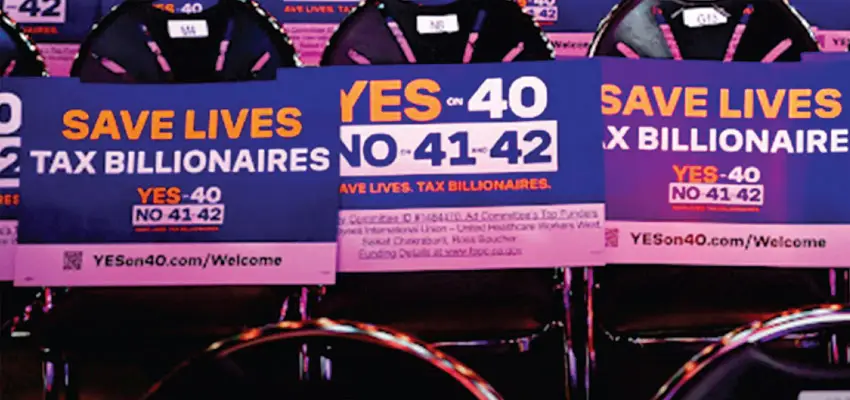
The measure would have imposed a one-time 5 per cent tax on the wealth of Californians whose net worth exceeds $1 billion. Most of the money would have been used to backfill federal funding cuts to healthcare, and 10 per cent would have gone toward education and foodassistance programs. SEIU United Healthcare Workers West, which backed the tax, said it was necessary to replace an estimated $100 billion the state will lose in federal healthcare funding over five years.
Biggest test
Proposition 40 was the nation’s biggest test yet on an idea progressives have long championed: raising taxes on the ultra-rich by targeting the main way they make their money — through their investments as opposed to the paychecks they receive from work.
The measure attracted support from liberal leaders beyond the state, including Vermont Sen. Bernie Sanders, who rallied in cities across California in the race’s closing weeks to urge voters to pass it.
For and against
The AP Voter Poll indicates that the majority of young voters in California — those younger than 30 — voted “yes” on Proposition 40. Older voters were far less supportive, with roughly 7 in 10 voters who were 65 and older saying they voted “no” on the ballot measure.
About half of voters with a household income under $100,000 annually said they were in support of the initiative. Closer to 6 in 10 California voters with an income of $100,000 or higher said they were opposed.