Blitz Bureau
NEW DELHI: The air around the Jind-Sonepat section hummed with a quiet revolution on July 17. As India’s maiden hydrogen-powered train sliced through the tracks, it carried more than just passengers; it carried the aspirations of an Atmanirbhar Bharat. Having seamlessly clocked over 1,200 kilometers during its initial trial phase, this 10-coach marvel had already spared the atmosphere from 3,200 litres of fossilised diesel exhaust, leaving behind nothing more taxing to nature than wisps of clean water vapour.
The hydrogen train generates electricity onboard through a chemical reaction between hydrogen and oxygen. There is no smoke, and no tailpipe carbon emissions, making it the cleanest form of rail propulsion currently available.
The project is an indigenous effort led by Indian Railways. The train has two hydrogen driving power cars deliver 2,400 kW total power, supported by lithium iron phosphate batteries and hydrogen cylinders.
Multiple independent safety systems detect leaks, heat, flames and smoke, backed by automatic shut-off systems, continuous ventilation, international standards and all mandatory validation. Following the successful operation between Jind and Sonipat, trial on the Delhi route will begin soon.
India’s hydrogen fuel cell train is more than a technological achievement. It establishes an indigenous hydrogen rail ecosystem and demonstrates India’s commitment to sustainable, zero-emission rail mobility, paving the way for future expansion and global leadership in clean transportation.
India’s hydrogen fuel cell train is more than a technological achievement. It establishes an indigenous hydrogen rail ecosystem and demonstrates India’s commitment to sustainable, zero-emission rail mobility, paving the way for future expansion and global leadership in clean transportation.
For a nation striving to balance economic expansion with net-zero commitments, this trial points towards a transformative horizon. Yet, beneath the celebratory horn of the hydrogen locomotive lies a complex matrix of physics, economics, global competition, and chemical engineering.
What is it essentially?
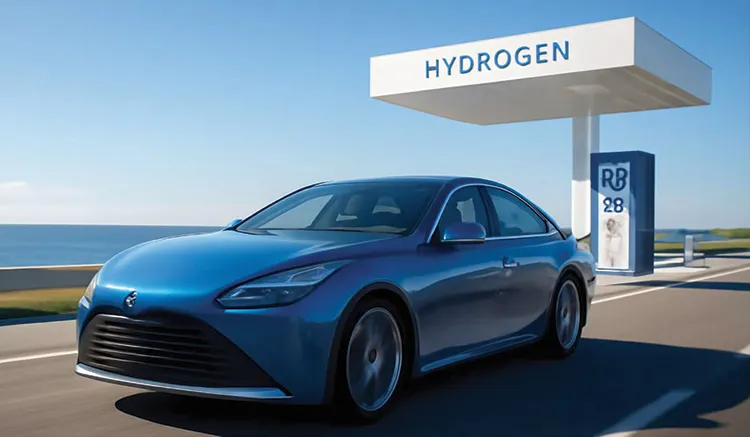
At its core, a hydrogen vehicle — whether a car, bus, or train — is an electric vehicle (EV). However, instead of storing electricity in grid-charged chemical batteries, it carries its own power plant: a hydrogen fuel cell.
Instead of burning the hydrogen in an internal combustion engine (which would create harmful nitrogen oxides), the fuel cell facilitates an electrochemical reaction. This process forces hydrogen atoms to split into protons and electrons. While the protons pass through a membrane, the electrons are forced to travel through an external circuit, generating direct current electricity to spin the traction motors. The only exhaust of process is pure H2O — water vapour.
When colour says a lot
Not all hydrogen is born equal. It is categorised by colour codes depending on its production footprint:
Grey hydrogen: Produced from natural gas via steam reforming, emitting carbon dioxide.
Blue hydrogen: Same as grey, but with carbon capture and storage (CCS) applied.
Green hydrogen: Produced via the electrolysis of water using renewable energy sources (solar, wind), resulting in a zero-carbon footprint.
India’s national roadmap anchors on green hydrogen. Under the National Green Hydrogen Mission, India aims to produce 5 million metric tonne of green hydrogen annually by 2030.
Why is it not the norm already?
If hydrogen promises clean water as exhaust and swift refuelling times, its delayed ubiquity comes down to three hurdles: infrastructure, thermodynamics, and cost.
The infrastructure void: Unlike gasoline or electric charging stations, a hydrogen ecosystem requires new pipelines, cryogenic transport tankers, and high-pressure storage hubs (such as the pioneering 500-bar setup at Jind). Building this ground-up network demands billions of dollars of expenditure.
Storage and leakage challenges: Hydrogen is the smallest molecule in the universe. It leaks easily through microscopic gaps and causes “hydrogen embrittlement,” making certain metals brittle over time. Specialised composite materials are required to safely contain it at extreme pressures.
Efficiency losses: Creating green hydrogen requires splitting water (electricity), compressing / transporting it, and running it back through a fuel cell to make electricity. Every conversion step loses energy. Direct electrification is fundamentally more energy-efficient than converting power to hydrogen and back again.
Globally, nations laying down the tracks for a hydrogen economy are relying heavily on public-private partnerships and stringent regulatory mandates:
European Union: The EU has dedicated regional funding streams under its “hydrogen strategy,” focusing on heavy-duty freight, maritime shipping, and rail corridors that are difficult or cost-prohibitive to overhead-electrify.
Who else is using hydrogen?
Hydrogen transit is no longer purely experimental; it is finding heavy-duty commercial footing worldwide:
Trains: Germany pioneered commercial hydrogen passenger rail operations with Alstom’s Coradia iLint trains running regional routes in Lower Saxony. France, Italy, and Canada are rolling out similar pilot and commercial regional rail lines.
Buses and commercial fleets: Cities across China, South Korea, Japan, and parts of California (USA) operate thousands of hydrogen fuel cell buses. China leads the globe in total hydrogen vehicle deployment, skewed towards commercial trucks and municipal buses.
At the heart of the fuel cell is an electrochemical catalysis process. Platinum or advanced non-noble catalysts are typically used to drive the reaction between hydrogen and oxygen.
The economics are dictated by two main pillars: Capital expenditure and operational expenditure. Catalyst cost: Fuel cells required high amounts of expensive platinum catalysts, driving up manufacturing costs. Modern engineering has drastically reduced platinum loadings, improving economic feasibility.
For a hydrogen train to compete economically with diesel, the cost of green hydrogen must drop significantly. While diesel remains heavily exposed to global crude oil price shocks, localised green hydrogen production tied to falling solar tariffs in India offers a long-term deflationary cost curve.
Hydrogen vs. electricity
Since the hydrogen train ultimately uses an electric motor powered by electricity from a fuel cell, the question arises: why not bypass hydrogen altogether and run trains on standard overhead electric wires (OHE)?
The answer lies in network economics and geography. Electrifying a railway line requires installing masts, copper catenary wires, and heavy traction substations every few kilometers. On high-density trunk routes, OHE is deeply cost-effective. However, on low-density, rural, or heritage routes (such as narrow-gauge or isolated regional tracks), the capital cost of stringing thousands of kilometers of copper wire is economically unviable.
Instead of spending immense capital to electrify remote tracks with overhead lines, hydrogen fuel cell power cars act as self-contained mobile power plants. They utilise existing track infrastructure without requiring a single kilometer of electrical grid wiring.
Why not batteries?
While batteries are brilliant for cars, they become prohibitively heavy and slow to recharge for massive freight trains or long-distance buses.
Hydrogen offers high energy density by weight, allowing a train to carry massive amounts of stored energy in compact tanks, providing rapid refuelling times (under 20 minutes) without the need for billions of dollars in overhead catenary wire infrastructure on remote routes.
Direct battery electric vehicles (BEVs) boast a well-to-wheel efficiency of roughly 70-80 per cent, whereas the green hydrogen pathway (water – electrolysis – compression – transport – fuel cell – electricity) drops efficiency to around 30-35 per cent due to multiple energy conversions. But still, there are efficiencies of other kind in hydrogen-run vehicles.
For instance, excess electrical energy generated during regenerative braking is captured and stored in onboard Lithium Iron Phosphate (LiFePO4) battery packs, optimising overall energy efficiency.
A large-scale commercial deployment of green hydrogen for trains and buses in India is projected to materialise progressively between 2030 and 2035, anchored directly to the milestones of the National Green Hydrogen Mission.
Right now, green hydrogen is more expensive to produce than fossil fuels or grey hydrogen. For large-scale rollout to make financial sense for public transport corporations and railways, the cost of green hydrogen must drop significantly. Analysts and policy targets anticipate this cost parity arriving closer to 2030 as domestic electrolyser manufacturing scales up and renewable energy tariffs fall.
Indian Railways is treating hydrogen traction as a specialised tool rather than an immediate blanket replacement for all diesel or electric lines.
Initial deployment focuses on low-density, remote, or ecologically sensitive heritage and tourist routes where stringing expensive overhead electrical wires (OHE) is financially unviable.
Full-scale expansion across broader regional rail segments will follow only after long-term reliability, maintenance data, and safety audits are finalised from early operational hubs like the 3,000 kg storage and refuelling facility at Jind.