Blitz Bureau
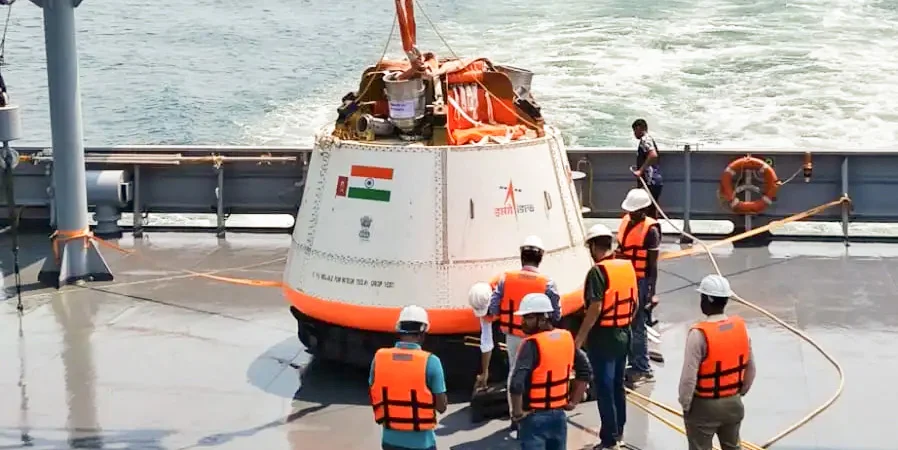
NEW DELHI: India’s first human spaceflight moved a measured step closer this week. The Indian Space Research Organisation has completed three qualification tests for the Gaganyaan crew module — the capsule that will one day carry Indian astronauts to low-Earth orbit and, crucially, bring them home. The trials focused on the least glamorous but most vital part of any crewed mission: the safe return.
One test validated the crew-module uprighting system, a stored cold-gas mechanism that turns the capsule the right way up should it settle upside-down after splashing into the sea. A second qualified the connect-disconnect system that separates the crew module cleanly from the service module during re-entry. A third confirmed the structural strength of the apex cover, the shield that protects the parachutes until they are needed. They follow an integrated main-parachute air-drop test carried out on July 7 at a drop zone in Sheopur, Madhya Pradesh.
Spaceflight is remembered for the launch, but it is won on the return. India is testing, patiently, the systems that bring its astronauts home.
At a Glance
Programme: Gaganyaan — India’s first human spaceflight
Cleared: crew-module uprighting; connect-disconnect separation; apex-cover strength
Also done: integrated main-parachute air-drop test, July 7, Sheopur (MP)
Goal: 4th nation to independently send and safely return astronauts
Each test buys down risk on a mission India intends to fly with human lives aboard, and the sequencing — uncrewed demonstrations and system qualifications before any crewed flight — is exactly the disciplined path the world’s established space powers followed. Success would make India the fourth country, after the United States, Russia and China, to independently launch and recover its own astronauts.
The constructive read is that India is building a human-spaceflight capability the right way — methodically, test by test, with safety as the organising principle rather than the schedule. Every qualification deepens a national engineering base whose dividends reach far beyond the launch pad, into materials, avionics, medicine and the aspirations of a generation of young scientists.