Prabhu Chawla
INTRO BLURB: While there are few avaricious gainers in this senseless war, citizens of over a dozen nations who are not a part of the war are the worst losers.
In the volatile cauldron of West Asia, conflicts seldom stay confined to battlefields. Their tremors reverberate through the veins of global commerce, oil pipelines, stock tickers and the quiet ledgers of households every day. The ongoing maelstrom pitting Iran against the US and Israel exemplifies this ruthless alchemy. It has transmuted geopolitical strife into an economic cataclysm that has spared no corner of the world.
This war has already lasted for two relentless weeks. What began as a surgical campaign to neutralise Iran’s nuclear threshold and ballistic-missile infrastructure has metastasised into a regional inferno. Ironically, while there are few avaricious gainers in this senseless war, citizens of over a dozen nations who are not a part of the war are the worst losers.
Tehran’s retaliation has been ferocious but asymmetric. The human cost, however, is dwarfed by the economic haemorrhage. Credible assessments by credible researchers place the daily cost at approximately $1.8 billion. Two weeks have already consumed more than $23 billion in direct military outlays alone. The conflict has cleaved the world into stark, unforgiving blocs. And no one is interested in halting the war. Why?
Conspicuous by their absence from any serious mediation effort are the two Asian giants – China and India – whose silence is as eloquent as it is self-serving. Beijing’s calculus is ruthlessly transactional. As Iran’s largest oil customer and a major investor in the Belt and Road corridor through Chabahar and Gwadar, Beijing cannot afford Tehran’s collapse.Yet, it also cannot risk a rupture with Washington that would torpedo its $600-billion annual trade with the US or endanger its Gulf energy imports.
India’s abstention is more paradoxical and more painful. New Delhi is the world’s third-largest oil importer and was the largest buyer of Iranian crude before the sanctions were tightened. At the same time, India maintains a robust defence partnership with Israel.
Inexplicably, the Modi-led BJP Government has offered little beyond generic calls for “de-escalation” and “dialogue”. Why? Domestic political compulsions, with Assembly elections looming in key states and inflation already a flashpoint, mean any high-profile diplomatic gamble risks being painted as a weakness.
Strategic realism, which Indian analysts privately calculate, says that a prolonged bleeding of Iran serves to keep Pakistan’s western neighbour distracted and reduces Chinese influence in the Gulf. Finally, the Ministry of External Affairs lacks the bandwidth and institutional framework for a sustained shuttle between Tehran, Riyadh and Washington.
Diplomatic ambiguity
While Indian diplomats have quietly conveyed concerns to their American and Israeli counterparts, no public peace initiative like the 1991 Gulf War mediation or the 2003 Iraq outreach has materialised. Consequently, India is suffering the most profound economic wounds. It has opted for the comfort of strategic and diplomatic ambiguity over the risks of leadership.
The first tremor of such a war is always felt in energy markets like India’s. This volatility favours a few while punishing many. Oil titans like Saudi Arabia, the UAE and their Gulf brethren revel in the windfall as their coffers swell with each price spike. Yet, for nations shackled to imports, the sting is profound and immediate. India, a colossus of energy hunger, embodies this peril.
Air travellers are bearing the brunt all over. Tourism is wilting under the pall of instability as investors shun ventures in shadowed regions. But the cruellest lash falls upon ordinary hearths
Devouring over 80 per cent of its crude from abroad, the nation shudders under even modest surges. A mere $10 uptick per barrel inflates India’s yearly import tab by $15-20 billion; at $100 a barrel, the haemorrhage could surpass $25 billion in a single fiscal cycle, straining reserves, widening the current-account deficit and igniting inflationary fires that would scorch the rupee and erode foreign-exchange buffers painstakingly rebuilt since 2013.
The financial tempest swept in swiftly. Market capitalisation in India evaporated by nearly Rs 16 lakh crore in the initial panic sell-off. The echoes resounded globally: Germany’s DAX, France’s CAC and Hong Kong’s Hang Seng plunged as capital fled to havens like gold and energy equities.
A grotesque irony
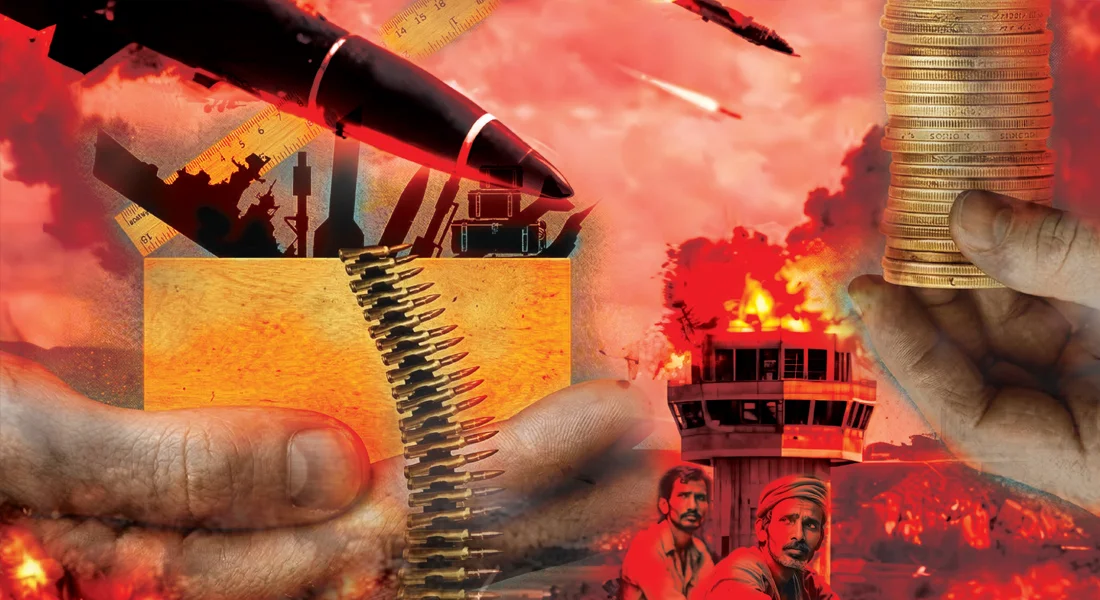
Amid this wreckage, a grotesque irony emerges in the war economy. While vast swaths of industry bleed, select empires thrive on the carnage. The defence behemoths stand as undisputed victors in this grim pageant. Lockheed Martin, RTX, Northrop Grumman and BAE Systems furnish arsenals with their precision munitions, stealth fighters and drone swarms now consumed at prodigious rates. As US and Israeli strikes continue to pulverise Iranian targets, these firms harvest the spoils.
Lockheed Martin’s shares have soared from $470 to around $650 over the past year, ballooning its valuation by $40 billion. RTX surged 5 per cent amid the escalation, tacking on $6-7 billion, while Northrop and BAE mirrored these multibillion-dollar windfalls. Collectively, these titans have amassed $50-60 billion in added market heft as the skies darkened over Iran. Each day of conflict is adding roughly $300-400 million to their combined market cap.
Energy conglomerates join in the feast. ExxonMobil and Chevron reap fatter margins from elevated crude, while Saudi Aramco, valued at almost a staggering $2 trillion, accrues billions in surplus with every barrel’s ascent.
Yet, these gains exact a toll from the broader tapestry of global enterprise. Air travellers are bearing the brunt all over. Tourism is wilting under the pall of instability as investors shun ventures in shadowed regions. But the cruellest lash falls upon ordinary hearths. Soaring oil begets pricier transportation, electricity and cooking fuel. The Modi Government is grappling with subsidy strains while families are confronting rising bills. For India, the nightmare is leading to a yawning current-account chasm, a plummeting rupee and households crushed by exorbitant gas, transport and food costs.
Insidious calculus
Defence moguls and oil overlords would, meanwhile, continue to amass fortunes. This is the insidious calculus of conflict. It’s a grand redistribution where arms peddlers and energy emperors ascend, while consumers and import-reliant entities like India descend into penury. The winners of this war are already identified. They are the US-Israeli strategic axis that has achieved operational dominance, the defence-industrial complex that has added tens of billions to its valuation, and the oil-exporting monarchies whose revenues have surged.
If the war grinds on unchecked for another month, it has serious implications for India, which is dreaming of a $5-trillion economy by 2027. For us, this conflict is not a distant headline, but a dagger at the heart of our ambitions. India just can’t afford to be an accidental and hapless victim of a war in which it hasn’t fired a bullet, leave alone a bomb.