Blitz Bureau
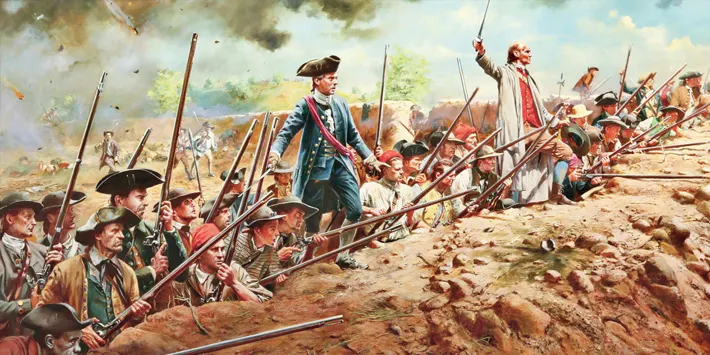
NEW DELHI: Inspired by a centuries-old map, archaeologists have been digging in the park that sits on the site where American patriots hastily constructed an earthen fort to slow advancing British forces at what became known as the Battle of Bunker Hill.
Soon after digging the ¿rst trench, the team led by Joe Bagley, the city of Boston’s archaeologist, recently found de- ¿nitive signs of a ditch constructed hours before the battle on June 17, 1775, one of the ¿rst of the American Revolution.
Musket balls and other artifacts from one of the Revolution’s most consequential battles were buried just below their feet the whole time. Archeologists also found objects likely left behind by British troops who occupied the area after the battle — including tea cups, tobacco pipes, sleeve buttons and a wig curler. There were nearly 150 combatants who died there but no human remains have been found, though a forensic archaeologist is on site to identify any bones.
“Everything about the ditch is from 1775. You’ve got musket balls, gun Àints. It’s what you would expect to see,” Bagley said. “It’s pretty powerful because these things are being dropped in the middle of the battle.”
The start of the American Revolution is often associated with the Battle of Lexington and Concord, skirmishes fought on April 19, 1775. But many scholars cite Bunker Hill and June 17 as the war’s ¿rst signi¿cant battle.
Rebels intended to hold oႇ a possible British attack by fortifying Bunker Hill, a 110-foot-high (34-meter-high) slope in Charlestown across the Charles River from British-occupied Boston. But for reasons still unclear, they instead took a position on a smaller and more vulnerable ridge known as Breed’s Hill, where most of the ¿ghting took place.
American victory
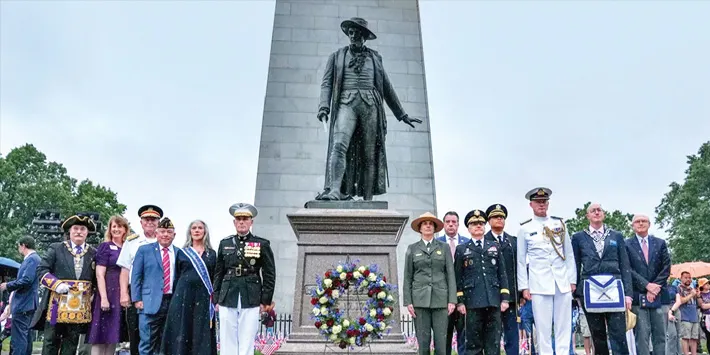
The battle ended with the rebels in retreat, but not before the British had sustained more than 1,000 casualties. Bunker Hill is often portrayed as an American victory, since the British failed to win decisively and it served to galvanize the colonies against the British. Today, a 221-foot (67-meter) white obelisk atop Breed’s Hill memorializes the battle.
Musket balls and other artifacts from one of the American Revolution’s most consequential battles were buried just below their feet
Several tourists from Colorado stopped by to watch the dig. One visitor, Greg Nockleby, who had spent a week in Boston learning about American history, said watching the archaeologists at work was a “wonderful surprise.”
Commemorating the battle
Bunker Hill Day, observed every June 17, is a legal holiday in Suႇolk County, Massachusetts (which includes the city of Boston), as well as Somerville in Middlesex County.
State institutions in Massachusetts (such as public institutions of higher education) in Boston also celebrate the holiday.
On June 16 and 17, 1875, the centennial of the battle was celebrated with a military parade and a reception featuring notable speakers. Celebratory events also marked the sesquicentennial (150th anniversary) in 1925 and the bicentennial in 1975.
In June 2025, multiple events were held during Bunker Hill Commemoration Week, celebrating and exploring the 250th anniversary of the Battle of Bunker Hill.