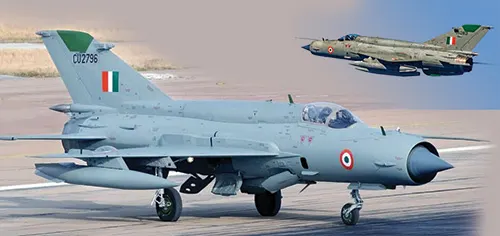
 FEW aircraft have shaped the history of the Indian Air Force (IAF) as much as the MiG-21. For decades, it was not just a fighter jet – it was the symbol of India’s air power. At its peak, the IAF operated over 20 squadrons, making it the largest MiG-21 fleet outside the Soviet Union.
But even legends face turbulence. By the 1980s, the MiG-21, particularly the Type-96 variant, was in deep crisis. Recurring inflight fires were grounding pilots, shaking public confidence, and threatening to tarnish the aircraft’s proud legacy.
The late 1980s were supposed to be the MiG-21’s finest hour. With 21 squadrons in service, including half a squadron at the Tactical Air Combat Development Establishment, the aircraft carried a fearsome arsenal. On paper, the fleet was at its peak. In reality, however, it was under siege.
‘Fire in air’ mishaps
The nightmare came in the form of ‘fire in air’ accidents. Fires started in the starboard RF section near the thermal blanket, spreading rapidly. In many cases, no reheat, still fire engulfed the RF in air. The fire warning amplifier was already modified and upgraded; so this was not a spurious fire warning. The result: aircraft lost, lives risked, and confidence shaken. Questions echoed in Parliament, the press, and the Ministry of Defence. Engineers from the Hindustan Aeronautics Limited (HAL) and Russian design bureaus in Nizhny Novgorod and Motor Design Ufa grew alarmed.
The MiG-21 was branded in public memory as unsafe, and words like ‘flying coffin’ and ‘widow maker’ frequently appeared in the media.
The turning point
Amid this crisis, Air Marshal RK Nehra – then Air Officer Maintenance (AOM) – took charge. A visionary engineer, he understood that the solution lay not in patchwork fixes but in re-engineering trust. Investigations revealed that the root cause was a misalignment between the aircraft’s longitudinal axis and aero-engine. This subtle defect had cascading effect, triggering the fires that haunted the fleet.
For the IAF, this was a moment of reckoning. For engineers, it was the beginning of one of the most ambitious recovery programmes in history.
The answer came in the form of TURF-21 (Technological Update and Review Facilities for MiG-21). More than a maintenance schedule, it was a fleet-wide reset of standards, systems, and culture. The key measures of TURF-21 included engine realignment; flying-halt across the fleet; every single engine removed, realigned, and reinstalled; tie rods sealed to prevent future shifts; and blankets under hydraulic dampers replaced. Over ten corrective measures were consolidated under SI-44.
System reforms
Among the system reforms carried out were: Engine Ground Running Records (EGRR) introduced and cross-checked with SARPP data; outdated F-700 system replaced with modern, user-friendly logbooks; and CSDO servicing schedules were recast for efficiency and accountability. As part of fire safety upgrades, improved fire detection systems were installed and hydraulic systems modified to reduce overheating and localised fire risks. This was no quick-fix, it was an overhaul.
The implementation was critical; there were no deviations, no excuses. For execution, two dedicated teams were formed. Team 1: Led by Gp Capt SM Bhatia, VSM, with Sqn Ldr Rakesh Yadav and DASi (Directorate of Air Staff Inspection) officers. Team 2: Led by Gp Capt Magdum, VSM, with officers from the Directorate of Maintenance Inspection (DMi). Each team was allotted a Dornier aircraft, flying base to base, checking compliance line by line. Over two months, they covered the entire MiG-21 fleet. And in classic DASi fashion, there was no room for compromise: compliance was mandatory – zero deviations were accepted.
Pathankot to Air HQ
Amid all this, one event changed the course of my career. When the AOM visited Pathankot, I demonstrated the compliance of SI-44 in the hangar. That day proved to be a turning point – for the IAF and for me. Within ten days, I was posted to Air Headquarters.
At Air HQ, I was given the responsibility of driving TURF-21 implementation across the entire Air Force. While two Group Captains were designated team leaders, the operational responsibility rested with me. This assignment provided me with invaluable exposure to fleet-wide engineering management, coordination with HAL, and high-level technical decision-making. Combined with my earlier involvement in Courts of Inquiry and technical investigations into MiG-21 accidents, this experience later enabled me – as a Group Captain – to independently resolve the complex ‘fire in air’ issues of the MiG-23/27 fleet. Gradually, the transformation was visible.
Accident rates fell. Squadrons regained trust in their aircraft. The outcry in Parliament and the press faded. The MiG-21, once seen as unsafe, was back in the air with confidence– sharp, reliable, and still feared by adversaries. Though the media continued to blame the MiG-21 for every mishap, professionals within the IAF knew: the crisis had been overcome.
Lessons learnt
The MiG-21 crisis was one of the most difficult engineering challenges the IAF ever faced. It was not solved by patches or shortcuts, but by leadership, discipline, and collective resolve. Under Air Marshal Nehra’s vision, TURF-21 restored both the aircraft’s reliability and the institution’s confidence. For me, the journey from Pathankot to Air HQ, and later to the recovery of the MiG23/27 fleet, was equally defining. It proved that crises can be the best classrooms, if met with courage and clarity.
The MiG-21 went on to serve the IAF with distinction for decades, and for those of us who lived through its toughest years, it left behind more than a legacy – it left lessons in perseverance, teamwork, and trust. (The writer, commissioned in Aero