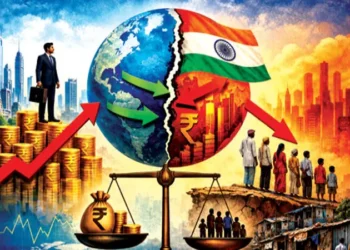
NEW DELHI: It takes only 30 minutes for anyone to exit from the high-speed transit corridor in Gurugram or a gleaming tech-park atrium in Bengaluru, and enter a world where digital economy feels like a distant murmur. This stark juxtaposition defines the central economic anxiety of modern India.
As the nation races towards a projected trajectory of high growth, commanding global headlines for its digital public infrastructure and industrial expansion, a parallel narrative persists – one of deeply entrenched wealth concentration and structural disparity.
According to data from the World Inequality Report, the upper echelons of the domestic economy capture a dominant share of national income, while the bottom half subsists on a fraction. In a developing democracy aiming for high-income status, inequality is not merely an accounting anomaly; it represents an existential friction. Left unaddressed, systemic disparities can choke consumer demand, fracture social cohesion, and leave millions stranded outside the perimeter of formal prosperity.
Sustainable Development Goal 10 (Reduced Inequalities) confronts this exact friction, demanding that growth be measured not just by aggregate expansion of gross domestic product (GDP), but by how effectively it lifts those at the base of the economic pyramid.
The modern disparity
Disparity today has evolved beyond simple wage gaps into a multi-dimensional challenge. It manifests across geography, gender, and access to capital.
Geographically, the chasm between metropolitan urban clusters and deep rural districts remains wide. While urban centres thrive on high-value tech, financial services, and global trade integration, agrarian economies face escalating vulnerabilities driven by climate shifts and fragmented land holdings.
Labour market data highlights a persistent gender imbalance: female labour force participation, though experiencing incremental upward nudges through targeted rural livelihood missions, continues to lag behind global averages, restricted by the heavy burden of unpaid domestic labour and unequal economic mobility.
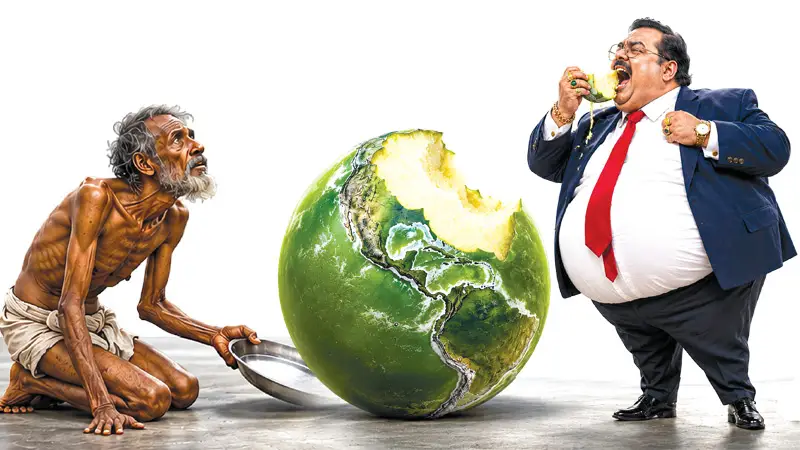
At the same time, wealth accumulation has taken on an asymmetric character. The exponential rise of asset ownership – spanning real estate, corporate equities, and digital capital – means that those who hold capital see their wealth compound much faster than those who rely strictly on wage labour.
This asset divide creates a sticky ceiling, preventing inter-generational social mobility for a significant segment of the population.
Policy counter-offensive
Recognising these structural vulnerabilities, public policy has pivoted towards massive, technology-enabled safety nets designed to redistribute opportunity rather than merely handing out relief. The expansion of India’s social protection systems has been monumental: official figures from the Ministry of Statistics indicate that the proportion of the population covered by formal social protection systems and safety floors has scaled dramatically, rising from roughly 22 per cent a decade ago to over 65 per cent today.
At the core of this inclusion architecture are foundational public goods. Unified digital identity frameworks, direct benefit transfers (DBT) that eliminate bureaucratic leakage, universal food security schemes, and expansive rural employment guarantees form the bedrock of India’s anti-inequality shield.
Additionally, financial inclusion initiatives – bringing hundreds of millions of previously unbanked citizens into the formal credit and savings ecosystem – have laid the groundwork for grassroots entrepreneurship through credit schemes like Mudra.
Structural mandate
Despite these sweeping safety nets, bridging the inequality chasm requires deeper structural interventions. Moving the needle on SDG 10 demands a three-pronged strategic evolution:
Formalising and upskilling the workforce: With a massive share of the labour force still trapped in low-productivity informal sectors, targeted investments in vocational re-skilling, digital literacy, and formal workplace protections are non-negotiable.
Redirecting capital towards human infrastructure: Public expenditure on quality public education, universal healthcare, and early-childhood nutrition must scale aggressively. Equalising life chances at the starting line is the only proven antidote to hereditary wealth disparity.
Fostering regional economic decentralisation: Growth must be deliberately engineered beyond top-tier metro hubs. Developing secondary and tertiary industrial clusters in Tier-2 and Tier-3 cities will prevent hyper-concentration and generate localised employment.
Inequality is not an inevitable by-product of economic modernisation; it is a structural design flaw that requires intentional policy correction. For India, ensuring that the fruits of its economic momentum reach every tier of society is the ultimate test of sustainable development.
The exponential rise of asset ownership – spanning real estate, corporate equities, and digital capital – means that those who hold capital see their wealth compound much faster than those who rely strictly on wage labour