
• About us
  • Team
  • Privacy Policy
  • Contact
Wednesday, October 14, 2026
  • Login
No Result
View All Result
World's first weekly chronicle of development news
  • Blitz Highlights
    • Special
    • Spotlight
    • Insight
    • Entertainment
    • Sports
  • Opinion
  • Legal
  • Perspective
  • Nation
    • East
    • West
    • North
    • South
  • Business & Economy
  • World
  • Hindi Edition
  • International Editions
    • Dubai
    • Tanzania
    • United Kingdom
    • USA
  • Blitz India Business
  • Blitz Highlights
    • Special
    • Spotlight
    • Insight
    • Entertainment
    • Sports
  • Opinion
  • Legal
  • Perspective
  • Nation
    • East
    • West
    • North
    • South
  • Business & Economy
  • World
  • Hindi Edition
  • International Editions
    • Dubai
    • Tanzania
    • United Kingdom
    • USA
  • Blitz India Business
No Result
View All Result
World's first weekly chronicle of development news
No Result
View All Result

A Fictional State… When a State ran like a company

by Blitz India Media
September 12, 2025
in Special
0
A-Fictional

Arun AroraIn a bustling town somewhere in India, life mirrored the struggles faced by millions across the nation. Frequent power cuts plunged neighbourhoods into darkness, streets swelled with honking vehicles locked in relentless traffic jams, schools battled to keep children engaged, and the sky wore a heavy, grey cloak of pollution.

Everyone knew these problems all too well. Everyone assumed they were just part of life’s fabric – unchangeable. Then, one morning, the State’s leader did something extraordinary. Instead of walking into a typical Cabinet meeting full of politicking and power games, he gathered everyone and declared boldly: “Let’s run this State like a company that delivers results. No vague promises. Just measurable outcomes.”

A radical idea

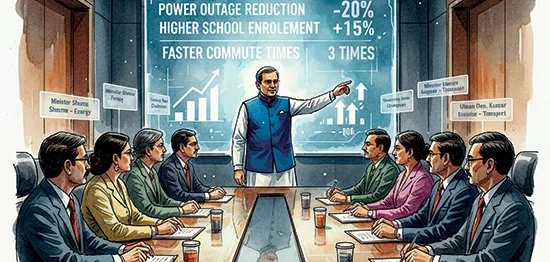
The room fell silent. The idea sounded radical – too radical, perhaps. Yet it planted a powerful seed. That very day, the Cabinet crafted the State’s first-ever Mission Statement. It wasn’t a slogan, but an explicit, sharp declaration resonating through Government offices – from sprawling cities to the smallest villages: “Every role matters. Every outcome counts. We will serve our citizens like customers – with transparency and accountability.” From that moment on, the Government operated like a well-oiled organisation. Leaders stopped talking vaguely about “better governance” and instead set specific, ambitious goals: v Cut power outages by 20 per cent within two years v Raise school enrolment rates by 15 pc in three years v Slash commute times by a third in major cities.

Every quarter, the leadership team sat down for honest, data-driven conversations. They refused to waste time hunting for excuses. Instead, they asked tough questions
Real commitment

Each target came tagged with a name – a minister, a secretary, or a district official – who owned it personally. These Key Responsibility Areas were not mere buzzwords; they sparked real commitment. For instance, the official in charge of education in a remote district discovered a new purpose. She didn’t just manage paperwork anymore – she led the mission to bring more children into classrooms.

Every quarter, the leadership team sat down for honest, datadriven conversations. They refused to waste time hunting for excuses. Instead, they asked tough questions: What is working? What is not? Where are the roadblocks? Then, armed with facts and feedback, they modified policies and strategies. When grand plans faltered, they pivoted fast. Consider the public transport initiative. Initially, officials envisioned a sprawling network that would cover every inch of the city. But the data revealed a different story – commuters desperately needed frequent bus service along a few crowded corridors. So, the sprawling blueprint gave way to a nimble, high-frequency bus network. The change worked. People noticed. Commutes became smoother.

Open feedback

Yet the true revolution came from embracing open feedback. Citizens voiced complaints; experts, and even political critics, joined the dialogue. They no longer acted as enemies but as partners, helping to refine policies and resolve problems more efficiently.

The Government also took the opportunity to celebrate its champions. Those who surpassed targets earned public praise and new responsibilities. This culture of recognition sparked enthusiasm across Government offices. People felt valued. They aimed higher, pushed harder – not simply fulfilling duties, but exceeding expectations.

The most inspiring change came in recruiting talent. Politics took a backseat. Whether someone belonged to a rival party or openly criticised past administrations, the leadership welcomed the best brains – urban planners, environmentalists, innovators – to lead key projects. This professionalism-first approach unlocked creativity and expertise that politics once stifled.

Focused governance

Slowly but surely, lives improved. Power scenario became reliable. Schools buzzed with students eager to learn. Traffic snarls eased. Crime rate fell. Entrepreneurs found new opportunities. Most importantly, growth reached the marginalised, lifting long-overlooked communities.

The story proves a vital truth: governance can operate with the focus and professionalism of a top corporation. With clear vision, a defined strategy, assigned accountability, regular reviews, flexibility to adapt, and fair rewards; leaders can transform a sluggish bureaucracy into a nimble organisation dedicated to improving everybody’s life, every day. When leaders choose to run states like CEOs, people’s dreams turn to realities. The journey begins with a vision and a commitment to make every role and every outcome count.


Related Posts

SDG 16: Why Peace, Justice and Institutions Matter
Special

We shall overcome

October 3, 2026
Moets Expands with New Delhi Food Hubs
Special

A well thought out expansion

October 3, 2026
cookies
Special

Cookie Prices Around the World: India to Russia

October 3, 2026
Modi
Special

The birthday wish that matters most

September 21, 2026
India inequality and SDG 10
Special

Children of lesser god

September 18, 2026
Nordic model and inequality
Special

It worked: THE NORDIC MODEL

September 18, 2026
Load More
Next Post
Co-op boom

Co-op boom: A grounded and grassroots revolution

Recent News

India Canada diplomatic ties
News

India News: Canada Ties, Ports, Minerals and Stubble Fires

by Blitz India Media
October 14, 2026
0

PM Modi to visit Canda in Dec as ties gather fresh momentum NEW DELHI, 14 October — Prime Minister Narendra...

Read moreDetails
Asian Champions Trophy 2026

Pathak returns as India names squad for Asian Champions Trophy

October 13, 2026
Electronics production grows seven-fold : MeitY

New Delhi, 13 October : India’s fintech sector raised $2.2 billion in the first nine months of 2026 (January 1, 2026–September 30, 2026), up 14 per cent from $1.9 billion in the same period a year earlier, a report said. The report from data intelligence platform Tracxn Technologies Limited said funding rounds dipped from 260 to 153, adding that the funding was concentrated in a smaller number of large late‑stage rounds, with five mega‑rounds of $100 million or more accounting for $1.1 billion or 48 per cent of total capital. The report said in the first nine months of 2026, digital lending and payments topped the category rankings, while Bengaluru accounts for over three-fifths of all capital raised. On the exit side, IPOs saw a 50 per cent uptick while overall acquisitions slowed. As many as 30 companies raised their first funding round, down 49 per cent from 59 in the previous year. Series A and later rounds totalled 77, down 31 per cent from 112. Late-stage funding (Series C+, PE, and pre-IPO) led the mix, rising 95 per cent to $1.5 billion in the first nine months of 2026 — up from $751 million during the same period in the previous year. This capital surge pushed late-stage investments to 67 per cent of total market funding, the report noted. Earlier stages experienced contractions in capital and deal counts. Early-stage funding fell 33 per cent to $668 million across 52 rounds, compared to $1 billion across 82 rounds in nine months of 2025. Seed funding fell 57 per cent to $73.8 million across 76 rounds, down from $173 million across 148 rounds. New unicorns crossed the billion-dollar threshold in an average of 7.1 years after their Series A funding. Moreover, the industry saw 3 IPOs in nine months of 2026, up 50 per cent from 2 in the previous year, alongside 11 acquisitions, down 45 per cent from 20.

October 13, 2026
Indian stock market

IBM and MeitY Startup Hub partner to support India’s deep-tech startups with AI, cloud, quantum computing and mentorship.

October 13, 2026
IBM

IBM, MeitY sign MoU to boost India’s deep-tech

October 13, 2026

Blitz Highlights

  • Special
  • Spotlight
  • Insight
  • Entertainment
  • Health

International Editions

  • US (New York)
  • UK (London)
  • Middle East (Dubai)
  • Tanzania (Africa)

Nation

  • East
  • West
  • South
  • North
  • Hindi Edition

E-paper

  • India
  • Hindi E-paper
  • Dubai E-Paper
  • USA E-Paper
  • UK-Epaper
  • Tanzania E-paper

Useful Links

  • About us
  • Team
  • Privacy Policy
  • Contact

©2024 Blitz India Media -Building A New Nation

Welcome Back!

Login to your account below

Forgotten Password?

Retrieve your password

Please enter your username or email address to reset your password.

Log In

    No Result
    View All Result
    • Blitz Highlights
      • Special
      • Spotlight
      • Insight
      • Entertainment
      • Sports
    • Opinion
    • Legal
    • Perspective
    • Nation
      • East
      • West
      • North
      • South
    • Business & Economy
    • World
    • Hindi Edition
    • International Editions
      • Dubai
      • Tanzania
      • United Kingdom
      • USA
    • Blitz India Business

    ©2024 Blitz India Media -Building A New Nation