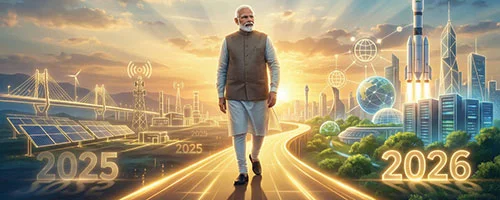
T he Narendra Modi Government closed 2025 having reinforced its narrative of political stability, infrastructure-led growth and decisive governance. The year was more about execution, consolidation and setting the stage for an ambitious policy push in 2026.
Hours before the dawn of the New Year, arrived the big news that India has surpassed Japan to become the world’s fourth-largest economy with a size of $4.18 trillion and is poised to overtake Germany to become the third largest by 2030.
A Government announcement also said that with continuing good growth numbers, India remains the world’s fastest-growing major economy.
Foreign direct investment remained robust in manufacturing, electronics and renewables, while production-linked incentive (PLI) schemes helped push mobile phone and electronics exports past record levels. The country’s exports numbers reinforced confidence in the Government’s long-term manufacturing strategy.
Infrastructure remained the Government’s strongest calling card in 2025. Capital expenditure crossed Rs 11 lakh crore in the Union Budget, with roads, railways, ports and urban transport receiving sustained focus. Over 10,000 km of national highways were added or upgraded during the year, while Vande Bharat train services expanded to more than 50 routes.
Metro rail networks grew across Tier-II and Tier-III cities, underlining the Government’s push for balanced urbanisation.
Welfare delivery continued to be a major political plank of the Government. By the end of 2025, over four crore houses had been sanctioned under the Pradhan Mantri Awas Yojana, while tap water coverage under the Jal Jeevan Mission crossed 75 per cent of rural households. Free foodgrain distribution under the PM Garib Kalyan Anna Yojana benefited more than 80 crore people.
The Government also pushed its green transition aggressively. Renewable energy capacity crossed 190 GW, with solar leading the way, while green hydrogen and ethanol blending initiatives gained traction.
India achieved nearly 15 per cent ethanol blending ahead of schedule, reducing import dependence and supporting farmers.
Internationally, Prime Minister Modi’s diplomacy remained central to India’s global positioning. Strategic ties with the US, Europe and the Indo-Pacific deepened, while India continued to project itself as the principal voice of the Global South, a legacy of its G20 leadership.
Looking ahead to 2026, expectations are unmistakably high. The Government is expected to announce a new generation of reforms focusing on labour-intensive manufacturing, semiconductor ecosystems, urban housing, and job creation.
With political authority intact and the Opposition still searching for coherence, the Government enters 2026 seeking to convert policy momentum into long-term structural gains – and to further entrench its