Blitz Bureau
NEW DELHI: Artificial Intelligence has entered a more mature and strategic phase in India’s policy imagination. The India AI Impact Summit in New Delhi made it clear that the technology is now being viewed through a far wider lens – one that blends regulatory direction, industrial scale and geopolitical positioning.
Far from being confined to startups or software applications, AI is being recast by policymakers as foundational infrastructure, integral to the country’s economic and strategic architecture.
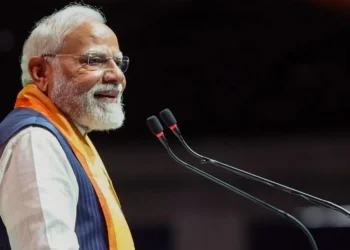
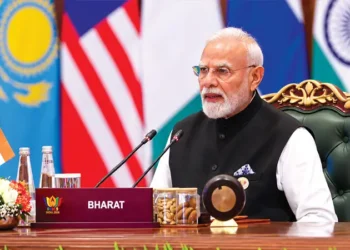
Attended by heads of state, global technology executives, investors and innovators, the summit underscored the scale of India’s ambition. Prime Minister Narendra Modi framed AI as a transformative force that must remain “human-centric, transparent and rooted in democratic values.”
MANAV Vision
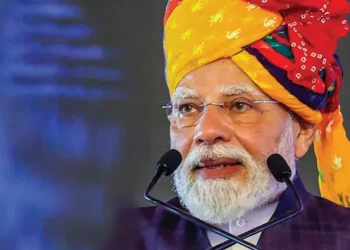
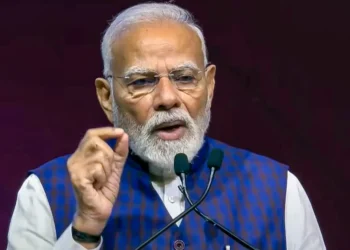
In his keynote address that set the tone, PM Modi unveiled the ‘MANAV Vision’ — Moral and ethical systems, Accountable governance, National sovereignty, Accessible and inclusive, and Valid and legitimate frameworks. “AI must be a tool for inclusive growth and human empowerment, not exclusion,” he said, arguing that while AI should be given an “open sky,” the reins must stay in human hands.
PM Modi cautioned against reducing people to mere data points and called for democratising AI so that it serves the Global South as much as advanced economies. Warning about deepfakes and fabricated content, he advocated global standards, watermarking and authenticity labels to build trust into digital systems. The real question, he stressed, is not what AI can do in the future, but what societies choose to do with it now.
The deeper shift lay in AI’s economic positioning. Policymakers described compute capacity, secure data centres and trusted digital frameworks as the new highways of development. AI is being treated not as an adjunct to India’s IT services model but as foundational capacity, comparable to power grids or telecom networks.
Population scale
Union IT Minister Ashwini Vaishnaw emphasised deployment “at population scale,” targeting agriculture, healthcare, education and public services. The strategy rests on expanding compute through public-private partnerships, building indigenous models trained on Indian languages and embedding AI in governance.
Corporate leaders echoed the infrastructure thesis. Mukesh Ambani, Chairman of Reliance Industries, said AI would be “the most powerful technology multiplier of our lifetime” and stressed that “India must build scale in compute, data and energy if it wants to lead, not follow.”
Similarly, OpenAI CEO Sam Altman noted that “India’s pace of AI adoption is extraordinary,” describing the country as “both a massive market and a serious innovation partner.” Industry voices converged on a single message: compute is the new capital stock.
Strong European participation added geopolitical heft, with leaders describing the summit as a potential turning point in shaping global AI governance.