Blitz Bureau
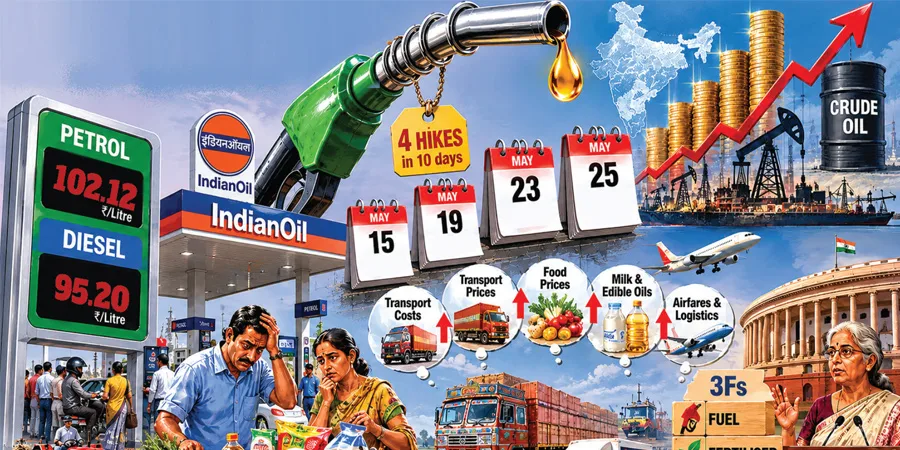
NEW DELHI: Four successive increases in petrol and diesel prices in less than two weeks have sharpened inflation concerns even as the Government asserted that the economic situation in the country remains positive and resilient.
The fuel price revision – after a prolonged months-long freeze – followed a slow drip pattern. While the first revision on May 15 witnessed an increase of Rs 3 per litre in the prices of both petrol and diesel, it was followed by Rs 0.87 and Rs 0.91 increase for the two fuels on May 19 and May 23; and finally Rs 2.61 and Rs 2.71 on May 25. The cumulative increase in Delhi has been Rs 7.35 for petrol and Rs 7.53 for diesel during the 10 days.
The hikes came as oil marketing companies resumed price adjustments in line with rising global crude oil prices. India imports nearly 85 per cent of its crude oil requirements, making the economy highly vulnerable to external energy shocks. Opposition parties accused the Government of delaying fuel price revisions until after state elections to avoid political backlash. They argued that repeated increases will soon push prices of food items, transport services and essential commodities, worsening pressure on middle and lower-income households.
Economists say the concern extends far beyond petrol pumps because diesel remains central to transport, agriculture and logistics sectors. Truck operators in several states have already started revising freight charges upward, raising fears that prices of vegetables, fruits, milk, edible oils and packaged consumer goods could rise further in the coming weeks.
Industries dependent on transport and fuel – including aviation, cement, steel, chemicals and e-commerce delivery networks – are also expected to face rising operational costs. Airlines may eventually raise fares, while manufacturers could pass higher logistics expenses on to consumers. Despite these concerns, the Government does have some basis for its confidence. India’s retail inflation remains within the Reserve Bank of India’s comfort band of 2-6 per cent. April retail inflation stood at 3.48 per cent, relatively moderate compared with many other economies.
India also has stronger foodgrain stocks, improved subsidy systems and larger forex reserves than during earlier inflation crises. Analysts, however, say the real issue is not current headline inflation but the possibility of inflationary pressures building gradually. Fueldriven inflation often spreads across the economy with a time lag. By the time headline inflation rises sharply, transport, food and manufacturing costs may already have climbed significantly. Finance Minister Nirmala Sitharaman’s recent emphasis on ‘3Fs’ – fuel, fertiliser and forex – has been interpreted by economists as a sign of official concern over external vulnerabilities, especially crude oil prices and pressure on the rupee.