Blitz Bureau
NEW DELHI: India’s ethanol story is entering a new phase. For more than a decade, the focus was on blending ethanol into petrol and reducing dependence on imported crude oil. Today, policymakers are looking far beyond the fuel tank. According to a report in the Economic Times, the Government is working on a framework to introduce ethanol as a mainstream cooking fuel and is even considering a retail model where consumers could buy ethanol through dedicated “ethanol ATMs” in canisters for use in kitchen stoves. The proposal may sound futuristic, but it points to a larger shift underway in India’s biofuel strategy.
India has already achieved nationwide E20 rollout ahead of schedule. Yet instead of slowing down, the search for new ethanol applications is accelerating. Cooking fuel, flex-fuel vehicles, sustainable aviation fuel and exports are all moving up the agenda. Beneath all these initiatives is the fact that India has built an ethanol production ecosystem that is becoming larger than the demand currently available to absorb it even though the demand is seen to grow fast in near future.
The success and the challenge
The ethanol blending programme has been one of the most ambitious energy initiatives undertaken by the Modi Government. Ethanol blending in petrol has climbed from barely 1.5 per cent a decade ago to 20 per cent, helping reduce crude oil imports, improve farm incomes and create a large domestic biofuel industry. India achieved the E20 target years ahead of schedule and is already discussing the next stage of biofuel adoption. Since 2014-15, ethanol blending has helped save more than Rs 1.4 lakh crore in foreign exchange while generating additional income for farmers and distilleries.
India has already achieved nationwide E20 rollout ahead of schedule. Yet instead of slowing down, the search for new ethanol applications is accelerating. Cooking fuel, flex-fuel vehicles, sustainable aviation fuel and exports are all moving up the agenda. Beneath all these initiatives is the fact that India has built an ethanol production ecosystem that is becoming larger than the demand currently available to absorb it even though the demand is seen to grow fast in near future.
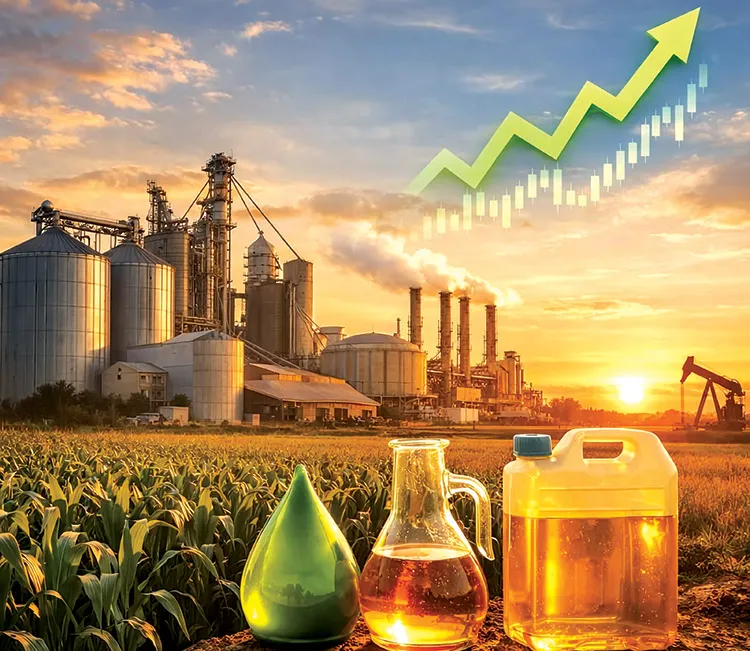
The industry responded to these policy signals with massive investments. Sugar mills expanded distillation capacity. Grain-based ethanol producers entered the market aggressively. New projects came up across Uttar Pradesh, Bihar, Maharashtra and several other states. The result is that India may now be facing an ethanol capacity overhang.
Billions of litres waiting for uptake
The push for ethanol as a cooking fuel makes much more sense when viewed through the lens of capacity. According to a May report by CareEdge Ratings, India’s ethanol production capacity has already crossed 20 billion litres annually. Another 4 billion litres of capacity is expected to come onstream during the current financial year, taking total installed capacity to roughly 24 billion litres.
Against that, the Government’s E20 blending programme consumes about 11 billion litres a year. Liquor manufacturers, pharmaceutical companies and chemical producers account for another 3-3.5 billion litres of demand. That still leaves nearly 7 billion litres of unutilised capacity. Industry executives have also begun exploring export opportunities in countries such as Nepal, Bangladesh and Indonesia, which have blending targets but insufficient domestic production capacity.
To be sure, India is not necessarily sloshing about in a glut of ethanol. It is sitting on distilleries and investments capable of producing far more ethanol than existing markets require. That is why the conversation has shifted from blending targets to consumption targets. Earlier ET had reported that distillery capacity was growing much faster than incremental demand under the E20 programme. With discussions around raising the blending cap beyond 20 per cent moving slowly, producers and policymakers have been forced to think beyond petrol.
Kitchen as the saviour
The proposed move into cooking fuel could potentially open one of the largest new demand pools available to ethanol. India remains heavily dependent on LPG for household cooking. Although domestic production has increased, imports continue to account for a significant share of demand. Every spike in global energy prices affects both the country’s import bill and the Government’s subsidy calculations.
Ethanol offers an attractive alternative from a policymaker’s perspective. It is produced domestically and supports farmers and rural industry. It reduces dependence on imported fuels. It can also be distributed through a decentralised retail model rather than relying entirely on LPG cylinders.
According to the ET report, policymakers are exploring dedicated dispensing points or ethanol ATMs where consumers could refill canisters for specially designed cooking stoves. Such a system would create an entirely new retail ecosystem for ethanol. Even if adoption remains limited initially, the significance lies elsewhere. The proposal shows that ethanol is no longer being viewed merely as a blending agent for petrol. It is being positioned as a standalone energy source.
Exports emerge as another outlet
Domestic consumption is not the only answer being explored. India is increasingly looking at ethanol exports to neighbouring countries that have blending mandates but lack sufficient feedstock or distillation capacity. Nepal, Bangladesh and Indonesia have all emerged as potential markets. For a country that until recently worried about ethanol shortages, the idea of becoming a regional ethanol supplier marks a dramatic shift.
The export option is becoming more important because large investments have already been made across the ethanol value chain. Distilleries that were built to serve a rapidly expanding blending programme now need assurance that demand will continue growing.
Aviation could be next frontier
Cooking fuel may be the latest idea, but aviation could eventually emerge as one of the most important new destinations for Indian ethanol. In April this year, the Government amended aviation fuel regulations to allow Sustainable Aviation Fuel (SAF) to be blended with conventional Aviation Turbine Fuel. It also approved a roadmap that envisages 1 per cent SAF blending for international flights by 2027, rising to 2 per cent in 2028 and 5 per cent by 2030. The move is part of India’s effort to reduce emissions from aviation while building a domestic SAF industry.
What makes this relevant for the ethanol industry is the production pathway being favoured by many companies. One of the recognised routes for producing sustainable aviation fuel is the alcohol-to-jet process, which converts ethanol into jet fuel. In other words, ethanol is no longer being viewed only as a transport fuel additive. It is increasingly being positioned as a feedstock for an entirely new category of fuel.
The industry has already begun investing on that assumption. India’s first ethanol-to-jet fuel plant is being developed near Visakhapatnam by NTPC Green Energy and GPS Renewables. The facility is expected to produce around 1,800 tonne of sustainable aviation fuel annually using ethanol-based technology.
For policymakers, SAF offers something that petrol blending and cooking fuel do not. Airlines across the world are under growing pressure to lower emissions and are willing to pay a premium for sustainable aviation fuel. If ethanol can find its way into aviation at scale, it could create a high-value market for producers at a time when domestic capacity is running ahead of demand.
CAFE-III will kick off the next phase
The Government’s recently released draft Corporate Average Fuel Efficiency (CAFE)-III norms provide another clue about the direction of policy. For the first time, the framework proposes incentives linked to ethanol and other biofuels. Traditionally, discussions around fuel-efficiency norms have revolved around electric vehicles. The latest proposals suggest policymakers are increasingly interested in creating a broader ecosystem where ethanol, flex-fuel vehicles and other biofuels play a larger role.
The significance of this shift should not be underestimated. Once E20 became a reality, the next challenge was always going to be demand creation. CAFE-III appears designed, at least in part, to ensure that future vehicle technologies can absorb more ethanol.
From a sugar policy to an energy strategy
Perhaps the most important development is that ethanol is no longer just a by-product of the sugar industry. Grain-based ethanol has expanded rapidly and maize has emerged as a major feedstock. According to industry data, grain-based sources now account for a majority of ethanol supplies. The ethanol ecosystem increasingly includes grain processors, distilleries, technology providers and fuel retailers alongside traditional sugar mills. Shift away from sugarcane can also alleviate ecological concerns as sugarcane is considered a water-intensive crop.
Once ethanol was part of sugar policy and now it has evolved to energy policy. That shift is visible in the range of sectors now being discussed. Ethanol is being considered for transportation, cooking, exports and aviation fuel. Every new application serves the same underlying purpose of creating demand for a production ecosystem that has already been built.