Blitz Bureau
NEW DELHI:One European trade agreement is live and already moving goods. The larger one is finished, checked and unsigned. For an Indian exporter, a student or a nurse, the difference between those two states is everything.
The India–UK Comprehensive Economic and Trade Agreement entered into force on 15 July 2026, alongside the Double Contribution Convention on social security. On the first day of operation, more than 50 consignments worth over $140 million were dispatched from India to the United Kingdom under the agreement — an average of about $2.8 million a consignment, which tells you these were not trial shipments but real, waiting order books. Six weeks on, it is the only comprehensive trade agreement India has in force with a G-7 economy.
What the UK conceded is the larger half of the deal. Duties were removed on 99 per cent of Indian tariff lines — up to 70 per cent on processed foods, 21.5 per cent on marine products, 18 per cent on engineering goods and auto components, 16 per cent on leather and footwear, 12 per cent on textiles and clothing and 8 per cent on chemicals and pharmaceuticals. Textiles and clothing alone got duty-free access across 1,143 tariff lines. India, in return, offered concessions on 89.5 per cent of its own lines, covering 91 per cent of UK exports by value, of which 24.5 per cent becomes duty-free immediately and the rest phases in.
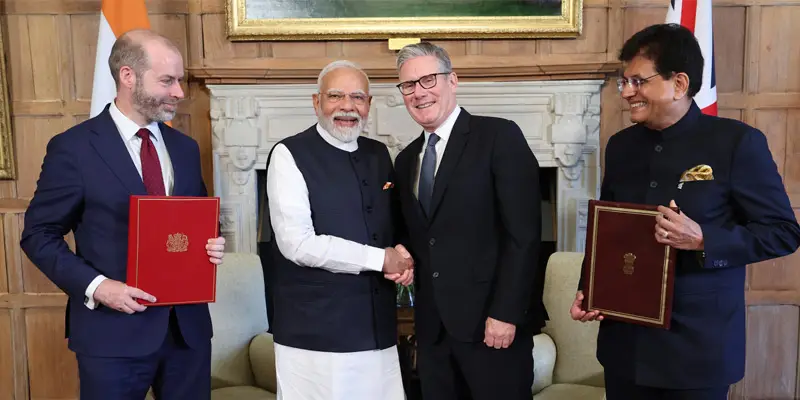
The signature that is already working. India’s Commerce and Industry Minister Shri Piyush Goyal with the UK Secretary of State for Business and Trade, Jonathan Reynolds, at the signing of the India–UK trade agreement. CETA entered into force on 15 July 2026.
A concluded agreement and an operating one are separated by a signature, and about a year of exports.
At a Glance
• India–UK CETA: in force since 15 July 2026, with the Double Contribution Convention
• Day one: 50-plus consignments, over $140 million shipped under the agreement
• UK side: duties removed on 99% of Indian tariff lines
• Textiles: duty-free across 1,143 tariff lines; UK duty of up to 12% removed
• India side: concessions on 89.5% of lines, covering 91% of UK exports
• India–EU FTA: negotiations concluded 26 January 2026; legal scrubbing complete
• EU status: internal approvals and translation under way; signature expected by end-2026
The European Union agreement is at a different, and more frustrating, stage. Negotiations concluded on 26 January 2026. As of 20 August, the legal scrubbing — the line-by-line reconciliation of the negotiated text into a signable treaty — is complete, and what remains is internal approval and translation on the EU side, where a trade agreement must be produced in every official language of the Union before it can be signed. Both sides remain committed to signature before the end of 2026. Until then, nothing changes at a European customs post: the tariffs an Indian exporter pays into the EU today are the tariffs of a decade ago.
For readers who are not exporters, the corridor matters in three quieter registers. The Double Contribution Convention means Indian professionals posted to Britain for up to three years no longer pay into two social-security systems for the same period — a straightforward increase in take-home pay for the software engineer, the accountant, the site manager. Cheaper Scotch, cars and medical devices are the visible consumer half. And for students, the direction of travel matters more than the tariff schedule: trade agreements with mobility chapters tend to be followed by qualification-recognition arrangements, which is what actually determines whether an Indian degree counts abroad. The constructive way forward for Delhi is to spend the pre-signature months on the unglamorous work — exporter awareness of rules-of-origin self-certification, which is where first-year FTA utilisation usually leaks — so that when Brussels finally signs, Indian firms are ready on day one, as they visibly were on 15 July.