Robo-callers come under India’s spam rule book
New Delhi, 18 September 2026Anyone in India who has answered a call that begins with a half-second of silence knows the sound of a machine dialling. Until today the regulations had no word for it. The Telecom Regulatory Authority of India notified the Telecom Commercial Communications Customer Preference (Third Amendment) Regulations, 2026 on 18 September 2026, and buried in its definitions is the first Indian legal description of an application-to-person call: a voice call started by an application, software system or automated platform without direct human dialling, including autodialler, robo-call and pre-recorded or AI-voice technology.
Naming it is the whole point. An entity that wants to place such calls must now tell its telecom service provider in advance, and list the calling line identities it will use. An A2P call made without that declaration is, by the regulation’s own words, unsolicited commercial communication — which means every enforcement step that already exists for a spammer now reaches the software too.
The price of a machine call
The amendment also attaches a cost. Under the regulations notified by TRAI on 18 September 2026, a terminating access provider may levy a termination charge of up to five paise a minute on the originating access provider for an A2P call. Calls made through the numbering series the Authority has already set aside for regulated commercial traffic are exempt.
Five paise sounds like nothing. It is meant to. A bank confirming a transaction will not notice it. An operation dialling lakhs of numbers an hour will, and that asymmetry is the design.
Three complaints, not five
The second change is quieter and probably larger. Under the existing framework, action against a sender began only after five unique complaints inside ten days. The amendment keeps that threshold but adds a faster one beside it: where three or more unique complaints arrive within ten days and the sender’s calling line identity has separately been flagged by an operator’s AI system as suspected of sending unsolicited communication, action starts.
The machine and the citizen now have to agree, and when they do the count comes down by two. TRAI’s press release records that the Authority had already directed operators on 27 February 2026 to share AI-derived intelligence on suspect senders between themselves; the amendment writes that direction into the 2018 regulations as Regulation 21A, which is the difference between an instruction and a rule.
Where five or more calling line identities tied to one sender are flagged inside ten days, access providers move through re-verification of KYC, physical verification, suspension of outgoing service and, on repeat misuse, disconnection.
Six hours to pull a header
On misuse of a header or a content template — the mechanism behind most fraudulent SMS — the originating provider must suspend the misused header or template within six hours of learning of the misuse. Where the misuse is traced to a telemarketer, all of its telecom resources are disconnected for one year and the entity is blacklisted.
A complaint you can appeal
For the ordinary subscriber the most usable change is the smallest. Until now, a complaint about a spam call was resolved or it was not, and there it ended. The amendment creates an appeal: a consumer may appeal the resolution of an unsolicited-communication complaint to an appellate authority within fifteen days, through the TRAI DND app, an operator’s app or portal, or by call or SMS to 1909.
There is a matching restraint on the other side. Call-management applications may no longer blanket-block, filter or tag as spam the calls coming from the numbering series set aside for commercial and government communication — the 1600xx and 1601xx service and transactional series, and the 140xx promotional series. An individual subscriber may still block whatever they like on their own handset. The distinction is between a person choosing and an application deciding for everyone.
What the reader should watch
The regulation rests on a judgement that could be wrong: that operators’ AI systems are accurate enough to lower a complaint threshold on their strength. TRAI has hedged it by requiring corroboration from three human complaints before the lower trigger fires, which is the right hedge. But the exempt numbering series are exempt by category, not by conduct — a sender inside the 140xx series misbehaving is outside both the spam flag and the termination charge, and the first year of working data will show whether that gap is used.
Blitz Data Card: At a glance
Regulation amended: Telecom Commercial Communications Customer Preference Regulations, 2018
Amendment: Third Amendment Regulations, 2026, notified 18 September 2026
Draft issued: 13 March 2026; comments closed 19 April 2026; counter-comments 4 May 2026; open house 3 June 2026
Termination charge on an A2P call: up to Rs 0.05 a minute
Complaint threshold, existing route: 5 unique complaints in 10 days
Complaint threshold, AI-corroborated route: 3 unique complaints in 10 days
Header or template suspension: within 6 hours of the misuse being known
Telemarketer disconnection on traced misuse: 1 year, with blacklisting
Consumer appeal window: 15 days
How it compares
Existing complaint threshold: 5 complaints in 10 days — the higher bar, 100%
New AI-corroborated threshold: 3 complaints in 10 days — 60% of the higher bar
The AI-corroborated route needs 40% fewer complaints than the existing one before action begins.
What the numbers add up to
Consultation to notification: 13 March 2026 to 18 September 2026 is 189 days, of which 52 days were the comment and counter-comment window (13 March to 4 May) and 137 days were analysis and drafting after it. Blitz worked this from the dates in TRAI’s own release; the release states the dates and does not state the interval.
What India gains
Every mobile subscriber in the country gets, for the first time, a named category for machine-dialled calls, a cost attached to them, and a right of appeal when a complaint is closed against them.
Blitz appreciates
The Telecom Regulatory Authority of India, and the Ministry of Communications, for carrying a draft through a full consultation cycle — comments, counter-comments and an open house — before notifying it.
Blitz View
The exemption for regulated numbering series is drawn by category. A conduct test alongside it — an exempt series losing its exemption on a proven pattern of misuse — would close the one door this framework leaves open, and the data to build such a test will exist within a year.
Two Maharashtra rail projects clear together
New Delhi, 18 September 2026The Ministry of Railways announced two sanctions on 18 September 2026, both in Maharashtra and both released within two minutes of each other. The first is a 38.21 km new line between Mukutban in Yavatmal district and Gadchandur in Chandrapur district, on South Central Railway, at Rs 493 crore. The second is the doubling of the 10.86 km Chowk–Karjat section of Central Railway, at Rs 497 crore.
Almost the same money; a quarter of the distance. Doubling an existing section here costs Rs 45.76 crore a kilometre against Rs 12.90 crore a kilometre for laying new track — three and a half times as much, which is what happens when the alignment runs through the Panvel–Chowk–Karjat corridor’s existing constraints rather than open ground.
The Mukutban–Gadchandur line serves cement plants, Western Coalfields Limited’s coal mines and limestone quarries around them. The ministry’s release says the detailed project report expects 6.08 million tonnes of freight a year and two MEMU services each way daily once it opens, and that it will give the coal and cement cluster a direct road to the Majri–Nanded route, cutting time towards Jalna, Parbhani and Chhatrapati Sambhajinagar. It also takes load off the congested Ballarshah–Nagpur high-density network route.
Chowk–Karjat, on the ministry’s figures, adds five passenger train pairs a day and 18.35 million tonnes a year of freight capacity on a single-line stretch that currently holds both back.
Sugar stock limit doubles for industry
New Delhi, 18 September 2026The Department of Food and Public Distribution raised the sugar stock-holding limit for bulk consumers from 15 days to 30 days on 18 September 2026, with one condition that carries the whole policy: the quantity above the old 15-day line may be sourced only from sugar imported under the Advance Authorisation Scheme or the Tariff Rate Quota. Stock bought on the open market stays capped at fifteen days of consumption.
Bulk consumers — the department defines them as users of more than 10 tonnes a month as raw material — had asked for room ahead of the festival season. They have it, and the domestic pool has not been touched to give it to them. Declarations go up once a week on the department’s foodstock portal.
The release also carries a figure the government is plainly unhappy with. Retail sugar has come down about 10% from its peak, from Rs 65 in August to Rs 58.50. Mill-gate prices have fallen roughly 25%. Fifteen percentage points of that fall have stopped somewhere between the mill and the shop, and at a joint meeting on 18 September with the Indian Sugar and Bio-energy Manufacturers Association, the National Federation of Cooperative Sugar Factories and the sugar trade, the department’s secretary said so.
From 1 October 2026, with the new sugar season, cane growers receive a fair and remunerative price of Rs 365 a quintal.
Steel cut for second missile vessel
Kochi, 18 September 2026Cochin Shipyard Limited held the steel-cutting ceremony for the second ship of the Next Generation Missile Vessel project on 17 September 2026, with Rear Admiral Kapil Mehta, Assistant Controller Warship Production and Acquisition, as chief guest, the Ministry of Defence said in its release of 18 September 2026.
The contract for the NGMVs was signed with Cochin Shipyard in March 2023. The ministry’s release states that all major role-defining equipment on the class has been indigenously developed and manufactured — the sentence to hold on to, because it is the difference between assembling a warship in India and building one.
Kuno-born cheetah delivers four cubs
Kuno, 18 September 2026KGP12, a female cheetah born in India, gave birth to four cubs at Kuno National Park in Madhya Pradesh, Akashvani reported on 18 September 2026 — a day after Project Cheetah completed four years. The Union Minister for Environment, Forest and Climate Change, Bhupender Yadav, called the birth a symbol of hope and of the growing success of cheetah conservation in India, and congratulated the Kuno and Project Cheetah teams.
An imported animal breeding is a translocation working. An Indian-born animal breeding is a population beginning to run itself, and that is a different claim altogether.
Rozgar Mela to hand 51,000 letters
New Delhi, 18 September 2026The Prime Minister will distribute more than 51,000 appointment letters to newly recruited young people in central government departments and organisations at the 20th Rozgar Mela on 19 September 2026, through video conferencing, the Prime Minister’s Office said in its release of 18 September 2026. He will address the gathering.
India’s foot-and-mouth outbreaks fall to twenty
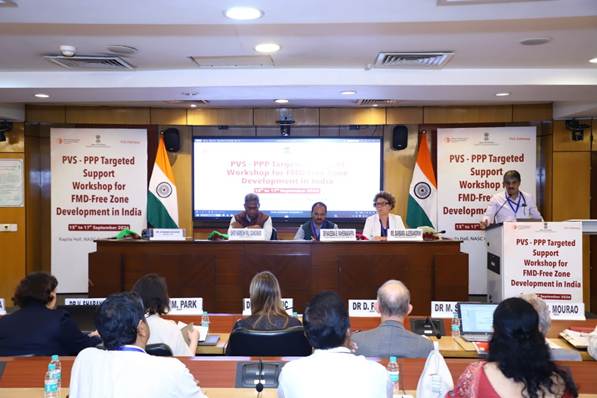
New Delhi, 18 September 2026The Department of Animal Husbandry and Dairying, with the World Organisation for Animal Health, closed a three-day PVS-PPP targeted support workshop on FMD-free zone development at the National Agricultural Science Complex, New Delhi, on 17 September 2026. Twelve state animal husbandry departments, WOAH Paris, the central and regional disease diagnostic laboratories, the National Dairy Development Board and ICAR research institutes took part.
The figures the department’s secretary, Naresh Pal Gangwar, placed before the workshop, as recorded in the release of 18 September 2026, are the reason the meeting matters. Under the Livestock Health and Disease Control Programme, more than 147.16 crore FMD vaccine doses have been administered, benefiting about 8.04 crore farmers. Foot-and-mouth outbreaks fell from 132 in 2019 to 40 in 2025 and to 20 up to August 2026. Non-structural protein antibody positivity fell to 8.1% by 2025.
Reading the two series together
Outbreak counts and antibody positivity measure different things, and a desk that quotes only the first is quoting the easier number. An outbreak count can fall because reporting weakened. NSP positivity — the share of animals carrying antibodies to the parts of the virus a vaccine does not contain — falls only if fewer animals have met the live virus. The two falling together is what makes the claim survivable, and it is why the department can now talk about proving freedom in zones rather than only about controlling spread nationally.
Against 2019, outbreaks are down 69.7% by 2025 and 84.85% by August 2026. Blitz derived both from the counts in the release; the release gives the counts and not the percentages. A caution belongs with the second one: the 2026 figure runs to August and the year is not closed.
What the workshop actually produced
Nine priority states brought draft action plans and defended them on the third day before WOAH experts. The department has framed guidelines for creating FMD-free zones, and in 2025 set minimum standards for veterinary infrastructure in India for the first time, supporting states under the Scheme for Special Assistance to States for Capital Investment where they identified gaps. The secretary asked the workshop to take up the emerging threat of the SAT serotypes, which are exotic to India.
The stated national goal is FMD freedom by 2030. What stands between here and there is not vaccine supply; it is traceability — animal identification good enough that an importing country will accept a zone’s claim.
Blitz View
The nine state action plans would be worth publishing as they stand. A zone claim is finally a document an importing country’s veterinary service reads, and plans written in the open are easier to defend abroad than plans summarised in a release.
Statistics ministry closes 5,147 pending files
New Delhi, 18 September 2026The Ministry of Statistics and Programme Implementation set out its record under the Special Campaign for Disposal of Pending Matters for November 2025 to August 2026, in a release of 18 September 2026, ahead of Special Campaign 6.0, which runs from 2 to 31 October 2026.
Across the ministry, its attached and subordinate offices and its autonomous body: 5,617 files reviewed, physical and electronic; 467 physical files weeded; 4,680 e-files closed; 61 cleanliness drives; 426 public grievances disposed of and 65 grievance appeals; and Rs 34,105 realised from scrap disposal. The campaign was monitored monthly on the SCDPM portal, and references from the Prime Minister’s Office, parliamentary assurances and state government references were given particular attention.
Of the 5,617 files reviewed, 5,147 were closed or weeded — 91.63%, on Blitz’s own arithmetic from the ministry’s counts. Of those closures, 90.93% were e-files. That second ratio is the finding: the disposal is running almost entirely in the electronic record, which is where a statistics ministry’s pendency now lives.
Special Campaign 6.0 has a preparatory phase from 15 to 30 September 2026 and an implementation phase from 2 to 31 October 2026, and is focused on collection, segregation and disposal of e-waste in field offices, to guidelines of the Ministry of Environment, Forest and Climate Change.
Blitz View
The scrap figure is Rs 34,105 over ten months and it is honestly reported. A line beside it for the office space released, as the Ministry of Earth Sciences has been reporting, would say more about what the campaign is actually recovering.