
Munish Gupta
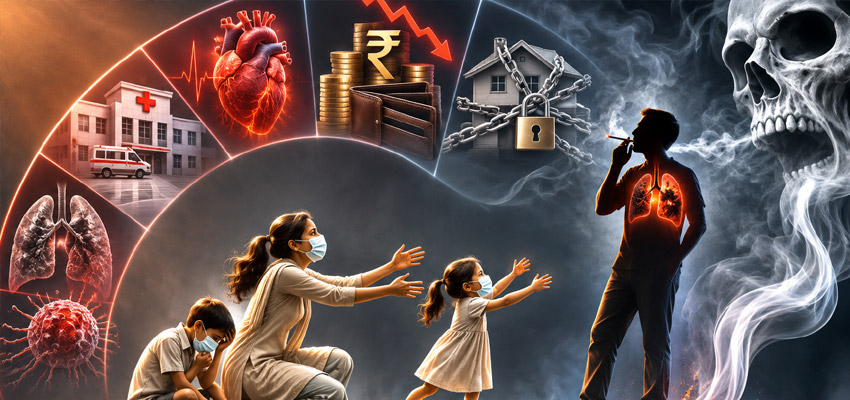
One person smokes a cigarette, everyone in the room breathes its smoke. In India, that room is often the family’s own home. The second Global Adult Tobacco Survey, carried out in 2016-17 and known as GATS 2, found that smoking was allowed inside the house in 48.8 per cent of households. The figure was 54.4 per cent in rural homes and 38.2 per cent in urban homes. More than a third of non-smokers, 35 per cent, were exposed to second-hand smoke at home.
The figure has now fallen. The share of non-smokers exposed at home dropped from 48.0 per cent in the first survey, of 2009–10, to 35.0 per cent in the second. Still, a third of India’s non-smokers breathe someone else’s smoke in their own home.
Second-hand smoke
The science on second-hand smoke is settled. The US Surgeon General’s report of 2006 concluded: “Secondhand smoke causes premature death and disease in children and in adults who do not smoke.” It found that “there is no risk-free level of exposure to secondhand smoke”.
The US Surgeon General’s preface to the 2010 report puts it in words every family can follow: “Every inhalation of tobacco smoke exposes our children, our families, and our loved ones to dangerous chemicals that can damage their bodies and result in life-threatening diseases such as cancer and heart disease.”
Every inhalation of tobacco smoke exposes our children, our families, and our loved ones to dangerous chemicals that can damage their bodies and result in life-threatening diseases such as cancer and heart disease
The 2006 report found that, in adults, second-hand smoke “has immediate adverse effects on the cardiovascular system and causes coronary heart disease and lung cancer”. The International Agency for Research on Cancer has classified second-hand tobacco smoke in Group 1, as “carcinogenic to humans”. The Surgeon General’s report of 2014 added stroke to the diseases it causes.
The World Health Organisation’s report of 2025 states: “Studies estimate that over 1.6 million nonsmokers die every year from exposure to second-hand smoke.” Women bear the larger share. The report explains that women “are more likely to be nonsmokers but are often exposed to second-hand smoke in their own homes”.
Women and children
The US Surgeon General’s report of 2014 records that, since 1964, nearly 2.5 million non-smokers in the United States died from heart disease or lung cancer caused by second-hand smoke. Another 100,000 babies died of sudden infant death syndrome, or of complications of prematurity, low birth weight or “other conditions caused by parental smoking, particularly smoking by the mother”.
A separate room does not solve the problem. The 2006 report found: “Separating smokers from nonsmokers, cleaning the air, and ventilating buildings cannot eliminate exposures of nonsmokers to secondhand smoke.”
Children cannot leave the room. The World Health Organisation’s 2025 report notes that “Women and children are especially vulnerable to second-hand smoke.” The 2006 report found that children exposed to second-hand smoke face an increased risk of sudden infant death syndrome, acute respiratory infections, ear problems and more severe asthma. It also found that “Smoking by parents causes respiratory symptoms and slows lung growth in their children.”
The harm reaches further. The International Agency for Research on Cancer found that parental smoking causes hepatoblastoma, a cancer of the liver, in children. It also observed a positive association between parental smoking and childhood leukaemia.
Tuberculosis risk
Indian studies add tuberculosis to it. The Union Health Ministry’s 2022 report cites two new case-control studies. They found that exposure to second-hand smoke increased the likelihood of tuberculosis in children aged 1 to 14. The ministry’s 2004 report had already called second-hand smoke “an important cause of respiratory infections, worsening of asthma and poor lung functions” among non-smokers, “especially children and women”.
Indian schoolchildren feel the exposure. The Global Youth Tobacco Survey of 2019 covered students aged 13 to 15. It found that 12 per cent had been exposed to second-hand smoke at home in the previous seven days. Twenty-two per cent had been exposed in enclosed public places.
The harm begins before a child is born. The WHO Framework Convention on Tobacco Control records in its preamble that there is “clear scientific evidence that prenatal exposure to tobacco smoke causes adverse health and developmental conditions for children”.
The Health Ministry’s 2022 report lists the effects. Smoking during pregnancy can lead to low birth weight, gestational diabetes or maternal death. Exposure to second-hand smoke at home or at work during pregnancy can lead to stillbirth or low birth weight. For a woman trying to become pregnant, such exposure can delay conception. The ministry’s 2004 report had listed the effects of a mother’s tobacco use, smoked or smokeless, during pregnancy. They include “decreased foetal growth, spontaneous abortions, foetal deaths” and “long term effects on the surviving children”.
Student smokers
Children start young. The 2019 youth survey found that 3 per cent of students aged 13 to 15 smoked cigarettes and 2 per cent smoked bidis. It found that the median age at which students began smoking cigarettes was 11.5 years.
Thirty-six per cent of the students who had ever smoked a cigarette had tried their first before their tenth birthday. Among students who bought cigarettes in the previous 30 days, 44 per cent bought them as single sticks.
For 26 per cent of student smokers, home is the usual place of smoking, ahead of school and friends’ houses at 17 per cent each. The survey found tobacco use lower among students whose parents do not use tobacco than among those with one or both parents who do. It also found that “Parents asking children to buy tobacco products increases the tobacco use among the children considerably.”
One trend should worry every parent. Tobacco use among students fell from 17 per cent in 2003 to 8 per cent in 2019. Yet among girls, the prevalence of smoking rose by 40 per cent over the same period.
The years of danger run into early adulthood. The Health Ministry’s 2004 report states that “The most susceptible time for initiation of tobacco use in India is during adolescence and early adulthood, i.e. in the age group of 15-24 years.” GATS 2 found that “one third of all daily smokers aged 20-34 had started smoking tobacco on a daily basis before attaining the age of 18”. GATS 2 also reports that “81.5 per cent of current cigarette smokers aged 15-17 years buy cigarettes from kiosks/paan shops and 16.7 per cent are able to buy cigarettes from a store”.
Secondhand smoke causes premature death and disease in children and in adults who do not smoke. There is no risk-free level of exposure to secondhand smoke
Draining family money
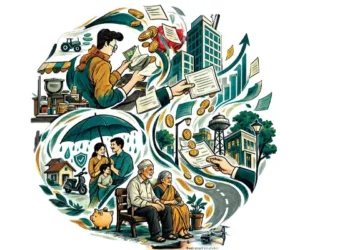
Smoking also drains the family’s money. GATS 2 found that a daily cigarette smoker spends Rs 1,192.45 a month on cigarettes on average. That is more than Rs 14,000 a year. After adjusting for inflation, this spending had risen from Rs 668.04 a month in the first survey.
The World Health Organisation explains what this means for poor homes. “For the poor, money spent on tobacco is money not spent on basic necessities, such as food, shelter, education and health care.” In the poorest households, spending on tobacco “can mean the difference between an adequate diet and malnutrition”. And “If the main breadwinner becomes ill from tobacco use, the family’s ability to purchase food and other necessities is threatened.”
The Indian evidence points the same way. The Health Ministry’s 2004 report draws on a United Nations report to record that “Some street children and other homeless people in India spend more on tobacco than on food, education or savings”. The ministry’s 2016 monograph on smokeless tobacco cites an estimate of tobacco’s effect on poverty.
On that estimate, counting spending on tobacco would raise poverty rates by 1.5 per cent in rural India and 0.72 per cent in urban India. The rise would affect 11.8 million and 2.3 million people respectively. The monograph also records that tobacco users face “a higher risk of borrowing and selling assets during hospitalisation than others”. The ministry’s 2022 report states that tobacco-induced diseases push “millions of families to below the poverty line”.
Some costs are seldom counted. The ministry’s 2004 report speaks of the “discomfort, pain and suffering” that smoking imposes on smokers and their families, and of “the cost of bereavement”.
The World Health Organisation describes tobacco and poverty as “a vicious circle from which it is often difficult to escape”. The ministry’s 2004 report observed that “The poor, the young and women are particularly vulnerable for becoming the victims of tobacco.”
The Parties to the WHO Framework Convention recorded in its preamble their concern at the rising consumption of cigarettes and other tobacco products. They also recorded their concern at “the burden this places on families, on the poor, and on national health systems”. The smoker lights one stick at a time. The family pays for each one, in breath, in health and in money. Stick by stick, drag by drag, the cost passes from one person to the whole home.
Children exposed to second-hand smoke face an increased risk of sudden infant death syndrome, acute respiratory infections, ear problems and more severe asthma