
Dr Seema Dwivedi
What the cigarette costs India’s economy, its health system and its land
The Union Health Ministry’s 2022 report, which relies on estimates for 2017, puts the economic cost of the diseases and deaths caused by tobacco in India – among people aged 35 and above – at Rs 1,77,341 crore, or $27.5 billion. That’s about 1.04 per cent of the country’s gross domestic product. Rijo M John, a health economist and three co-authors from the World Health Organisation’s India office published the report in the journal, ‘Nicotine & Tobacco Research’.
The study attributes 74 per cent of the cost to smoking and 26 per cent to smokeless tobacco. Men bear 91 per cent of the total. Smoking alone cost about Rs 1.31 lakh crore in that single year.
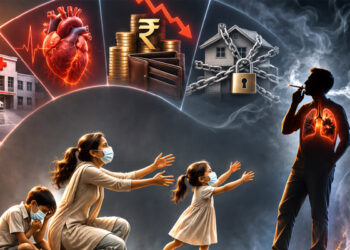
A cigarette stick carries a price, and the smoker pays; but the country pays another price that no packet shows. It pays in hospital bills, in lost work, in lives cut short in their prime, and in forests cleared and streets littered
Lives lost early
Most of the bill is lives lost early. The cost of premature deaths alone made up 75 per cent of the total. People aged 35 to 69 bore 93.3 per cent of the cost. This fits what the World Bank stated in 1999: “Half of all long-term smokers will eventually be killed by tobacco, and of these, half will die during productive middle age, losing 20 to 25 years of life.”
Treatment takes its share. The 2017-18 study found that the direct medical costs of tobacco alone came to 5.3 per cent of India’s total health expenditure.
Second-hand smoke adds to the bill. The Health Ministry’s 2022 report cites a study of its cost to people who do not smoke. That study estimated the annual direct economic costs of second-hand smoke among non-smokers aged 15 and above, in 2017, at Rs 56,670 crore. That was 0.33 per cent of the country’s GDP that year.
The bill is not new. An earlier national study, published by the Health Ministry in 2014, estimated the cost for 2004 and updated it to 2011 using the consumer price index. It put the economic cost of tobacco among people aged 35 to 69 in 2011 at Rs 1,04,500 crore, or $22.4 billion. The cost of premature deaths was Rs 73,000 crore of that sum. The total was 1.16 per cent of GDP. It was 12 per cent more than the combined spending of the Central and state governments on health in 2011-12.
Call for action
The study warned that, without urgent action, these costs “will continue to push families of millions of tobacco users towards poverty and steadily decelerate the economic growth of the country”.
The Health Ministry’s 2004 report made another comparison. Direct spending on tobacco in India had run at around 2 to 3 per cent of private final consumption expenditure over a long period. That spending, it found, “is more or less on par with the total private final spending on health care and medical services”.
Even in the 1990s, Indian researchers found that early death made up most of the cost of tobacco-related cancer. A task force study of the Indian Council of Medical Research followed 195 patients with cancers at tobacco-related sites, diagnosed in 1990-91. It put the total average cost for each patient at Rs 1,34,449, discounted to 1990 values. Premature death accounted for 83.7 per cent of this loss to society.
Tobacco does bring the Government revenue. But the revenue does not come close to covering the cost.
Tax comparison
The 2017–18 study compared the cost with the excise tax collected on tobacco. The excise revenue of the previous year was “only 12.2% of its economic costs”. The study puts it plainly: “for every INR 100 that is received as excise taxes from tobacco products, INR 816 of costs is imposed on society through its consumption.” The 2014 study found a similar gap for an earlier year. The Central excise revenue from all tobacco products in 2011-12 was “only 17 % of the estimated economic costs of tobacco”.
The revenue argument is old. In its report of 1999, the ICMR task force observed that “The revenue generated by tobacco and dependence of 5 to 7 million persons on tobacco is often considered a sufficient reason by the government to defer serious thought about tobacco’s eradication.” The 2014 study observed that revenue arguments “ignore several economic and social costs attributable to the rising burden of tobacco use”. Those costs include “pushing millions of people who are unable to bear the costs of treating tobacco related diseases into poverty”.
The Health Ministry’s 2004 report examined the claims about jobs and earnings. It found that “The employment, income, public revenue and foreign exchange earnings associated with tobacco production and consumption are incidental”. It added that “the replacement of tobacco consumption by other goods would surely lead to such flows of benefits from the other goods”. At the most, “some costs of transition are involved”. International studies agree.
The global cost
The World Bank found in 1999 that “the economic fears that have deterred policymakers from taking action are largely unfounded”. A 2016 monograph of the US National Cancer Institute and WHO concluded: “Tobacco control does not harm economies.”
India is not alone. A study published in Tobacco Control in 2018 put the global economic cost of smoking at $1,436 billion in 2012. That equalled 1.8 per cent of the world’s annual GDP. Health spending on diseases caused by smoking made up $422 billion of that cost, or 5.7 per cent of global health expenditure. Almost 40 per cent of the total cost fell on developing countries.
Citing earlier research, the Global Burden of Disease study, published in The Lancet in 2021, notes that smoking has caused more than 200 million deaths over the past 30 years. It warns that, in the absence of intervention, the annual toll of 7.69 million deaths “will increase over the coming decades”. The National Cancer Institute and WHO note that the health and economic burden of tobacco “is increasingly borne by low- and middle-income countries”.
Start to finish
The cost is not counted in money alone. The harm begins in the field. The 2004 report describes green tobacco sickness among the workers who grow tobacco. It is “an acute form of nicotine toxicity resulting from absorption of nicotine through the skin”. The 2022 report cites a study in Anand district of Gujarat. Of 685 agricultural workers exposed to tobacco plants in the field, 47 per cent had the sickness.
The cost also falls on the land. Dr Oleg Chestnov, WHO Assistant Director-General, wrote a foreword to the WHO’s 2017 overview of tobacco and its environmental impact. He observed that tobacco growing, manufacture and delivery “all have severe environmental consequences, including deforestation, the use of fossil fuels and the dumping or leaking of waste products into the natural environment”. He wrote: “From start to finish, the tobacco life cycle is an overwhelmingly polluting and damaging process.”
India has lost forests to tobacco. The Health Ministry’s 2004 report explains that tobacco takes forest in three ways: land cleared to grow it, fuelwood stripped to cure it, and forest resources used to pack it. The report cites a scenario exercise by the Indian Institute of Forest Management, Bhopal. The exercise estimated that fuelwood used between 1962 and 2002 to cure tobacco and to make cigarettes and other smoking products destroyed and degraded 680 square kilometres of scrub forest. That is 68,000 hectares, or about 1,700 hectares a year.
The study warned that, without urgent action, these costs “will continue to push families of millions of tobacco users towards poverty and steadily decelerate the economic growth of the country”
Adding to the harm
The end of each stick adds to the harm. The WHO overview notes that cigarette butts “are by far the largest single type of litter by count”. Since the 1980s, butts have made up 30 to 40 per cent of all items picked up in annual international coastal and urban clean-ups. The overview states that tobacco “can no longer be categorised simply as a health threat – it is a threat to human development as a whole”.
Put the figures side by side. The Health Ministry’s 2022 report puts the economic cost of tobacco use at about one per cent of India’s GDP. It calls tobacco “a major hurdle for sustainable economic growth”. Smoking accounts for nearly three-quarters of that cost. On the figures of the 2017-18 study, for every Rs 100 the Government collected in excise duty on tobacco, society bore Rs 816 in cost. The National Cancer Institute and WHO monograph explains why this is a matter for the State. It concludes that “Failures in the markets for tobacco products provide an economic rationale for governments to intervene in these markets.”
The smoker pays for each stick once, at the shop. The family pays again, as the previous story in this series showed. The nation pays a third time, stick by stick and drag by drag. These three stories have set out what the evidence shows about the cigarette. The next series will turn to the law, and ask how it should answer that evidence.
The Health Ministry’s 2004 report explains that tobacco takes forest in three ways: land cleared to grow it, fuelwood stripped to cure it, and forest resources used to pack it