
Blitz Bureau
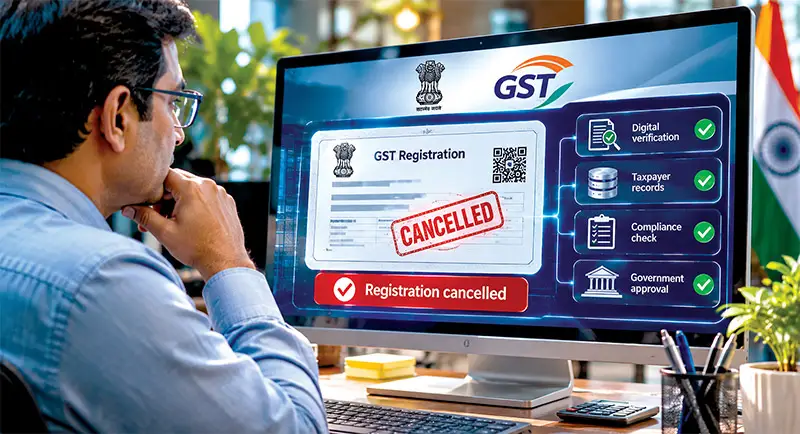
In a major step towards simplifying GST compliance and promoting ease of doing business, the Central Board of Indirect Taxes and Customs (CBIC) has introduced a system-enabled mechanism for cancellation of GST registration, allowing eligible taxpayers to obtain cancellation electronically through the GST portal without requiring manual approval from the jurisdictional tax officer. The reform aims to reduce procedural delays, minimise departmental intervention and facilitate faster exit from the GST registration framework.
The amendment gives effect to the first phase of registration cancellation reforms recommended at the 57th GST Council Meeting held on October 8.
Under the revised Rule 20 (1), a registered person seeking cancellation of GST registration under Section 29 (1) of the CGST Act, 2017, is required to submit an application electronically in Form GST REG-16 within 30 days from the occurrence of the event warranting cancellation. The application must contain details of inputs, semi-finished goods, finished goods and capital goods held in stock, together with the applicable tax liability and details of payments made. However, the prescribed 30-day filing requirement does not apply in the event of the death of a sole proprietor.
Significantly, the amended Rule 20 (2) makes filing of pending GST returns a mandatory precondition for submission of the cancellation application. Taxpayers must furnish all returns, including statements in Form GST CMP-08, wherever applicable, that are required to be filed by the date of application for the relevant periods.
Importantly, automatic cancellation is permitted where the output tax liability does not exceed ₹2.5 lakh in any month from the date of registration until submission of the cancellation application. This is a monthly threshold applied throughout the relevant registration period and not a cumulative threshold of ₹2.5 lakh.
The revised provisions also provide relief to taxpayers whose relevant monthly output tax liability has exceeded ₹2.5 lakh during any month since registration. Under Rule 20(5)(b), such taxpayers may also qualify for system-based cancellation where Form GSTR-10 is furnished within three days from the due date for furnishing the remaining returns referred to in Rule 20(3), wherever applicable, and all other prescribed compliance and payment conditions have been satisfied. Thus, exceeding the ₹2.5 lakh threshold does not, by itself, permanently exclude a taxpayer from automatic cancellation.
The introduction of system-enabled GST registration cancellation is expected to reduce manual intervention, accelerate processing of applications, improve transparency and lower compliance costs for businesses seeking to discontinue operations or otherwise surrender their GST registration.
Notably, the amended Rule 20(12) provides a safeguard against procedural delays. Where the Proper Officer fails to take action within 15 days of receipt of the application forwarded for examination, or within 15 days of receipt of the taxpayer’s reply, as applicable, the cancellation application shall be deemed to have been approved, and the same shall be communicated electronically in FORM GST REG-19. This statutory mechanism is expected to provide greater certainty and reduce unnecessary pendency of cancellation applications.
Cancellation of GST registration does not extinguish any outstanding tax liability or statutory obligation relating to the period prior to cancellation. Taxpayers remain responsible for discharge of applicable liabilities, including those arising from closing stock and capital goods, in accordance with the provisions of the CGST Act, 2017.
The introduction of system-enabled GST registration cancellation is expected to reduce manual intervention, accelerate processing of applications, improve transparency and lower compliance costs for businesses seeking to discontinue operations or otherwise surrender their GST registration. By linking automatic cancellation with timely filing of returns and payment of statutory dues, the revised framework promotes a more efficient, technology-driven and taxpayer-friendly GST administration.
The reform marks another significant step towards simplified GST compliance, ease of doing business and greater automation of taxpayer services, while ensuring that the statutory safeguards relating to payment of taxes and outstanding liabilities remain intact.
The ₹2.5 lakh limit concerns the monthly output tax liability on specified supplies to registered persons, as described in Rule 20(5)(a). It is not a ₹2.5 lakh turnover limit. Taxpayers exceeding the threshold may still obtain automatic cancellation by satisfying the alternative FORM GSTR-10 condition and other statutory requirements.
The system-based mechanism for voluntary cancellation effective November 1, 2026, is also distinct from the separate system-based cancellation and revocation mechanism for certain non-compliances, scheduled to take effect on April 1, 2027.