Blitz Bureau
NEW DELHI: Offering a promising new approach to precision cancer therapy, scientists from the Agharkar Research Institute (ARI), Pune, have developed a next-generation nanomedicine platform that can selectively target and silence key genes responsible for breast cancer growth.
The research, published in the journal Advanced Healthcare Materials, demonstrates how biodegradable nanoparticles can deliver gene-silencing molecules directly to tumour cells, significantly inhibiting tumour growth while minimising systemic toxicity.
Developed by ARI’s Nanobioscience Group, the platform is based on biodegradable mesoporous silica nanoparticles, known for their high loading capacity and ability to carry therapeutic agents efficiently.
The nanocarrier
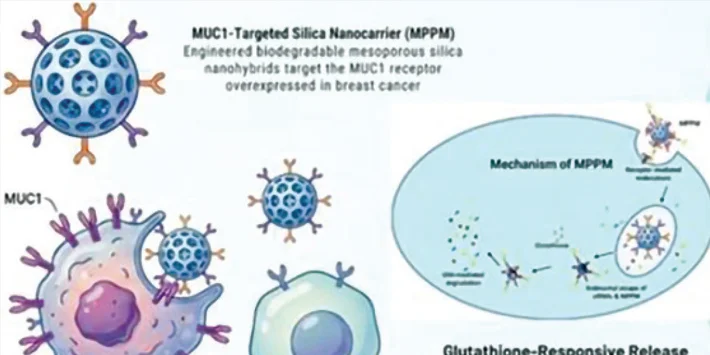
The researchers functionalised the nanocarrier with a protamine biopolymer and an MUC1-specific aptamer, enabling it to recognise and bind to MUC1 receptors that are overexpressed on breast cancer cells.
According to the study, this targeted approach enhances the uptake of therapeutic molecules by cancer cells while reducing off-target effects, a major challenge in conventional cancer treatments. A key feature of the technology is its dual gene-silencing strategy. The nanocarrier simultaneously delivers small interfering RNA (siRNA) molecules against two antiapoptotic genes—MCL-1 and Survivin—which help tumours survive and resist treatment.
Once inside the tumour microenvironment, a glutathione-responsive mechanism triggers the controlled release of the therapeutic payload, ensuring efficient intracellular delivery. Experiments conducted on MCF-7 breast cancer models showed robust suppression of both genes, increased cancer cell death and substantial tumour growth inhibition.