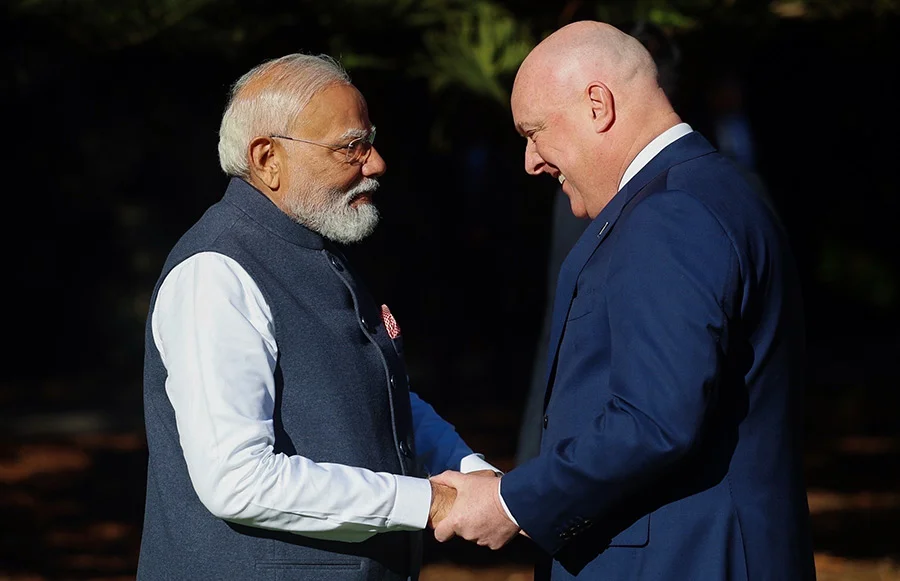
India and New Zealand elevated their relationship to a full Strategic Partnership in Auckland on Saturday, with Prime Minister Narendra Modi and his New Zealand counterpart Christopher Luxon unveiling a “Roadmap to 2030” that stretches from maritime security to dairy, and a New Zealand pledge to invest around $20 billion in India over the next 15 years. It was the first visit by an Indian prime minister to the country in more than four decades.
The day produced a dense sheaf of agreements — memoranda spanning defence and maritime security, hydrography, disaster management, sport, tourism, dairy, food technology, maritime heritage, culture and ocean research. On the security side, the two governments agreed to operationalise maritime cooperation arrangements, run bilateral naval exercises and stand up an annual Maritime Security Dialogue. The Auckland stop capped a six-day Indo-Pacific tour that also took in Indonesia and Australia.
Trust to trade: A Strategic Partnership and a Roadmap to 2030 anchor a day spanning security, commerce, dairy and culture.
The roadmap’s value is that it turns a warm visit into a calendar — annual dialogues, standing arrangements and an investment pledge that keep working long after the delegations fly home.
At a Glance
- Upgrade: Strategic Partnership + “Roadmap to 2030”
- Investment: New Zealand pledges ~$20bn in India over 15 years
- Trade: Up 50%+ in three years; goal to double in five
- Security: Naval exercises; annual Maritime Security Dialogue
Commerce ran alongside security. Two-way trade has grown more than 50% in three years, and the leaders set a goal of doubling it over the next five — toward roughly ₹35,000 crore by 2030 — while reviewing a free-trade agreement still under negotiation. The Auckland outcomes join a fast-widening map: the UK pact goes live July 15, an interim US deal is in its final stretch, and a concluded India–EU agreement is heading toward signature.
The constructive task now is to make the architecture live — convene the first Maritime Security Dialogue, translate the $20-billion pledge into projects on the ground, and close the trade talks on terms that suit both sides. Handled with patience, a historic first visit becomes a standing partnership rather than a single day’s headlines.