

• About us
  • Team
  • Privacy Policy
  • Contact
Thursday, October 15, 2026
  • Login
No Result
View All Result
World's first weekly chronicle of development news
  • Blitz Highlights
    • Special
    • Spotlight
    • Insight
    • Entertainment
    • Sports
  • Opinion
  • Legal
  • Perspective
  • Nation
    • East
    • West
    • North
    • South
  • Business & Economy
  • World
  • Hindi Edition
  • International Editions
    • Dubai
    • Tanzania
    • United Kingdom
    • USA
  • Blitz India Business
No Result
View All Result
World's first weekly chronicle of development news
No Result
View All Result

Architecture against odds

Bridges reflect India’s drive, determination

by Blitz India Media
March 10, 2026
in Opinion
0
Architecture against odds
Blitz Bureau

NEW DELHI: Spanning over turbulent rivers, deep gorges, and restless seas, India’s bridges stand as silent testimonies to the country’s engineering ambition. They connect not just towns and regions, but people, cultures, and economies, often in places where geography had long dictated isolation. Across the country, bridges shape everyday life in ways most of us barely notice. They shorten distances, open access to remote communities, and withstand nature at its fiercest. Among the countless bridges that form a vast network throughout the country, several key bridges exemplify the scale and vision of India’s infrastructure. Each one carries its own tale, of daring design, relentless weather, and the human resolve to overcome terrain.

Defining connectivity

Atal Setu: Stretching across the Arabian Sea like a bold stroke on the city’s canvas, the Atal Setu, also known as the Mumbai Trans Harbour Link (MTHL), marks Mumbai’s biggest step towards a horizon unrestrained by traffic and time. It has been developed to ease the heavy traffic burden of Mumbai’s island city. Its impact, however, extends beyond transportation. The MTHL has helped boost tourism in Mumbai and nearby regions, while also enhancing connectivity for trade and industry, contributing to the growth of the local economy.

Chenab Bridge: India’s engineering prowess has reached a new pinnacle with the completion of the Chenab Bridge, the world’s highest railway arch bridge. It has been hailed as a testament to the brilliance and commitment of the country’s engineers and workers as the project confronted hurdles, from difficult terrain and extreme weather to falling rocks in the mountains, making construction exceptionally demanding. Perched 359 metres above the Chenab River, the bridge forms a crucial segment of the Udhampur–Srinagar–Baramulla Railway Link (USBRL). With Vande Bharat trains set to operate on the route, travel time between Katra and Srinagar will reduce to just about three hours.

Vertical lift bridge

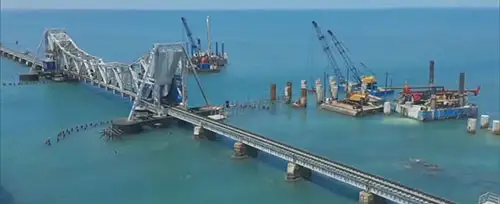
New Pamban Bridge: The newly constructed Pamban Bridge, connecting Rameswaram with the mainland, is India’s first vertical lift railway sea bridge. It has emerged as a standout symbol of modern Indian infrastructure on the world map. The 2.07- km structure includes a 72.5-metre vertical lift section that can rise 17 metres, allowing ships to pass safely without halting train movement. The new Pamban Bridge’s construction encountered major environmental and logistical challenges, including turbulent waters, strong winds, cyclones and seismic risks, and the difficulty of transporting heavy materials to the remote site within tight tidal windows.

Dhola–Sadiya Bridge: Also known as the Bhupen Hazarika Setu, it is a vital link between Assam and Arunachal Pradesh, providing the first permanent road connection between northern Assam and eastern Arunachal Pradesh. Built as a beam bridge, it sweeps over the Lohit River, one of the Brahmaputra’s major tributaries, connecting Dhola in Tinsukia district to Sadiya in the north. Stretching 9.15 km, it is built to withstand the load of 60-tonne military tanks, including the Indian Army’s Arjun and T-72 models. This capability adds significant strategic value to the structure.

Unmatched scale

Anji Khad Bridge: The bridge pierces the Himalayan landscape with an elegance and scale unmatched, emerging as India’s first cable-stayed railway bridge and a key link in the Katra–Banihal section of the Udhampur-SrinagarBaramulla Rail Line. Located about 80 km from Jammu and set against snowcapped peaks, the bridge soars 331 metres above the Anji River valley and extends 725 metres across the gorge. Its defining feature is an inverted Y-shaped pylon rising 193 metres above its foundation, supported by 96 high-tensile cables. More than 8,200 metric tonnes of structural steel reinforce the bridge, enabling it to withstand seismic activity. The bridge was built through extremely rugged conditions marked by cherty limestone formations and unstable hill-wash debris. India’s bridges are more than infrastructure; they are statements of intent, connecting a nation defined by scale and contrast. They rise from mountainsides, pierce through monsoon clouds, and skim the surface of some of the subcontinent’s most volatile waters. Through every corner of this vast terrain, these bridges reflect India’s drive and determination.


Related Posts

IRDAI Flags High Insurance Commissions and Mis-selling
Opinion

Whose insurance is it?

October 3, 2026
hiring
Opinion

Job impact crucial to e-mobility push

October 3, 2026
Global Fintech Fest 2026
Opinion

FinTech Fest signals INDIA’S LEAP

September 18, 2026
airline apps India stagnation
Opinion

The APP that lost altitude

September 4, 2026
Water
Opinion

Diplomatic impasse

September 4, 2026
Himalayan infrastructure and climate risk
Opinion

A wake-up call

September 4, 2026
Load More
Next Post
RBI

Lock the stable

Recent News

Third road to Ladakh opens new strategic route
News

Third road to Ladakh opens new strategic route

by Blitz India Media
October 15, 2026
0

LEH, 15 October For most of the year, Ladakh depended on two roads to connect from rest of India, the...

Read moreDetails
Rajnath Singh

India offers ASEAN joint manufacture of defence systems

October 14, 2026
India Canada diplomatic ties

India News: Canada Ties, Ports, Minerals and Stubble Fires

October 14, 2026
Asian Champions Trophy 2026

Pathak returns as India names squad for Asian Champions Trophy

October 13, 2026
Electronics production grows seven-fold : MeitY

New Delhi, 13 October : India’s fintech sector raised $2.2 billion in the first nine months of 2026 (January 1, 2026–September 30, 2026), up 14 per cent from $1.9 billion in the same period a year earlier, a report said. The report from data intelligence platform Tracxn Technologies Limited said funding rounds dipped from 260 to 153, adding that the funding was concentrated in a smaller number of large late‑stage rounds, with five mega‑rounds of $100 million or more accounting for $1.1 billion or 48 per cent of total capital. The report said in the first nine months of 2026, digital lending and payments topped the category rankings, while Bengaluru accounts for over three-fifths of all capital raised. On the exit side, IPOs saw a 50 per cent uptick while overall acquisitions slowed. As many as 30 companies raised their first funding round, down 49 per cent from 59 in the previous year. Series A and later rounds totalled 77, down 31 per cent from 112. Late-stage funding (Series C+, PE, and pre-IPO) led the mix, rising 95 per cent to $1.5 billion in the first nine months of 2026 — up from $751 million during the same period in the previous year. This capital surge pushed late-stage investments to 67 per cent of total market funding, the report noted. Earlier stages experienced contractions in capital and deal counts. Early-stage funding fell 33 per cent to $668 million across 52 rounds, compared to $1 billion across 82 rounds in nine months of 2025. Seed funding fell 57 per cent to $73.8 million across 76 rounds, down from $173 million across 148 rounds. New unicorns crossed the billion-dollar threshold in an average of 7.1 years after their Series A funding. Moreover, the industry saw 3 IPOs in nine months of 2026, up 50 per cent from 2 in the previous year, alongside 11 acquisitions, down 45 per cent from 20.

October 13, 2026

Blitz Highlights

  • Special
  • Spotlight
  • Insight
  • Entertainment
  • Health

International Editions

  • US (New York)
  • UK (London)
  • Middle East (Dubai)
  • Tanzania (Africa)

Nation

  • East
  • West
  • South
  • North
  • Hindi Edition

E-paper

  • India
  • Hindi E-paper
  • Dubai E-Paper
  • USA E-Paper
  • UK-Epaper
  • Tanzania E-paper

Useful Links

  • About us
  • Team
  • Privacy Policy
  • Contact

©2024 Blitz India Media -Building A New Nation

Welcome Back!

Login to your account below

Forgotten Password?

Retrieve your password

Please enter your username or email address to reset your password.

Log In

    No Result
    View All Result
    • Blitz Highlights
      • Special
      • Spotlight
      • Insight
      • Entertainment
      • Sports
    • Opinion
    • Legal
    • Perspective
    • Nation
      • East
      • West
      • North
      • South
    • Business & Economy
    • World
    • Hindi Edition
    • International Editions
      • Dubai
      • Tanzania
      • United Kingdom
      • USA
    • Blitz India Business

    ©2024 Blitz India Media -Building A New Nation