Blitz Bureau
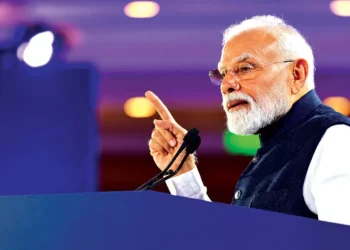
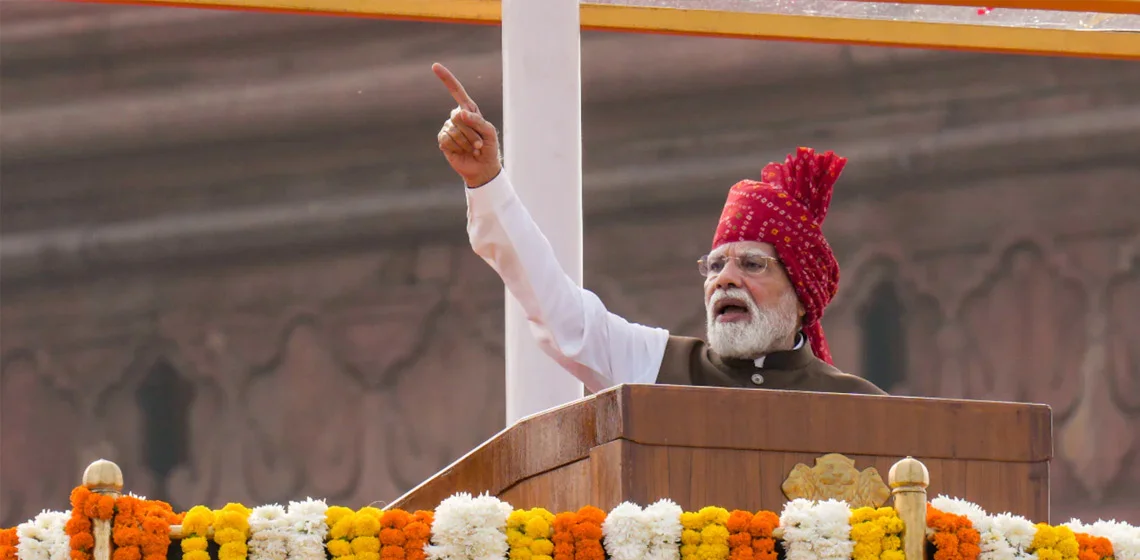
NEW DELHI: Resolve, continuity and decisive action; these were the central themes of Prime Minister Narendra Modi’s Independence Day address to the nation as he outlined his Government’s approach to steering India through global uncertainty.
From the ramparts of the iconic Red Fort, PM Modi unveiled a seven-point reform and development agenda – Shakti ki Saptdhara – to accelerate the country’s growth journey. The next ¿ve to seven years, he said, would be decisive in converting India’s economic and strategic ambitions into gains. The Prime Minister’s message was one of con¿dence as he declared that diႈcult circumstances would not slow India’s march towards Viksit Bharat by 2047.
Development current
Drawing on the ancient reference to Sapta Sindhu, or seven rivers, PM Modi described the seven “streams of strength” as a new current of development that would help India overcome un¿nished challenges and accelerate reforms. The framework reÀects his resolve to keep reforms moving despite pressures.
The seven pillars are manufacturing; agriculture and food processing; technology and innovation; Gati Shakti and high-speed connectivity; Raksha Shakti and defence capability; the green and blue economy; and the country’s soft power.
Manufacturing occupies the ¿rst place in the new framework. PM Modi said India could no longer remain merely a large market and must emerge as a competitive supplier. Indian products, he said, must compete globally on cost, quality and scale. Agriculture and food processing form the second pillar. The PM called for taking Indian farm products from “farm to export market”, identifying spices, millets, fruits, Àowers and traditional cuisine as potential global brands. Free-trade agreements, he said, were opening new markets for farmers.
Drawing on the ancient reference to Sapta Sindhu, or seven rivers, PM Modi described the seven “streams of strength” as a new current of development that would help India overcome unfinished challenges and accelerate reforms
Digital solutions
The third pillar – technology and innovation – places Arti¿cial Intelligence, quantum technology, space, robotics, data centres and next-generation communications at the heart of India’s growth strategy. Building on UPI and Digital Public Infrastructure, PM Modi called for Indian digital solutions to reach global markets and for Made-in-India 6G to reach the country. Gati Shakti, the fourth stream, focuses on faster and seamless connectivity, including highspeed rail, integrated transport networks and ports.
The ¿fth, Raksha Shakti, seeks to turn India from a major defence importer into a competitive producer and exporter. PM Modi stressed the need to develop advanced systems, including hypersonic technologies. The green and blue economy forms the sixth pillar, with an emphasis on green hydrogen, renewable energy, energy storage, ¿sheries, coastal tourism and ocean technology.
Soft power, the final stream, seeks to leverage Yoga, Ayurveda, tourism, wellness, culture and India’s creative industries. Together, the seven pillars are intended to give the country strength and momentum, providing a roadmap for completing un¿nished tasks in the years ahead.