Blitz Bureau
NEW DELHI: Six months after the February trade understanding cut the American reciprocal tariff on Indian goods to 18 per cent from 25, the first clean monthly read-out has arrived — and it came in the form of a record.
The sequence is worth restating precisely, because it has been reported loosely. Indian exports to the United States had faced a 25 per cent reciprocal tariff, to which a further 25 per cent penalty was added over India’s purchases of Russian crude, taking the headline rate to 50 per cent — among the steepest applied to any American trading partner. On 2 February 2026 the two governments announced an understanding under which the reciprocal tariff fell to 18 per cent and the additional 25 per cent penalty was removed by Executive Order. Union Commerce and Industry Minister Piyush Goyal confirmed the 18 per cent figure on 7 February.
The sectors that gain most from a tariff cut are not the largest ones but the thinnest-margin ones, and that is what the deal targeted. Textiles and apparel, gems and jewellery, pharmaceuticals and engineering goods all work on margins narrow enough that a 25-point tariff swing decides whether an order is placed in Tiruppur or in Dhaka. Alongside them a specific agricultural list — spices, tea, coffee, cashew, chestnut, avocado, banana, mango, kiwi and papaya — attracts zero duty in the United States. For a mango grower in Ratnagiri or a coffee planter in Chikkamagaluru that is not an abstraction; it is the difference between an American buyer and no American buyer.
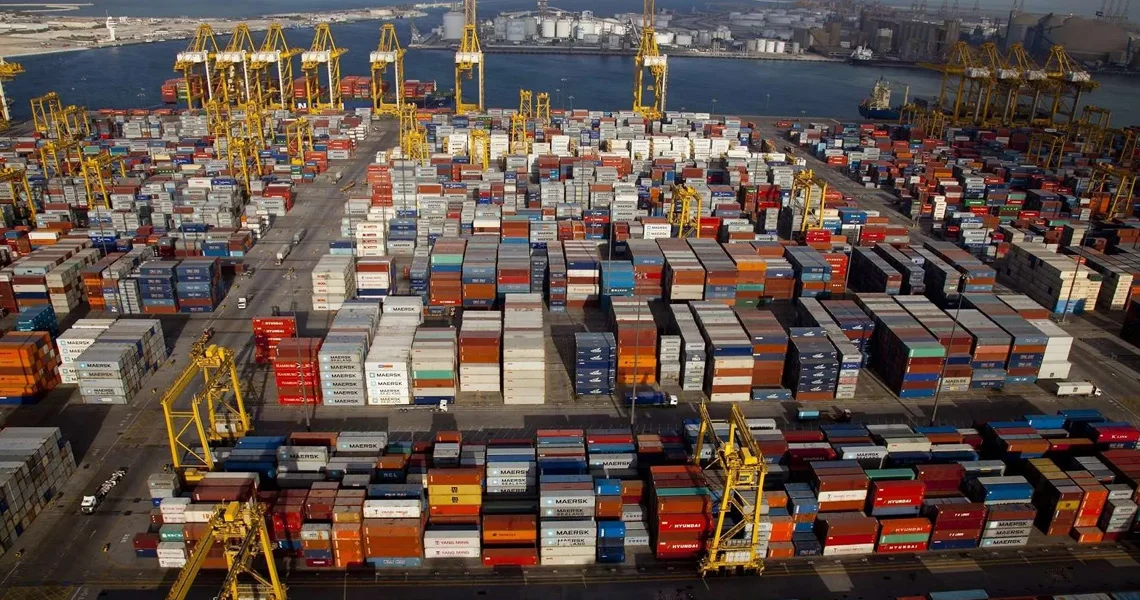
Where the tariff line lands: A container terminal in India. Merchandise exports reached $44.24 billion in July 2026, the highest monthly figure ever recorded, beating the previous July record of $38.34 billion set in 2022.
A tariff cut of 25 points on textiles, gems and engineering goods is not a diplomatic gesture. On margins that thin, it decides where the order is placed.
At a Glance
• Reciprocal tariff: cut to 18 per cent from 25, announced 2 February 2026
• Russian-oil penalty: additional 25 per cent removed by Executive Order
• Peak combined rate: 50 per cent before the understanding
• Sectors named: textiles and apparel, gems and jewellery, pharmaceuticals, engineering goods
• Zero-duty agricultural list: spices, tea, coffee, cashew, chestnut, avocado, banana, mango, kiwi, papaya
• July 2026 merchandise exports: $44.24 billion, up 19.63 per cent
• Previous July record: $38.34 billion (July 2022)
• April-July 2026-27 overall exports: $316.42 billion, up 13.16 per cent
July’s trade numbers are the first month in which the effect should show without distortion, and merchandise exports reached $44.24 billion, an all-time high for any July and 19.63 per cent above July 2025. The previous July record, $38.34 billion, had stood since 2022. The United States is not the only reason — the United Kingdom agreement came into force on 15 July and the Gulf trade is running at record levels — but a tariff cut of that size on that basket of goods is not a small part of it.
The honest qualification is that a single month is not a trend, and the same month’s import bill grew faster than the export line. Overall imports rose 15.82 per cent against 13.32 per cent for exports, which is arithmetically the whole reason the overall trade deficit widened to $15.03 billion. Energy prices explain much of that, and energy prices are not set in Delhi or Washington.
What would make the gain durable is diversification within the American market rather than volume alone. The lesson visible in India’s other export data — the makhana trade being the clearest small example — is that a concentrated market that buys a great deal at a low unit price is a weaker position than a spread of markets paying well. The forward-looking work now is in certification, cold chain and buyer relationships for the higher-value American segments, so that the 18 per cent tariff line translates into better prices and not only bigger containers. For the diaspora and for Indian exporters alike, the next number to watch is the destination-wise unit realisation, not the headline total.