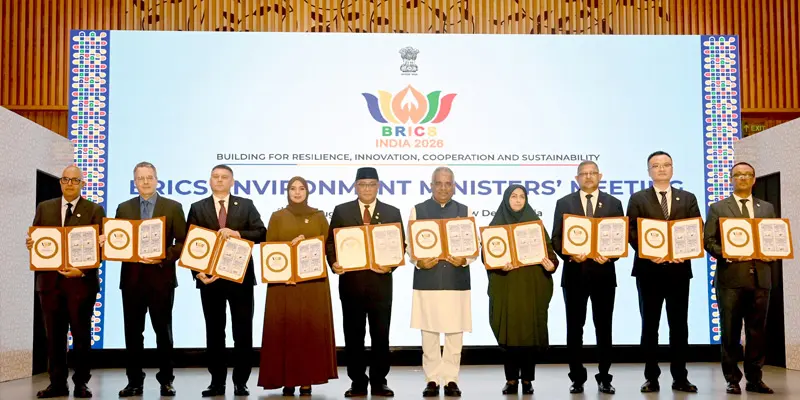
The 12th BRICS Environment Ministers’ Meeting which concluded here on August 18 adopted the Joint Ministerial Statement, comprising four outcome documents, which include the advancement of knowledge sharing, research, and innovation in sustainable lifestyles by the network of BRICS institutions.
The joint statement also covers BRICS principles for integrated landscape mana g e – m e n t for combating deserti¿cation, sustainable land management, and ecosystem resilience. Besides, it includes a common understanding for forest ¿re preparedness and response across BRICS and charts out the principles for advancing climate resilience through people-centric and community-based adaptation built on traditional knowledge.
Mutual learning
“ReÀecting the spirit of collaboration and mutual learning, under the India BRICS Chairship, the Compendiums of the Environment Working Group during the 12th BRICS Environment Ministers’ Meeting have been launched. The compendiums present a rich compilation of experiences, innovative approaches, traditional knowledge and shared experiences from BRICS Member Countries,” India’s Environment, Forest and Climate Change Minister Bhupender Yadav said.
Delivering the keynote address, he stated that India’s Chairship is guided by the vision of Prime Minister Narendra Modi in placing the concerns of the Global South at the forefront of the agenda and rede¿ning BRICS as “Building Resilience and Innovation for Cooperation and Sustainability”, with a peoplecentric approach and the spirit of “Humanity First”.
Noting that the progress achieved during India’s Chairship reÀects months of dialogue, negotiation and collaboration, he called for building resilience without leaving communities behind, pursuing innovation with responsibility and placing sustainability at the centre of development.
The minister further stressed that BRICS can “convert cooperation into collective and co-operative capability” through knowledge networks, technical exchanges, training, technology cooperation, and stronger institutional partnerships.
Environmental challenges
Yadav highlighted the growing global environmental challenges of climate change, biodiversity loss, pollution and disaster risks, particularly for developing countries where environmental vulnerability is often closely intertwined with broader development priorities. He called for stronger BRICS cooperation on forest ¿re prevention, preparedness, early warning, response and post-¿re recovery, while stressing the importance of climate ¿nance, adaptation and empowering local communities