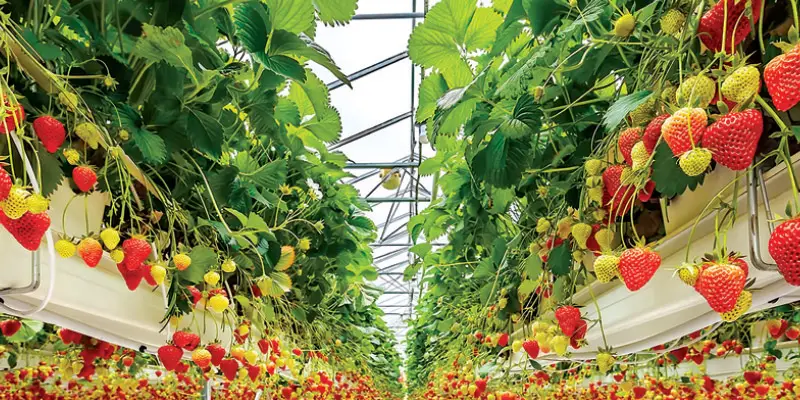
NEW DELHI: For crop factories to scale globally and achieve cost parity with traditional farming, the economic model must overcome three primary barriers: energy costs, capital expenditure, and automation. The global economics required to make this happen involve several key shifts.
Decoupling from grid electricity: The single largest operating expense for indoor farming is lighting and HVAC (heating, ventilation, and air conditioning). To scale economically, crop factories cannot rely on dirty or expensive grid power.
The economic solution is co-locating indoor farms with dedicated renewable energy sources, such as solar arrays with battery storage or geothermal energy. When power is virtually free and continuous at the point of generation, the energy barrier drops dramatically.
Early indoor farms suffered from high electricity bills because they used inefficient lighting. Advanced, highly efficient LED systems tailored precisely to the photosynthetic absorption peaks of specific plants have drastically cut energy footprints. As LED manufacturing scales globally, hardware costs continue to plummet.
Labour accounts for a massive slice of operational overhead in standard agriculture and early indoor setups (planting, pruning, harvesting, and packaging).
The economic solution lies in treating the crop factory like an automated automotive or electronics assembly line. Robotic seeding, automated gantry systems that move growing trays automatically, and AI-driven harvesting arms eliminate labour bottlenecks, driving unit production costs down over time.
Open-field farming hides massive external costs that indoor factories bypass. Up to 30 per cent of traditional fresh produce spoils during transport or in supply chains. Crop factories are built adjacent to or inside cities, reducing distribution loss to near zero.
Water and land efficiency: Indoor hydroponic systems use up to 95 per cent less water and zero pesticides. As water scarcity intensifies globally, governments will increasingly price water or heavily subsidise water-efficient indoor systems, shifting the economic balance away from open-field irrigation.