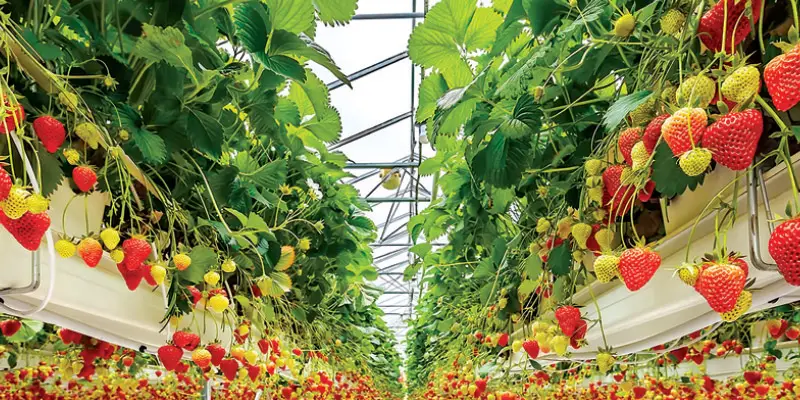
NEW DELHI: The transition of food production from open fields to closed, temperature-controlled environments – often referred to as Controlled Environment Agriculture (CEA) – is one of the most profound structural shifts in modern agriculture.
Deploying drones, IoT sensors, and precision machinery across open fields is fundamentally trying to optimise an inherently unoptimisable system. Open-air farming remains at the mercy of unpredictable weather, erratic rainfall, pests, and long supply chains. In contrast, treating a crop factory like a precision manufacturing line eliminates variables rather than just monitoring them.
Will indoor and greenhouse cultivation become the norm rather than the exception? The answer depends entirely on which crops we are talking about.
For leafy greens, herbs, and berries, yes. In urbanising regions and water-stressed countries, indoor vertical farms and high-tech greenhouses are rapidly capturing major market shares. For crops that have a short growth cycle, low height, and high retail value per kilogram, indoor factories are already outcompeting open-field agriculture.
For staple crops like wheat, rice, and corn, it is unlikely. Staples are ‘calorie-dense, low-value’ commodities. Growing a tonne of wheat under artificial LED lights and indoor climate control requires too much energy to compete economically with broad acre field farming.
Therefore, indoor ‘crop factories’ will not replace rural agriculture, but they will become the dominant norm for fresh, perishable, and high-value produce.