Blitz Bureau
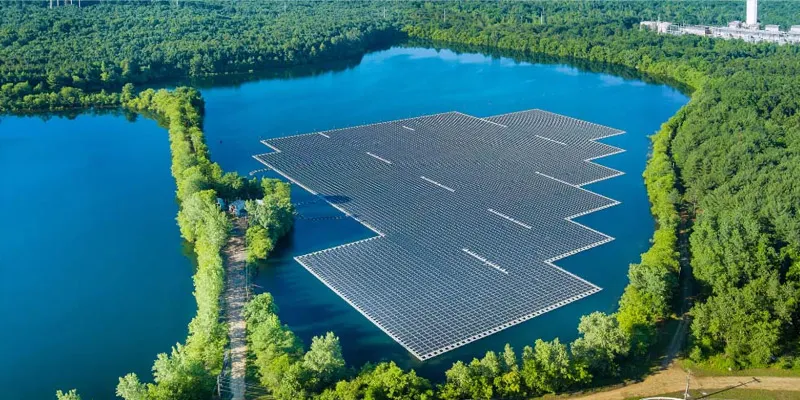
NEW DELHI: The binding constraint on Indian solar has not been panels, finance or ambition for several years. It has been contiguous land with a transmission line near it, acquired without a dispute. The Cabinet on July 31 approved the Pradhan Mantri Surya Sarovar Yojana with an outlay of ₹5,070 crore, supporting 5,000 MW of floating solar photovoltaic capacity paired with 10,000 MWh of co-located battery energy storage on reservoirs, dams, lakes and industrial ponds.
The financial structure tells you what the government thinks the obstacle is. Central assistance is ₹1 crore per MW, payable after successful commissioning — a completion-linked subsidy rather than an upfront grant, which shifts execution risk to the developer. Alongside it sits a smaller and more revealing provision: up to ₹50 lakh per project for feasibility work, explicitly including bathymetry and hydrography, environmental studies and other preparatory assessments. Bathymetry is the mapping of a water body’s floor. It is a line item almost no Indian renewable scheme has previously funded, and its presence is an admission that floating solar fails for reasons ground-mounted solar never encounters — anchoring depth, sediment, seasonal drawdown, and the behaviour of a reservoir that is two-thirds empty in May.
No acquisition, no displacement: the scheme targets reservoirs, dams, lakes and industrial ponds — surfaces the state already controls, most of them already connected to a grid substation.
A reservoir behind a dam is the rarest thing in Indian infrastructure: a large flat surface that nobody has to be moved off, already wired to the grid.
At a Glance
• Scheme: Pradhan Mantri Surya Sarovar Yojana, approved July 31, 2026
• Outlay: ₹5,070 crore
• Capacity: 5,000 MW of floating solar with 10,000 MWh of co-located battery storage
• Central assistance: ₹1 crore per MW, paid after successful commissioning
• Feasibility support: up to ₹50 lakh per project, including bathymetry and hydrography
• Sanction window: FY2026–27 to FY2030–31; disbursement continues to FY2032–33
• Projected effect: around 10 million tonnes of CO₂ avoided annually; 16,000–17,000 jobs
The storage pairing is the part that changes the electricity, not just the emissions. Two megawatt-hours of battery for every megawatt of panel is roughly two hours of full-output shifting — not enough to carry a night, but well matched to the evening ramp when Indian demand peaks and solar output has already collapsed. That is the specific hour at which the grid currently reaches for coal. Building storage into the same tender as the generation, rather than procuring it separately years later, is how a scheme of this size avoids repeating the sequencing problem that has left large amounts of Indian midday solar curtailed for want of anywhere to put it. There is a second, less obvious dividend: panels sitting on water run cooler than panels on hot ground, and cooler photovoltaic cells are more efficient ones, while the shading reduces evaporation from the reservoir beneath.
Two things will decide whether 5,000 MW actually appears. The first is the operating relationship between a solar developer and a dam authority whose primary duty is irrigation or flood control, not generation — reservoir levels will be managed for water, and the anchoring design has to accept that. Model concession terms issued centrally, rather than negotiated afresh with each state water resources department, would remove most of that friction at a stroke. The second is domestic content in floats and mooring systems, which is currently a thin manufacturing base; a five-year sanction window is precisely the visibility a component maker needs to invest, and the scheme’s own job estimate of 16,000 to 17,000 positions assumes that base develops. Both are solvable, and both are cheaper to solve now than after the first tender.