
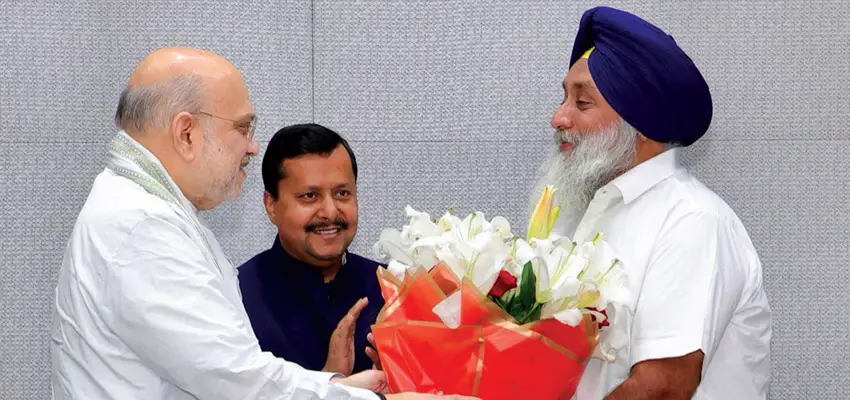
After a six-year separation, the Shiromani Akali Dal (SAD) and the Bharatiya Janata Party (BJP) have stitched their alliance again ahead of the 2027 Punjab Assembly elections.
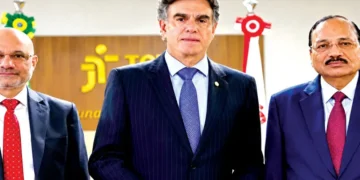
Union Home Minister Amit Shah, BJP National President Nitin Nabin and SAD President SAD, BJP stitch alliance again Sukhbir Singh Badal made the announcement at the BJP headquarters in New Delhi on November 24.
The announcement comes on the occasion of Guru Nanak Dev’s Prakash Purab.
The two had parted ways in September 2020 over the Centre’s now-repealed farm laws.
The announcement is expected to strengthen the Opposition’s efforts to challenge the ruling Aam Aadmi Party (AAP) Government and the Congress in the upcoming state elections.
“The Akali Dal will be in an elder brother’s role,” clarified Shah to the media, adding “the elder is in the role of the Chief Minister”.
The alliance for the 117-member Assembly marks the return of a partnership that dominated Punjab politics for years.
The two parties governed the state together from 2007 to 2017, but their relationship collapsed in 2020 when the SAD withdrew from the National Democratic Alliance (NDA) in protest against the three farm laws, which were subsequently repealed. Both parties struggled electorally after contesting separately.
In the 2022 Assembly elections, the AAP secured 92 of Punjab’s 117 seats, while the Akali Dal was reduced to three seats and the BJP won two. Their weakened electoral position has increased the incentive for the former allies to reunite.
Renewed alliance
The distribution of Assembly constituencies is likely to be one of the most crucial aspects of the renewed alliance. Under their earlier arrangement, the BJP generally contested around 23 seats, while SAD fielded candidates in the remaining 94.
However, the BJP is now seeking a larger share of seats, reflecting its ambition to expand its political footprint in Punjab.
The Akali Dal hopes the alliance will help it regain its traditional support base among Sikh voters, farmers and rural communities.
Congress leaders have criticised the proposed reunion, describing it as political opportunism and questioning whether the two parties have genuinely resolved the issues that led to their split in 2020.