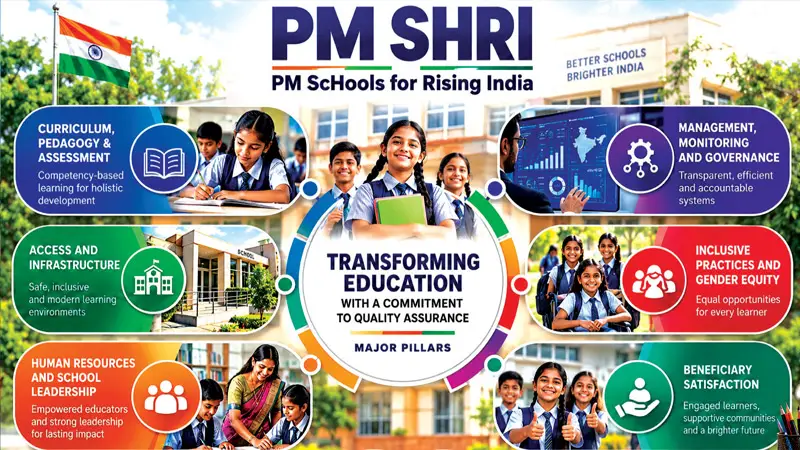
NEW DELHI: India is witnessing a significant transformation in its school education system, marked by a growing emphasis on quality, equity, inclusion, and future-ready learning. With 14.71 lakh schools serving more than 24.69 crore students, the education system is increasingly focused on enhancing learning outcomes and creating enabling environments that support holistic development.
The National Education Policy (NEP) 2020 furnishes the overarching framework for this transformation, while the PM SHRI initiative operationalises its vision at the school level, translating policy intent into institutional practice.
Launched on September 7, 2022, the Pradhan Mantri Schools for Rising India (PM SHRI) is a Centrally-sponsored scheme that seeks to qualitatively strengthen existing schools and develop them as exemplar institutions demonstrating the effective implementation of the National Education Policy (NEP) 2020.
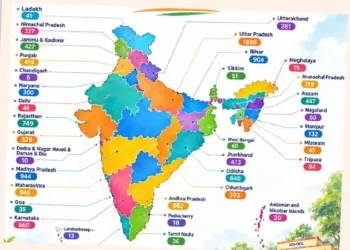
With a total project cost of Rs 27,360 crore, the scheme focuses on strengthening more than 14,500 existing schools as exemplar institutions. These schools are envisioned to provide safe, stimulating, and welcoming learning environments, supported by quality infrastructure, appropriate learning resources, and diverse learning experiences. As of July this year, 13,092 schools have been selected as PM SHRI schools.
Strategic focus
The scheme extends support beyond strengthening individual schools. PM SHRI schools are envisioned as models for their regions, sharing their practices and supporting neighbouring schools through mentoring, handholding, collaboration and clustering. This is intended to create a ripple effect, enabling more schools to develop towards exemplar standards over time.
At the core of the scheme is a vision of education that fosters lifelong learning and equips students with the capacity and disposition to learn, unlearn and relearn. The broader objective is to develop engaged, productive and responsible citizens capable of contributing to the creation of an equitable, inclusive and plural society.
The scheme aims to showcase all the components of the National Education Policy 2020 and focuses not only on cognitive development but also on creating holistic and well-rounded individuals equipped with key 21st century skills. It focuses on creating an equitable, inclusive, and joyful learning environment that caters to diverse backgrounds and varied academic abilities.
Major dimensions
Inclusive learning: Provide high-quality, equitable, and joyful education while addressing diverse backgrounds and multilingual needs.
Mentorship: PM SHRI schools serve as exemplar schools and provide leadership and mentorship to other schools in their regions.
Green schools: Promote sustainable and environment-friendly practices
Experiential learning: Emphasise experiential, holistic, integrated, inquiry-based, and learner-centered approaches
Learning outcomes: Focus on curriculum, pedagogy and assessment to strengthen learning outcomes and application of knowledge.
Quality infrastructure: Involves assessing school infrastructure on parameters including adequacy, functionality, aesthetics and safety.
Future-ready skills: Exposure to 21st century skills and linking schools with local entrepreneurial ecosystem.
Quality assessment: The School Quality Assessment Framework (SQAF) provides a structured mechanism to assess and monitor the quality of PM SHRI schools.
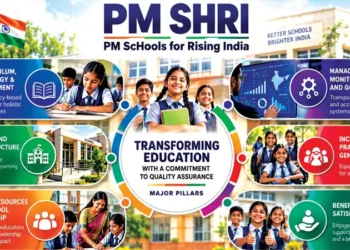
Key pillars of scheme
Learning designed around child: PM SHRI schools follow either the CBSE or the relevant state or UT syllabus. States and UTs have flexibility to contextualise the curriculum according to local needs. These schools also promote experiential learning through bagless days, internships with local artisans, and study of local arts, crafts and traditions.
Equity and inclusion: By focusing on bridging educational disparities, these schools help create a more equitable learning environment across India. The scheme also promotes the use of the mother tongue, local or regional language as the medium of teaching and learning.
Tech-enabled learning: A significant achievement of PM SHRI Schools lies in the systematic integration of technology into the teaching–learning environment. The provision of Information and Communication Technology (ICT) facilities, smart classrooms, internet connectivity, digital learning platforms, and STEM-based programmes is contributing to the creation of more interactive, experiential, and learner-centred educational environments.
Holistic development: PM SHRI Schools adopt a holistic approach to student development by integrating academic learning with extracurricular activities, sports, arts, and life-skills education. This approach extends beyond conventional academic achievement to foster the development of leadership capabilities, creativity, socio-emotional competencies, and interpersonal skills.
Empowering teachers: These schools seek to strengthen teacher capacity and institutional leadership through structured professional development initiatives supported by District Institutes of Education and Training (DIETs). Under the initiative, financial assistance of up to Rs 3 lakh per DIET is provided for capacity-building programmes. Principals are provided training in educational leadership, school management, and competency-based pedagogical planning.
The scheme seeks to qualitatively strengthen existing schools and develop them as exemplar institutions demonstrating the effective implementation of the National Education Policy (NEP) 2020
Models for change
PM SHRI represents a paradigm shift from an infrastructure-centric approach to school development towards the establishment of holistic, inclusive, equitable, and future-ready learning institutions. The initiative operationalises the vision and priorities of the National Education Policy (NEP) 2020 by emphasising quality and competency-based learning, continuous teacher professional development, technology-enabled education, and the creation of a safe, inclusive, and enabling school environment.
As exemplar institutions, these schools are envisaged to demonstrate and disseminate innovative educational practices that can be adapted and replicated by neighbouring schools, thereby contributing to broader systemic improvements in school education.
The overarching objective is to foster capable, confident, creative, and responsible learners, equipped with the knowledge, skills, and values required to participate meaningfully in a more equitable, inclusive, and future-ready India.
PM SHRI Schools adopt a holistic approach to student development by integrating academic learning with extracurricular activities, sports, arts, and life-skills education