Blitz Bureau
NEW DELHI:Not long ago, a simple financial transaction demanded time, effort, and patience. Paying bills meant standing in long queues. Sending money required a visit to the bank, filling out forms, and waiting days for confirmation. For millions in India without access to banking, it meant exclusion from the financial system itself. That India, however, is now the past.
India’s financial journey has evolved over centuries from barter systems and cowrie shells to coins, paper currency, and cheques. For much of its modern history, cash remained the dominant mode of transaction. While cheques and demand drafts formalised payments, they were slow and accessible only to a limited segment. Banking infrastructure was largely urban-centric, leaving rural and remote populations underserved.
Significant but limited
The early 2000s marked the beginning of digital transformation in payments. The Reserve Bank of India introduced systems like Real-Time Gross Settlement (RTGS) in 2004 and Immediate Payment Service (IMPS) in 2010, enabling faster and round-the-clock transfers. These were significant milestones, but their reach remained limited to those already within the banking ecosystem.
A large segment of India’s population remained outside formal finance, without access to credit, insurance, or secure savings. The absence of a scalable, inclusive, and real-time digital infrastructure meant that the benefits of economic growth could not fully reach everyone.
The need for a transformational shift was clear and it was this need that set the stage for India’s digital payments revolution.

India’s digital payments transformation is built on a foundational architecture comprising three key pillars – Pradhan Mantri Jan-Dhan Yojana (Jan Dhan), Aadhaar, and mobile connectivity, collectively known as the JAM Trinity. Each pillar serves a distinct purpose, but together they have strengthened the financial ecosystem by reducing leakages, enhancing trust in formal banking, and preparing citizens to engage with digital services.
A radical innovation
The Pradhan Mantri Jan-Dhan Yojana has brought millions into the formal banking system by enabling the large-scale opening of zero-balance accounts. Aadhaar has strengthened this foundation by providing a reliable digital identity. Complementing both, the rapid expansion of mobile connectivity and internet access has empowered citizens with a convenient, real-time interface for communication, authentication, and transactions.
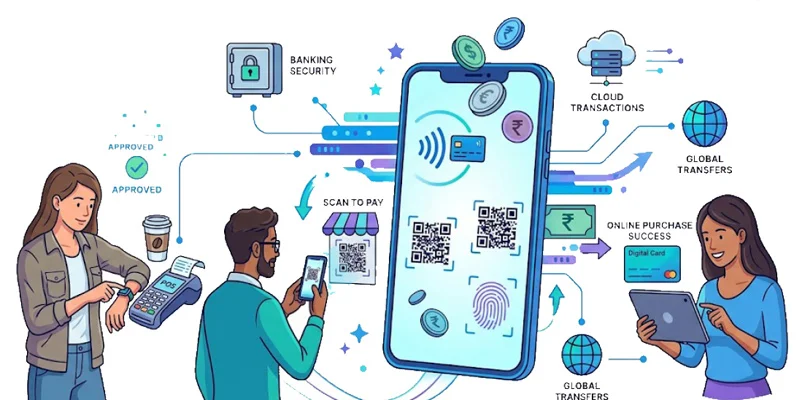
In 2016, the National Payments Corporation of India launched the Unified Payments Interface (UPI), a system that fundamentally simplified how money moves in India. At its core, UPI enables any bank account to connect with another through a Virtual Payment Address, removing the need to share detailed banking information.
The idea of UPI was radical in its simplicity. No account numbers to memorise. It replaces complex inputs like account numbers and IFSC codes with a simple interface. Users only need a mobile number, a UPI ID, and secure authentication to initiate instant transfers.
This interoperability has been central to UPI’s rapid expansion. From 216 banks in 2021 to 691 by January 2026, the network has grown into a unified payments infrastructure, enabling users to transact effortlessly regardless of their bank or platform.
As UPI scaled, its impact extended beyond ease of payments. It began to reshape how individuals, small businesses, and informal workers participate in the financial system. Digital transactions became more accessible, reliable, and widely adopted across regions and income groups.
Beyond convenience
UPI has moved beyond simplifying payments to reshaping participation in the financial system. By enabling instant, low-cost transactions, it has reduced dependence on cash, improved efficiency, and opened access to formal finance for millions. For small merchants and informal workers, this shift is especially significant, creating new pathways to credit, insurance, and savings.
UPI has moved beyond simplifying payments to reshaping participation in the financial system. By enabling instant, low-cost transactions, it has reduced dependence on cash, improved efficiency, and opened access to formal finance
The real story lies not in the volume of transactions, but in who is transacting. Autorickshaw drivers accept payments through QR codes. Village mandis settle transactions instantly. Street vendors no longer struggle with change. A domestic worker can send money across states in seconds using a basic smartphone.
In this system, the divide between urban and rural, formal and informal, steadily disappears – marking a decisive shift towards financial inclusion.
At the same time, UPI is evolving into a broader financial platform. UPI Lite supports quick, small-value payments, while UPI AutoPay streamlines recurring expenses such as utility bills and subscriptions. Credit on UPI extends its reach further by enabling access to pre-approved credit lines.
Building on this expanding ecosystem, UPI is now embedded in the everyday economic fabric of the country. What began as a tool for convenience has evolved into a dependable system that supports individuals, businesses, and financial institutions alike.
Ease and trust
For users, the experience is defined by ease and trust. Transactions can be completed anytime, from anywhere, through a single application connected to multiple bank accounts. There is no need to share sensitive banking details, and built-in safeguards ensure that payments remain secure.
Further strengthening this trust, the RBI has introduced enhanced authentication mechanisms for digital payment transactions, effective from April this year. The mandate of two-factor authentication ensures that every transaction is verified through multiple layers, such as PINs, biometrics, or secure tokens alongside OTPs. This significantly reducing fraud risks while reinforcing confidence in digital platforms.