
• About us
  • Team
  • Privacy Policy
  • Contact
Friday, November 20, 2026
  • Login
No Result
View All Result
World's first weekly chronicle of development news
  • Blitz Highlights
    • Special
    • Spotlight
    • Insight
    • Entertainment
    • Sports
  • Opinion
  • Legal
  • Perspective
  • Nation
    • East
    • West
    • North
    • South
  • Business & Economy
  • World
  • Hindi Edition
  • International Editions
    • Dubai
    • Tanzania
    • United Kingdom
    • USA
  • Blitz India Business
No Result
View All Result
World's first weekly chronicle of development news
No Result
View All Result

Wholesome POOR

It’s not just rupees, India’s crusade against poverty tracks 12 indicators

by Blitz India Media
October 31, 2026
in Special
0
Wholesome POOR

When the UN framed the 2030 Agenda for Sustainable Development in 2015, Sustainable Development Goal 1 – No Poverty – was placed at the very top. Under the earlier Millennium Development Goals (MDGs), poverty was largely measured through a narrow financial lens: did a household survive above or below a fixed income line (historically pegged to rigid daily expenditure benchmarks).

In the Indian context, this was mirrored for decades by traditional poverty lines like the Tendulkar or Rangarajan committees, which evaluated deprivation almost entirely on daily per capita consumption expenditure in rupees – such as Rs 27 a day in rural areas or Rs 47 in urban centers.

Empirical consensus

By 2015, a clear empirical consensus dismantled this purely income-centric definition. A household earning just a few rupees above an arbitrary statistical line could still be living in acute deprivation – trapped without clean drinking water, lacking access to electricity, exposed to crippling out-of-pocket medical expenses, and completely excluded from formal banking.

SDG 1 was constructed around a far more comprehensive mandate. It demanded not just the end of extreme poverty, but the halving of multidimensional poverty – defined by the simultaneous deprivations individuals face across health, education, and living standards – by 2030. The core philosophy recognised that daily rupee earnings are merely an input, whereas human capability, social dignity, and structural security are the true measures of poverty eradication.

For India, SDG 1 is not simply an international reporting exercise; it represents the primary national economic mandate. Historically, anti-poverty programmes in the post-Independence era relied heavily on untargeted food subsidies and fragmented relief measures, which frequently suffered from administrative friction and leakages.

Over the past decade, India’s policy architecture has undergone a fundamental transformation, pioneering a model known as targeted saturation delivery. Rather than relying on trickle-down economic growth alone, the state shifted toward universalising access to essential basic needs – constructing clean sanitation facilities under Swachh Bharat, providing piped drinking water through the Jal Jeevan Mission, expanding rural housing through the Pradhan Mantri Awas Yojana, ensuring clean cooking gas distribution via PM Ujjwala, and guaranteeing free foodgrain under the PM Garib Kalyan Anna Yojana.

Structural shift

This structural shift is tracked through Niti Aayog’s National Multidimensional Poverty Index (NMPI). Adapted from the Oxford Poverty and Human Development Initiative (OPHI) and UNDP methodology, the Indian NMPI tracks 12 indicator-based deprivations, explicitly incorporating maternal health and bank account access alongside standard living metrics.

Official data highlights one of the most rapid multidimensional poverty declines recorded in modern history:
India’s multidimensional poverty headcount ratio dropped dramatically from 24.85 per cent in 2015-16 to 14.96 per cent in 2019-21, effectively lifting over 135 million citizens out of multidimensional poverty within that brief five-year window.

Over a broader 15-year evaluation window, over 415 million people exited multidimensional poverty, demonstrating that coordinated public investment in basic living standards can fundamentally rewrite a nation’s socio-economic trajectory.

India’s saturation delivery model
Pillar What it covers
Basic Utilities Sanitation, Housing, Water
Social Security Health Cover (PM-JAY)
DBT Stack JAM Infrastructure, Leak-Free Transfers

Multidimensional Poverty

Economic vulnerability

Despite these landmark achievements, the final mile toward total poverty eradication presents complex structural obstacles. Eliminating the last pockets of extreme poverty requires moving beyond public infrastructure delivery to address systemic economic vulnerabilities:

Preventing re-entry into poverty: Millions of households hovering just above the poverty line remain highly vulnerable to economic shocks. A single major illness in the family, catastrophic crop failure, or sudden loss of daily-wage work in the informal sector can instantly push an uplifted family back into debt and poverty. Expandable safety nets like Ayushman Bharat (PM-JAY), offering Rs 5 lakh annual health coverage per family, provide critical buffers, but long-term security requires steady formal employment.

Overlapping climate threat: Climate change has emerged as a direct accelerator of rural poverty. Unpredictable heatwaves, flash floods, and erratic monsoon cycles disproportionately impact agricultural labour and rural daily-wage workers. Integrating climate resilience into agricultural schemes like PM-Kisan and rural employment guarantees (G-RAM-G) is now inseparable from poverty mitigation.

Regional disparities: While states like Kerala and Tamil Nadu have driven multidimensional poverty rates down near zero, interior rural belts across eastern and central India still require targeted, block-level micro-interventions under initiatives like the Aspirational Districts and Aspirational Blocks Programmes to bridge sub-national development gaps.

India’s journey demonstrates that eradicating poverty is not achieved through passive growth or simple cash handouts, but through a deliberate, tech-enabled, multi-sectoral strategy that builds permanent household resilience.

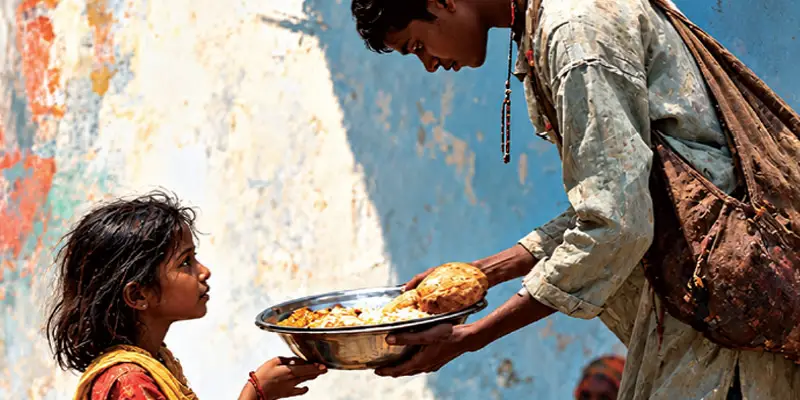
India’s multidimensional poverty headcount ratio dropped dramatically from 24.85 per cent in 2015-16 to 14.96 pc in 2019-21, effectively lifting over 135 million citizens out of multidimensional poverty

Related Posts

Water Prices
Special

World in a drop of water

October 31, 2026
Controlled Environment Agriculture
Special

October 16, 2026
Controlled Environment Agriculture
Special

From OPEN FIELDS to indoor ‘crop factories’

October 16, 2026
Zero Hunger
Special

Hungry TIDE

October 16, 2026
SDG 16: Why Peace, Justice and Institutions Matter
Special

We shall overcome

October 3, 2026
Moets Expands with New Delhi Food Hubs
Special

A well thought out expansion

October 3, 2026
Load More
Next Post
SCO Dialogue

Pak invited

Recent News

India-Japan Defence Cooperation
News

India, Japan reaffirm commitment to free, open and rules-based Indo-Pacific

by Blitz India Media
November 19, 2026
0

Blitz BureauTokyo, 19 November: India and Japan held a 2+2 Ministerial Dialogue in Tokyo, reaffirming their Special Strategic and Global...

Read moreDetails
Indian stock market

Sensex jumps 990 points, Nifty reclaims 25,500 as auto stocks power rally

November 19, 2026
Blitz BureauNew Delhi, 19 November: Former wicketkeeper Ian Healy believes Pat Cummins does not need to stand down as Australia’s Test captain, but he has lost a big part of his credibility following Cameron Bancroft’s fresh claims on the 2018 ball-tampering scandal. Healy’s comments come after Bancroft claimed that the entire side knew about the plan to use sandpaper during the Cape Town Test against South Africa, and that he ‘took the bullet’ for the group. That revelation has turned the spotlight back on Cummins, who was one of the bowlers on that team and who previously said at a press conference last week that they were unaware of the plot. “No, he doesn't need to stand down. And I don't want to get into another panic mode of what happened in 2018, it was panic, and they tried to do an investigation in no time, didn't talk to anyone, it was rubbish. It was a lack of quality and rubbish, and rushed, and panicked. “Now, I can't say whether he should stand down now. Will he stand down? That might be a different thing. He might stand down. I would feel without refuting Cameron Bancroft's words again, he will struggle to captain the team. You've had a big part of your credibility taken away with that press conference now that it's been proven to be not as complete as Pat made it out to be,” Healy told SEN Radio. As per Healy, the hit to the credibility also extends to Cummins fellow bowlers from that series: Josh Hazlewood, Mitchell Starc and Nathan Lyon. “I would say it taints their personal legacies. I don't think it's going to taint their performance legacies. “Either side of this period where there was ball tampering happening - how long was it going before South Africa and probably not much since - but they got very brazen with it, so that tells me it's probably been going on longer than we think. “So they probably achieved some success with their skills, with a ball that's doing more than it was going to. That's a little bit of a part of their career legacy. Performance legacy, no. I think their performances stack up ok to what all the cricket world have been doing. Personally now, they're not as credible as they once were, unless they change something drastically in the next few days.”

Cummins has lost a big part of his credibility, says Healy

November 19, 2026
modi

PM Modi challenges India Inc to raise quality standards

November 19, 2026
India, Italy to strengthen economic partnership

India, Italy to strengthen economic partnership: Goyal

November 18, 2026

Blitz Highlights

  • Special
  • Spotlight
  • Insight
  • Entertainment
  • Health

International Editions

  • US (New York)
  • UK (London)
  • Middle East (Dubai)
  • Tanzania (Africa)

Nation

  • East
  • West
  • South
  • North
  • Hindi Edition

E-paper

  • India
  • Hindi E-paper
  • Dubai E-Paper
  • USA E-Paper
  • UK-Epaper
  • Tanzania E-paper

Useful Links

  • About us
  • Team
  • Privacy Policy
  • Contact

©2024 Blitz India Media -Building A New Nation

Welcome Back!

Login to your account below

Forgotten Password?

Retrieve your password

Please enter your username or email address to reset your password.

Log In

    No Result
    View All Result
    • Blitz Highlights
      • Special
      • Spotlight
      • Insight
      • Entertainment
      • Sports
    • Opinion
    • Legal
    • Perspective
    • Nation
      • East
      • West
      • North
      • South
    • Business & Economy
    • World
    • Hindi Edition
    • International Editions
      • Dubai
      • Tanzania
      • United Kingdom
      • USA
    • Blitz India Business

    ©2024 Blitz India Media -Building A New Nation