Anoop Saxena
NEW DELHI: Inside a brightly lit community centre in rural Madhya Pradesh, 24-year-old Aarti Yadav is speaking into a low-cost smartphone. She isn’t sending a voice note to a friend or scrolling through social media. She is reading aloud a series of complex legal phrases in Gondi, a Central Indian tribal language.
With every sentence Aarti utters, an AI algorithm miles away in a Bengaluru tech park grows smarter. Aarti is an ‘AI Data Labeller’ one of thousands of rural women currently powering Project Bhashini, India’s National Language Translation Mission.
As Artificial Intelligence reshapes the global economy in 2026, the tech world faces an existential crisis: the ‘Silicon Divide’. Traditional Large Language Models (LLMs) are overwhelmingly English-centric, trained on Western data.
For the 70 per cent of India’s population living in rural districts – speaking over 22 official languages and thousands of dialects – the AI boom threatened to become a digital wall, locking them out of the future economy. Project Bhashini is the sledgehammer breaking down that wall, transforming SDG 10 (Reduced Inequalities) from a lofty target into a digital reality.
Hinterland data mines
The narrative around AI often centres on high-profile silicon valleys. But in 2026, the raw material driving India’s localised AI revolution is being harvested in places like Chhindwara.
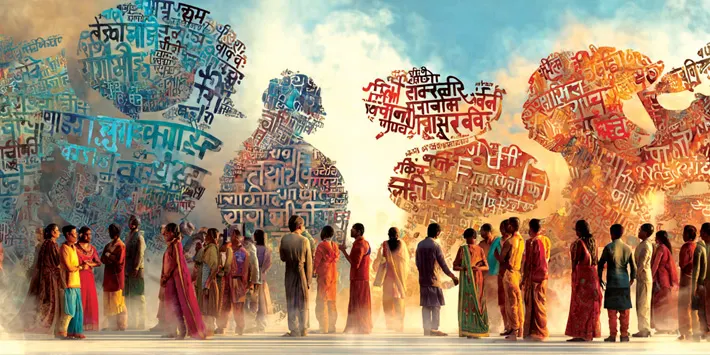
Through localised crowdsourcing apps, rural youths are being paid to validate, translate, and record audio files in their mother tongues. This localised data training ensures that voice-activated AI services can understand a farmer in Bihar or a micro-entrepreneur in Kerala, regardless of their accent or dialect.
“We used to think the digital divide was about who owns a computer,” says Dr Kiran Bedi, a digital inclusion researcher. “In the AI era, the divide is about who the machine understands. If an AI financial bot or healthcare app can only respond to flawless English or formal Hindi, we are effectively disenfranchising half the nation. Bhashini is ensuring the hinterland speaks, and the machine listens.”
The real-world applications of this localised AI are hitting the ground this year. In the agricultural sector, voice-bot systems are allowing non-literate farmers to ask questions about crop diseases in their local dialects and receive instant, AI-synthesised solutions.
In public health, AI triage bots are translating medical symptoms described in regional dialects into standard medical text for doctors in urban centres. This voice-first, local-language ecosystem is bypassing the literacy barrier entirely, levelling the playing field for the rural poor.
CSR for digital equity
This transformation isn’t a lonely Government effort. By early 2026, India’s corporate heavyweights – including Jio, Infosys, and Microsoft India – have aligned their CSR and ESG strategies with the Bhashini ecosystem.
Rather than building generic computer labs that quickly become obsolete, these corporations are funding ‘Dialect Hubs’ in tribal and aspirational districts. They are providing the high-speed connectivity and hardware required for rural communities to participate as paid stakeholders in the AI data supply chain, turning data annotation into a viable rural service sector.
But, it’s not as if the project is not facing any hurdles. Bhashini’s developers are fighting three main systemic bottlenecks:
The dialect chasm: India’s 22 official languages are just the tip of the iceberg. Dialects change every few dozen kilometers. Training an AI to distinguish between the Bhojpuri spoken in western Bihar and that spoken in eastern Uttar Pradesh requires immense amounts of hyper-local data.
Data quality dilemma: The Bhasha Daan crowdsourcing model relies on everyday citizens recording audio files. However, poor microphone quality, background village noise (traffic, wind, cattle), and mispronunciations create ‘dirty data’. Bhashini has had to deploy heavy secondary AI validation layers just to filter out unusable audio contributions.
Context, technical jargon: Translating everyday conversation is easy; translating a complex banking contract or an intricate medical diagnosis into tribal languages like Santhali or Gondi is incredibly difficult. It requires creating entirely new technical glossaries from scratch.
Where do we stand?
Since its launch in July 2022, the project has progressed rapidly through its deployment milestones:
Proof-of-concept phase (2022-2024): Focused on basic model generation, text translation portals, and the launch of the Anuvadini app for translating educational textbooks. It proved its mettle during major public events, providing real-time audio translation of the Prime Minister’s speeches into regional languages, like Tamil.
Infrastructure phase (2025-early 2026): Bhashini matured into a reliable infrastructure layer, crossing over 1.2 million downloads and integrating more than 350 distinct language models.
Sectoral integration phase (mid-2026): Right now, the focus is on deep institutional tie-ups. A prime example is the fresh May MoU signed with the Ministry of Ayush, which integrates Bhashini’s APIs into traditional Indian healthcare grids. This phase runs through 2027, prioritising the rollout of voice-first public service bots across health, justice, and agricultural sectors before nationwide saturation by 2029.
But for now, as Aarti finishes her session, she checks her digital wallet. She has just earned Rs 350 for her morning’s voice work. “They told us AI would take away jobs,” she says, adjusting her headphones. “But here in the village, AI is the first job that respects the way we actually speak.”
The localised data training ensures that voice-activated AI services can understand a farmer in Bihar or a micro-entrepreneur in Kerala, regardless of their accent or dialect