Blitz Bureau
Football has always insisted that no player is bigger than the team. Managers repeat it, players endorse it and statistics often prove it. Yet the 2026 FIFA World Cup is once again demonstrating the sport’s greatest contradiction: while trophies are won collectively, the tournament itself is driven by superstars.
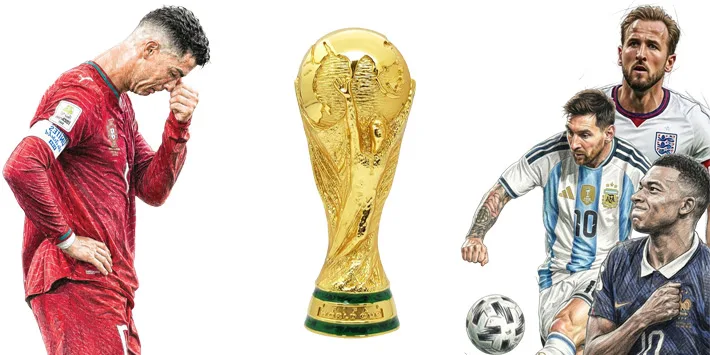
As the knockout stages gather pace, Lionel Messi, Kylian Mbappé, Harry Kane and Cristiano Ronaldo have become the defining faces of the competition. Their performances have dominated headlines, television coverage and social media conversations, reinforcing the notion that football’s biggest event remains a celebration of individual brilliance as much as tactical excellence.
Take Lionel Messi. At 39, the Argentine legend continues to defy time. Already among the tournament’s leading scorers with six goals, including a hat-trick against Algeria and crucial strikes in the group stage, Messi has once again carried Argentina’s attacking burden and remains firmly in the Golden Boot race.
Every Argentina match is viewed through one question: What did Messi do today? Whether he scores, creates or simply dictates the rhythm of the game, the defending champions are judged through the prism of their captain. It is proof that even after winning everything football has to offer, Messi continues to be the World Cup’s biggest attraction.
Mbappe embodies the future
If Messi represents enduring greatness, Kylian Mbappé embodies football’s future. The French captain has been simply unstoppable. His brace against Sweden took his tally to six goals, keeping him level with Messi in the race for the Golden Boot while breaking yet another World Cup scoring record. France’s march into the Round of 16 has been powered largely by Mbappé’s breathtaking pace, clinical finishing and ability to decide matches almost single-handedly.
France possess perhaps the most balanced squad in the tournament, yet it is Mbappé who dominates every discussion. The tactical systems, midfield control and defensive solidity often become secondary to his explosive performances.
England’s Harry Kane presents another compelling example. Critics have questioned England’s overall displays despite the team’s unbeaten run, but Kane has repeatedly delivered when it mattered most. His brace against DR Congo rescued England from an embarrassing exit and sent the Three Lions into the Round of 16, prompting former captain Alan Shearer to warn that England cannot continue relying solely on their skipper.
The warning itself highlights football’s paradox. England are blessed with talented players across every department, yet their World Cup fortunes appear inseparable from Kane’s finishing ability. One striker has become the symbol of an entire nation’s hopes.
Ronaldo, the ultimate showman
Then comes Cristiano Ronaldo, football’s ultimate showman. At 41, and playing what is expected to be his final World Cup, the Portuguese icon continues to command global attention. Against Croatia in the Round of 32, Ronaldo converted a crucial penalty—his first goal in a World Cup knockout match—to help Portugal advance before Gonçalo Ramos scored the winner. Even the post-match debate centred on Ronaldo after his Man of the Match award sparked widespread discussion, underlining his extraordinary influence on the narrative surrounding every Portugal fixture.
Collectively, these four players have become the tournament’s biggest storylines. The Golden Boot race itself has evolved into a battle between Messi, Mbappé and Kane, with Ronaldo adding another remarkable chapter to an already unparalleled international career.
Of course, football remains the ultimate team sport. Argentina cannot succeed without Emiliano Martínez’s saves. France need Aurélien Tchouaméni’s midfield control. England depend on Jude Bellingham’s creativity, while Portugal require the pace of Rafael Leão and the finishing of Gonçalo Ramos. Every World Cup champion is built on organisation, teamwork and collective sacrifice.
But history rarely remembers systems. It remembers heroes.
The 1970 World Cup belonged to Pelé. The 1986 edition became Diego Maradona’s masterpiece. The 2002 tournament is forever linked to Ronaldo Nazário, while Qatar 2022 became Lionel Messi’s crowning glory.
The same script is unfolding in North America. While coaches analyse formations and pressing patterns, fans tune in hoping to witness another Messi masterpiece, another Mbappé sprint, another Kane rescue act or one final Ronaldo moment.
That is the enduring magic of the FIFA World Cup. It may be football’s greatest team competition, but every edition ultimately belongs to the stars who define it. Teams lift the trophy, yet legends capture the imagination—and in 2026, the world’s biggest sporting event is once again revolving around four extraordinary footballers.